
If you peel back the layers of something Rebecca Lee built, what you'll find at the core is always the same.
When she designs a new product, her first move is accounting for each gear and lever of the nervous system.
How the brain reacts to pressure. How concentration thins. How even small tasks feel heavy and chip away at someone’s ability to read, understand, and make decisions.
Without that framework, she explains, building tools that support families through grief just isn’t possible.
Her perspective was shaped by two experiences: Years spent engineering large-scale systems in Silicon Valley, and later, studying psychology at Harvard.
Today, as Elayne’s co-founder and CTO, she’s applying that thinking to one of the most complex landscapes families encounter: estate settlement. In this conversation, we talk about her career path, how psychology can inform design, and converting a broken process into a structured system that anyone can navigate.
To begin, could you introduce yourself and share a bit about your background?
I grew up in a family of engineers and entrepreneurs. My grandfather worked in the defense industry, and my father ran small businesses. In college, I studied electrical engineering and computer science because I wanted to see how systems worked from the inside out.
Early in my career, I focused on understanding how companies scale, how infrastructure holds up under stress, and where it cracks. I joined Facebook as an intern, worked at Affirm as the company expanded toward its IPO, and then at Retool during its breakout growth. Later on, I co-founded a YC startup in the fintech space, and also built another company focused on improving access to mental health care.
In 2023, I began my MA in Psychology at Harvard. There, I studied how people change and respond under pressure. And how, during moments of grief, perception can harden into reality. One of the most important things I learned is that stress isn’t just “emotional noise.” It’s a measurable shift in how the brain processes complexity. It alters what people notice, what they miss, and what feels manageable versus impossible.
That experience reframed how I think about tech, and specifically, how it can be used to solve problems. Estate settlement is often described as a paperwork challenge, but it’s more layered than that. It’s not just dealing with banks, government agencies and court filings. It’s being handed a 10-sided, high-stakes Rubik’s Cube with missing pieces at the exact moment your mental bandwidth is at its lowest.
To me, improving estate settlement means taking a jumble of loose ends and turning them into clear, ordered steps. The architecture underneath may be intricate, but using it should feel calm, legible, and humane for families who’ve just lost a loved one.
You’ve worked on social networks, financial infrastructure, developer tools, and studied psychology at Harvard. When you look across that range, is there a common thread?
If there's a pattern, it's that I'm drawn to understanding systems, both human and technical.
I want to pinpoint where a structure bends, where it breaks, and what the cost of failure is. Every architecture I've worked on, from mental health to crypto protocols, has the same core problem: messy inputs, high stakes, and users who can't afford for something to go wrong.
Being raised by engineers, you learn early that systems are not abstract. You have to be close to the metal and you have to understand every single layer above it, all the way out to what the user sees and feels.
Facebook showed me what global scale looks like when it’s done well, and how networks behave when billions of people depend on them. Affirm taught me what it means to move money responsibly and handle sensitive information at high volumes. I joined in part because Max Levchin was leading the company, and I wanted to see firsthand how a financial platform is built and operated by someone of that caliber.
Later at Retool, as a deployed engineer, I worked directly with teams who were trying to improve the adoption of internal tools. That meant dealing with a series of challenges: legacy infrastructure, unclear requirements, tight deadlines, and people improvising around a given workflow. It forced me to think beyond the technically “correct” solution and focus on what actually holds up in practice.
Harvard sharpened each of those lenses. It pushed me to evaluate human behavior with the same discipline I apply to code. That means understanding how pressure impacts attention. How it weakens memory, confidence, and judgment. If you ignore that, you get products that work in calm conditions, but fracture once they’re poked and prodded.
At Elayne, each of those concepts becomes extremely concrete. We’re building for families who are grieving, managing paperwork, and trying to function on very little sleep. They need tools that provide clarity. They need consistency. They need to know that when they log in, the next step will be specific, straightforward and correct.
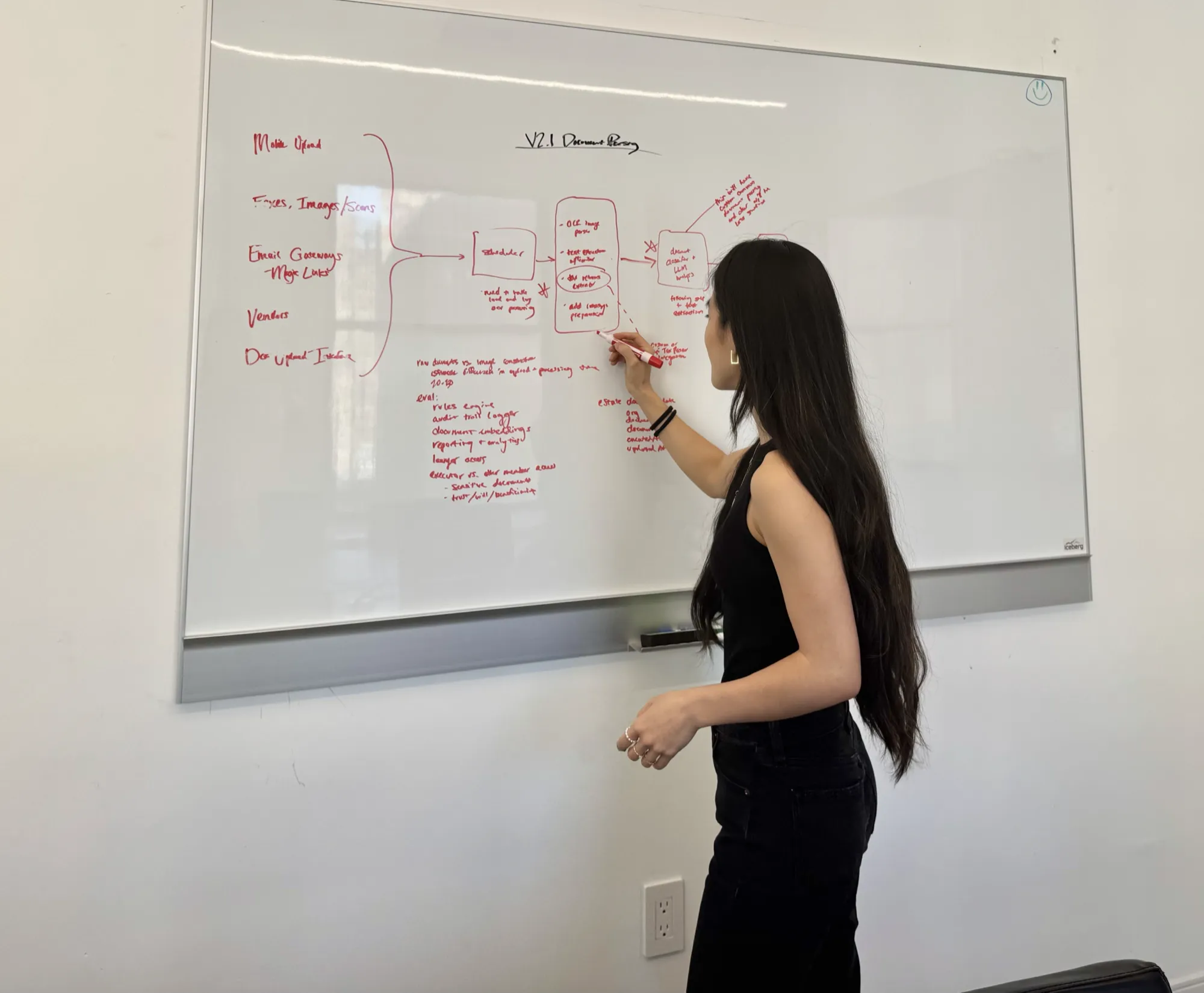
Could you tell us more about studying psychology? Specifically, how did it change the way you build products?
It raised the bar for what I consider “working.”
The program sharpened what I was already doing. I'd been building in mental health and fintech, and Harvard gave me the research and rigor to augment those efforts. Now, I can pair what I learned with engineering, and craft software with a higher degree of precision.
A clear example is understanding cognitive load. When someone is already managing grief and logistics, sending them a wave of options isn't empowering. It's exhausting.
So, we design in the opposite direction. We narrow the field. Instead of presenting a dashboard full of competing actions, we surface the single step that moves everything forward.
Take something like closing a group of financial accounts. Unstructured, it becomes a giant blur of paperwork and phone calls. Our platform turns it into a defined sequence: upload this document, confirm this detail, review this summary. Each item is auditable, and follows a logical progression.
Another topic that’s stuck with me is the difference between stress and resilience. Stress behaves like rising water. It can surge quickly and without warning. Resilience is different. It’s more like concrete. It’s poured in layers, reinforced carefully, and allowed to set over time.
That metaphor shapes how I think about our product. Elayne can’t remove the pain of loss. But when the administrative pressure increases for a family, and the water rises, we can make sure that the structure they’re standing on is solid.
From a technical perspective, why is estate settlement so hard to fix?
Estate settlement isn’t a single process. It’s a patchwork of systems that don’t communicate. Our job is to make the experience dramatically faster for families, while smoothing out the friction between institutions.
For context, every bank, insurance company, court, and government office runs on its own infrastructure. They use different tools. They ask for different documents. They move at different speeds. There’s no single place that shows what’s done, what’s pending, and what’s missing. Families have to take hundreds of fragments, and assemble that view on their own.
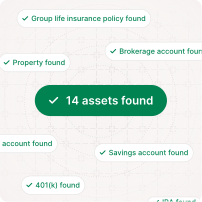
The first challenge is discovery. Before anything can be closed or transferred, you have to identify every account, policy, property record, bill, and subscription. Some documents are easy to find. Others exist in scattered emails, paper statements, or dormant logins.
The second challenge is proving authority. Even if you know an account exists, you can’t access it without the right documentation. One organization asks for a death certificate. Another requires letters testamentary. Another insists on its own internal forms. The same fact has to be proven again and again, across different rules and formats.
The third challenge is coordination. Some agencies respond within days, while others take weeks. Some allow documents to be uploaded online, while others still rely on fax, phone, or mail. Estate settlement is also filled with dependencies, meaning you need this document before you can close that account. Also, because every situation is unique, the exact sequence of steps is rarely the same from one family to the next.
This is the terrain we’ve built Elayne for. Our platform models everything, keeps a record of what’s been submitted, and highlights what still needs attention. Also, no matter how complex things get on the backend, we make sure that our interface is clear and easy to use.
And throughout all of this, the most important element to prioritize is security. We're operating in a high-risk PII environment. One leak, one wrong step, and it's catastrophic. So, everything is built defensively. Least-privilege access, layered verification, audit trails, encryption at every layer. We assume bad actors are already testing us.
Finally, regardless of how strong our platform is, we’ll always see our work as ongoing. As institutions evolve, we refine our models, reinforce safeguards, and sharpen the UX. Our responsibility is to absorb the disorder of a broken process, and present a structured, powerful, and reliable system in return.
You’ve described our AI document engine as “a work of art.” Could you expand on that?
When I call our engine a work of art, I’m referring to discipline.
I mean that Elayne reflects craft. It reflects intentionality. Our platform isn’t stitched together; it’s built with care.
A lot of products bolt general-purpose AI onto existing workflows. Those models are capable, but they’re built for broad, open-ended tasks. That’s not how estate settlement works. It follows defined legal rules, financial requirements, and strict documentation standards.
Families need to upload wills, court orders, account statements, and beneficiary forms. For files like these, a small misread isn’t cosmetic. It can change the sequence of actions, delay a transfer, or create compliance issues. In other words, it’s not enough for a tool to be fast. It also needs to be precise, consistent and verifiable.
That’s the reason we built our document engine in-house. It’s fine-tuned on the types of records we actually see. It’s designed to extract specific fields, flag inconsistencies, and understand how one document connects to another. Owning the system also gives us direct oversight. We know where performance is strong. We know where the outliers appear. When something breaks, we can trace, correct, and improve it.
From discipline, what emerges is durable infrastructure. Interlocking components. And ultimately, a system built specifically for estate settlement.
{{blog-cta-financial}}
In general, estate settlement is a long process. In some instances, it even takes years to complete. How does that timeline impact the way you build?
It shifts the unit of design from a session to a sequence.
Most products are built around short interactions. A user logs in, completes something, and exits. Estate settlement unfolds differently. It stretches from one month to the next, alongside grief, work schedules, and family dynamics.
On the engineering side, that means Elayne has to do more than store data. It needs to preserve meaning. The system must be able to explain what’s been done and what still requires action, while continuing to record everything as the settlement progresses.
It also means we build for handoffs, where users hold different levels of authority over the estate. One family member may begin the process. Another may step in later. Attorneys or advisors may need access at certain stages.
Anyone using the platform should be able to understand the full picture immediately, without piecing it together from memory, secondhand explanations or email threads.
Looking ahead 10 years from now, what impact do you hope Elayne has? As a company, how would you determine if we’ve succeeded?
Personally, I don’t think about it in terms of market share or adoption curves.
I think about whether we changed the baseline.
Right now, estate settlement leaves people confused, stressed, and often avoidant. It feels like walking through a fog. They’re not sure what needs to be done, where to begin, or how long the process will take.
A decade from now, I want families to enter this process assuming it will be structured and clear. That it will be visible. That when they submit a document, update a record, or complete a step, the system will register it correctly and carry them forward.
The strongest infrastructure is the kind you rarely notice. You don’t pause on a bridge to study its beams. You cross it because you trust that it will hold. You trust that it was designed for weight, for weather, for years of use. You trust it enough to not think about it at all.
If we succeed, estate settlement will stop compounding the pain of loss. It will no longer feel like a second blow delivered at the worst possible time.
And if we’ve truly done our job, it’ll mean one very specific outcome: for millions of families, the system we built held. It supported them from start to finish, no matter how difficult the process became. Under pressure, and when the stakes were highest, our platform delivered.








.svg)