

The waiting room was quieter than Sofia had expected.
She’d imagined something louder and more chaotic: phones ringing, stretchers passing through, and constant shouting. Instead, there was just a muted television on the wall, closed captions sliding beneath a talk show that no one was watching. The smell of disinfectant mixed with burned coffee, and every tick from the clock seemed to pump more uncertainty into the air.
Marco was next to her, and despite the shakiness of his voice, kept reminding Sofia that everything was going to be okay. Their mother, Lorena, sat alone in the corner, and hadn’t let go of her orange rosary since they arrived.
Sofia’s father, Javier, had driven himself to the hospital that morning. “Chest pain,” he said, promising to call once the doctors ran a few tests. By early afternoon, the situation had escalated. They received a call from the hospital, and drove there immediately.
About eight hours later, as a doctor began walking toward them, they could sense what was coming. There had been complications. The staff had done everything they could.
“I’m so sorry for your loss.”
Initially, his words didn’t register. It felt like there was a misunderstanding, or that he was speaking to someone else.
The first sign of acceptance were Lorena’s tears. Over the next hour, what followed was a blur of confusion, anger, and despair.
It was about 2 AM when they left the hospital. The parking lot lights were harsh, flattening everything beneath them. As Sofia reached the car, another form of dread started to surface, and it arrived in the form of a question: What happens now?
There was no plan waiting for them. Javier was gone, their lives were shattered, and somehow, they’d have to pick up the pieces.
{{blog-cta-financial}}
The Weeks After
The house filled quickly.
Food arrived in foil trays and mismatched containers. Messages piled up on Sofia’s phone, some from people she hadn’t spoken to in years. Everyone wanted to help. No one quite knew how.
Sleep came in short stretches. Sofia woke often, her thoughts racing ahead to the calls she’d need to make, and the paperwork that had to be managed.
Marco stayed for the funeral, and then flew back home a few days later. Every evening, he called Sofia to check in. They’d talk about their mother, and how she was holding up. But when it came to settling the estate, neither of them knew what to say, or where to begin.
Lorena spent a lot of time alone, often at the kitchen table. Mail arrived daily; the envelopes usually had Javier’s name on them, and a heft that made them difficult to open.
“Mija, por favor,” Lorena would say, as she slid letters across the counter toward her daughter.
Sofia spoke English fluently. Lived nearby. And when decisions needed to be made, was the person her family turned to. By default, she became the estate’s executor.
During breaks at work, she’d call agencies and scribble notes on scraps of paper. She listened to recorded menus and hold music, learning which numbers led to an actual person. At night, she Googled things like “probate” and “intestacy.” She’d do her best to navigate the dense language, but worried about missing something important.
About a week into executor duties, Sofia was exhausted. It wasn’t just the tasks themselves. It was the process of figuring out what was even necessary, and the order it had to be completed in.
The grief of losing her father was overwhelming, and constantly dealing with uncertainty made that pain even sharper.
Finding a Starting Point
On a Sunday night, after Lorena had gone to bed, Sofia sat alone on the couch with her laptop. The house was quiet except for the hum of the refrigerator, and the occasional sound of a car passing by.
She typed a question about estate taxes into the search bar, and found an article from Elayne.
It explained how the process worked, how families could prepare, and what resources were available. She browsed through a few more pages, and eventually, decided to test out one of Elayne’s features.
Sofia pasted a link to her father’s obituary into the platform, and a few seconds later, a checklist for estate settlement appeared.
The tasks were specific. Prioritized with deadlines. And customized to her state’s requirements. The list could adapt with updates, track progress, and was easy to share and work with family members on. It also had an option for human support, and covered everything from identity protection to notifying agencies and closing accounts.
The work was still heavy, but no longer shapeless. For the first time since the hospital, Sofia had a sense of direction.
The next morning, she opened the list again.
She read through each page, noting which tasks could wait, and which needed immediate attention. She chose one that seemed manageable, and completed it that afternoon.
Over the following days, Sofia worked on the checklist in 20-minute increments. Insurance tasks were assigned to Marco, and Lorena gathered documents related to Social Security, banks and utility accounts.
Little by little, they were moving forward.
The Long Middle
Having a structure didn’t make the pain disappear.
Grief still arrived without warning, in ordinary places and at inconvenient times.
Sofia would be at a grocery store, and feel tears when she reached for something that her father used to buy. On some mornings, Lorena would take out a second coffee mug, before remembering that Javier was no longer there. At work, Marco would lose his place in meetings, miss details, and reread the same email until the words blurred.
The settlement process didn’t pause for any of this. The mail kept coming. Deadlines kept approaching. And agencies still required forms, signatures, and follow-ups. Even in the midst of mourning, responsibilities continued to stack up, and someone had to keep track of what was urgent, what could wait, and what had already been handled.
This was the stretch where Sofia began leaning on Elayne for more than the checklist.
When new letters arrived, she used Elayne’s step-by-step guidance to understand what each document meant, what action it required, and what it was connected to.
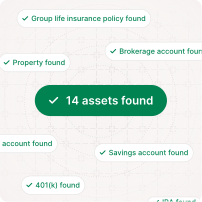
As they worked through Javier’s accounts, Elayne helped them locate insurance policies and unclaimed assets, and gave Sofia a clear view of the estate’s finances. She used that visibility to catch charges, cancel subscriptions, and prevent small problems from turning into expensive ones.
When legal questions came up, Elayne connected her with vetted attorneys, and helped prepare the necessary paperwork before each meeting.
And when Sofia had moments that felt too heavy to move through alone, Elayne’s Care Managers were able to help. These were real people who could step in, and complete tasks on the family’s behalf.
The grief never went away. But over time, the uncertainty did. And slowly, that made the days survivable.
{{blog-cta-financial}}
One Year Later
A year after Javier passed away, the estate was settled.
Accounts had been closed or transferred. Paperwork was complete. Every item had been mailed, signed, or scanned. The checklist was finished.
Sofia sat at the same kitchen table where the first letters had piled up, where her mother had slid envelopes across the counter. Lorena sorted through photographs nearby, choosing which ones to keep out and which to store away. Marco had a Zoom call in the other room, his voice relaxed in a way Sofia hadn’t heard in months.
The loss remained. It always would. What had changed was everything around it. The constant fear of missing something important, of making the wrong decision, of discovering too late that they had failed Javier in some irreversible way, was finally gone.
Sofia thought back to the waiting room. The muted television. The closed captions sliding beneath a talk show no one watched. The moment the doctor walked toward them and panic set in. She remembered the parking lot lights, harsh and flat, and the question that had followed her all the way home.
“What happens now?”
12 months later, despite every challenge and setback, she had an answer. Life never did return to normal. But, it moved forward, piece by piece. Because of the work they did when they could barely stand, and the help they accepted when the weight became too difficult to carry.
The hardest year of their lives had passed. They were still standing. And they hadn’t had to face the journey alone.
*Editor’s note: This story is a fictional composite. It’s based on the real experiences of families that Elayne has guided through estate settlement.










.svg)