

A large share of assets, including jointly held property, accounts with named beneficiaries, and anything held inside a trust, transfer directly to new owners without any probate court involvement.
When it comes to probate, the question to ask is not how large the estate is overall, but how much of it consists of solely owned assets with no beneficiary designation, no joint owner, and no trust holding title. That figure, measured against the threshold set by the state where the person lived, is what determines whether probate applies.
Key Takeaways:
- Probate is required for solely owned assets above state thresholds, ranging from $50,000 in some states to $208,850 in California as of 2026.
- Assets with beneficiary designations, jointly held property, and revocable living trusts skip probate entirely.
- A will does not avoid probate; it guides the court through the process instead of bypassing it.
- Skipping required probate leaves assets legally frozen and can create personal liability for family members.
- Elayne sorts probate from non-probate assets and handles filings, agency notifications, and deadline tracking across the settlement process.
What Is Probate and How Does It Work?
Probate is the court-supervised legal process that transfers a person's assets to their beneficiaries or heirs after they die. It gives the court a way to confirm the will is valid, settle outstanding debts, and make sure the right people receive what's theirs.
The process generally moves through a few core stages:
- Filing the will (if one exists) with the appropriate county probate court
- Appointing a personal representative or executor to act on behalf of the estate
- Inventorying and valuing the assets owned solely by the person who died
- Notifying creditors and paying valid debts, final bills, and applicable taxes
- Distributing the remaining property to beneficiaries named in the will or, to heirs under state intestacy law
Each state runs probate a little differently, but the framework stays consistent across the country.
When Is Probate Required?
Probate is generally required when the person who died left behind assets that cannot transfer any other way. A few common situations where probate is introduced:
- Solely owned assets above the state's small-estate threshold, with no joint owner or named beneficiary
- Real estate titled only in the name of the person who died, without a transfer-on-death deed or co-owner with right of survivorship
- Bank, brokerage, or retirement accounts that have no payable-on-death or beneficiary designation
- Disputes among heirs or beneficiaries about who inherits what, or challenges to the validity of the will
- A will that names assets requiring formal court administration to transfer title
State rules shape the specifics, but these patterns between probate and non-probate assets generally hold true.
{{blog-cta-legal}}
How Much Does an Estate Have to Be Worth to Go to Probate?
The dollar value that triggers probate varies widely by state, and the figure applies only to probate assets, not the total worth of everything the person owned. Jointly held property, accounts with named beneficiaries, and assets held in trust sit outside that calculation.
| State | Threshold for formal probate |
|---|---|
| California | Estates above $208,850 |
| Wisconsin | Estates worth $50,000 or more |
| Virginia | More than $50,000 in personal property |
| Oregon | Above $75,000 in personal property or more than $200,000 in real property |
Sources: California probate threshold, Wisconsin probate FAQs, Virginia probate avoidance, Oregon probate scenarios
When Is Probate Not Necessary?
Probate exists to move assets that have no other way to transfer. It's generally not necessary for:
- Assets held in a revocable living trust, which pass to beneficiaries under the terms of the trust
- Property owned jointly with rights of survivorship, including most real estate held by spouses
- Retirement accounts, life insurance, and annuities with a named beneficiary
- Bank and brokerage accounts with payable-on-death or transfer-on-death designations
- Real estate covered by a transfer-on-death deed in states that allow them
- Vehicles transferred through a state's beneficiary designation or simplified title process
Small estates often skip formal probate as well. Most states offer a small-estate affidavit or summary administration when the value of probate assets falls below a set threshold, letting heirs claim property with a signed form and a short waiting period instead of a full court case.
Does Having a Will Avoid Probate?
A will does not keep an estate out of probate. A will is the document the probate court uses to confirm the wishes of the person who died, validate the named executor, and guide how assets get distributed. Without that court review, the will has no legal force on its own.
However, a revocable living trust doesn't go through probate. Assets titled in the name of the trust pass directly to beneficiaries under the trust's terms, with no court involvement required.
State-Specific Probate Requirements: What You Need to Know
Each state writes its own probate code, so whether probate is required depends heavily on where the person lived and where their property is located.
California
California raised its small-estate threshold to $208,850, and a separate provision now lets a primary residence valued up to $750,000 pass through a simplified petition. Anything above those limits typically heads to superior court.
Virginia
Virginia offers a small-estate affidavit for personal property valued at $50,000 or less, available 60 days after death. The state also charges a probate tax of roughly $1 per $1,000 of estate value, plus local recording fees.
Oregon
Oregon uses a tiered structure: estates with $75,000 or less in personal property and $200,000 or less in real property can use a small-estate affidavit. Beyond either ceiling, formal probate applies.
Pennsylvania, Georgia, and Florida
Pennsylvania allows simplified settlement for estates under $50,000 (excluding real estate and certain payments). Georgia permits a no-administration option when heirs agree and no debts remain. Florida offers summary administration for estates under $75,000 or when the person died more than two years ago.
What Happens If No Probate Is Filed?
If the law requires it, and probate is skipped, several things tend to happen:
- Assets titled solely in the name of the person who died cannot be legally transferred
- Property can sit in the decedent's estate with a clouded title that blocks any future sale or refinance
- Creditors keep the right to pursue claims, since the clock probate normally starts on creditor deadlines never begins
- Beneficiaries lose access to what the will leaves them, because no court order exists to release funds or retitle assets
- A family member holding assets, collecting income, or paying bills from the estate can face personal liability for mishandling property that should have gone through court
{{blog-cta-legal}}
How to Settle an Estate Without Probate
Common options that families use before death:
- Creating a revocable living trust and retitling assets into it
- Adding payable-on-death or transfer-on-death designations to bank and brokerage accounts
- Naming beneficiaries on retirement accounts, life insurance, and annuities, and keeping them current
- Titling real estate as joint tenants with right of survivorship, or recording a transfer-on-death deed where state law allows
- Using beneficiary designations on vehicles in states that offer them
After a death, small-estate affidavits and summary administration remain an option for qualifying estates. These require waiting periods and sworn statements that the estate falls under the state's threshold.
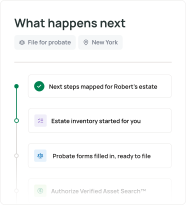
How Elayne Helps Families Determine Whether Probate Is Required and Handle the Settlement Process
Elayne reviews the estate documents, identifies which assets require probate, and helps with the following areas as well:
- Locating overlooked accounts, policies, and benefits that may impact whether probate is required
- Handling filings, agency notifications, and account closures across institutions
- Coordinating transfers for both probate and non-probate assets in one shared dashboard
- Tracking deadlines to help make sure that everything stays on schedule
FAQ
When is probate required for a house?
Probate is required for real estate titled only in the name of the person who died, with no joint owner, transfer-on-death deed, or beneficiary designation. If the property was held jointly with right of survivorship or placed in a revocable living trust, probate is not necessary.
How much does an estate have to be worth to go to probate?
The dollar value where probate becomes mandatory varies by state and applies only to probate assets, not the total value of everything owned. In 2026, California requires probate for estates above $208,850, Wisconsin for estates worth $50,000 or more, and Virginia for more than $50,000 in personal property.
Can I settle an estate without probate?
Yes, if assets pass outside probate through a trust, beneficiary designations, joint ownership, or payable-on-death accounts. Small estates that fall below the state's threshold can often use a small-estate affidavit or summary administration instead of full court probate.
What happens if you don't file probate in California?
Assets titled solely in the name of the person who died cannot be legally transferred, property remains stuck with a clouded title that blocks any sale, and creditors retain the right to pursue claims indefinitely. Beneficiaries lose access to what the will leaves them because no court order exists to release funds or retitle assets.
Is probate necessary if there is a will?
Yes. A will is the document the probate court uses to confirm the wishes of the person who died, validate the named executor, and guide how assets get distributed. A revocable living trust is the planning tool that allows assets to pass to beneficiaries without court involvement.
*Disclaimer: This article is for informational purposes only and does not provide legal, medical, financial, or tax advice. Please consult with a licensed professional to address your specific situation.










.svg)