

For many families handling an estate, the tax side is more complicated than expected. Between the final return for the deceased, potential estate income filings, and keeping track of deadlines that vary by form, it's not the kind of work that most people have done before. Some estate tax preparation services walk you through the process, while others complete the actual filings for you. We broke down the differences across six services to help you figure out which level of support matches where you are right now.
Key Takeaways:
- Executors must file a final 1040, and often Form 1041 for estate income and Form 706 for estates above a certain amount
- Most estate tax services provide guidance only; few actually file returns or notify agencies on your behalf
- Elayne automates IRS notifications, coordinates all filing deadlines, and handles tax prep as part of full estate settlement
- EstateExec and Atticus organize finances well but leave all tax filings to you
- Elayne automates estate settlement including tax filing, asset discovery, and agency notifications in one platform
What Are Estate Tax Filing Services for Executors?
Estate tax filing services are professional services that help executors meet the tax obligations that arise after someone dies. These services range from individual CPAs and enrolled agents to specialized software and full-service estate administration firms.

Executors typically must file a final individual income tax return (Form 1040) for the person who died, covering income earned up to the date of death. If the estate generates income during settlement, such as dividends, interest, or proceeds from asset sales, a separate estate income tax return (Form 1041) is also required. Larger estates may trigger a federal estate tax return (Form 706) as well.
Why Executors Often Seek Outside Help
Most executors are not tax professionals. The forms involved carry strict deadlines, and errors can result in penalties or delays in closing the estate. A few reasons families seek professional support:
- The final return must account for income from multiple sources across a partial year, which can be more complicated than a standard annual filing.
- Form 1041 is unfamiliar to most people and requires tracking estate income separately from the deceased's personal finances.
- Form 706 applies only to estates above $15 million under the current 2026 federal threshold, but state-level estate taxes may apply at much lower values depending on where the person lived.
{{blog-cta-financial}}
How We Ranked Estate Tax Filing Services
Not all estate tax filing services work the same way. Some complete the actual filings; others provide guidance and leave the execution to you. That distinction was central to how each service was ranked here.
The criteria used to assess each option:
- Does the service actually file paperwork, or only advise on it?
- Does it cover estate income returns (Form 1041) alongside the final individual return?
- Does it track executor-specific deadlines and flag obligations automatically?
- Does it support the broader settlement process, or stop at tax forms alone?
Services that handle more of the work, with less left to the executor, ranked higher.
Best Overall Estate Tax Filing Service: Elayne
Elayne handles estate settlement end-to-end, which sets it apart from services focused only on individual tax forms. Tax filing coordination is built into the full post-loss process, so executors are not piecing together separate services for different parts of the work.
Elayne can:
- Automate IRS and agency notifications for tax compliance
- Coordinate filing deadlines across final returns, estate income returns, and estate tax returns
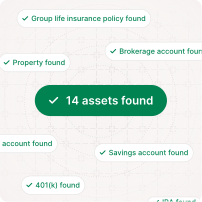
- Search for unclaimed assets and survivor benefits that affect tax obligations
- Handle account closures and transfers in line with tax regulations
Bottom line: Elayne helps reduce the hundreds of hours executors can spend on estate settlement by automating notifications, deadline tracking, and paperwork tasks.
EstateExec
EstateExec is a spreadsheet-style software tool for tracking estate assets, debts, expenses, and distributions. At $99 one-time, it generates PDF financial reports, follows state-specific laws, and automates calculations to keep estate finances organized.
What EstateExec Offers
- Automated guidance with step lists and due dates to help executors stay on schedule
- Integrated accounting across assets, debts, and distributions in one place
- Optional sharing with co-executors, attorneys, or heirs for transparency
- $99 one-time cost, which qualifies as a reimbursable estate expense
Good for executors who are comfortable managing estate administration themselves and want organized financial tracking without managed services.
Bottom line: EstateExec organizes estate finances well, but all tax filings, agency notifications, and account closures remain the executor's responsibility. Elayne handles those steps directly on the executor's behalf.
Atticus
Atticus is a mobile app for probate and estate settlement, built for executors who prefer to work through the process themselves with structured, step-by-step guidance.
What Atticus Offers
- Probate forms for any state, searchable within the app
- An interactive step-by-step guide with access to local laws and relevant deadlines
- Asset inventory organized by snapping photos of items with financial or sentimental value
- Reports summarizing assets, decisions made, time spent, and actions taken
Good for families who prefer a mobile-first, DIY approach to probate and want state-specific legal guidance built in.
But keep in mind: Atticus focuses on probate forms and legal guidance. Filing tax returns, notifying agencies, and closing accounts all remain steps the executor must handle separately.
Bottom line: Atticus is a solid starting point for the DIY executor working through probate. Elayne goes further by filing tax returns, notifying agencies, and carrying out the administrative execution that Atticus leaves to you.
Sunset Estate App
Sunset focuses on estate asset discovery, searching across financial accounts, life insurance, real property, and credit accounts. All tools are free to families, with bank partners covering costs through interest earned on estate accounts.
What Sunset Offers
- Asset discovery across banks, credit unions, insurers, and tri-bureau liabilities, with most accounts located within one day
- Non-alerting search methods that avoid triggering account flags during the process
- Probate documents covering all 50 states and 3,000+ counties
Good for families who need help locating unknown accounts and feel comfortable managing all other settlement steps, including tax filings, on their own.
Bottom line: Sunset excels at finding assets without charge to families, but Elayne provides end-to-end support from discovery through final distribution, including tax filing coordination and agency notifications that Sunset does not handle.
Alix
What Alix Offers
Alix is an AI-powered estate settlement service that helps executors manage the administrative side of settling an estate. The service covers steps like notifying agencies, closing accounts, and organizing estate paperwork.
For executors dealing with tax-related responsibilities, Alix offers some general guidance, but tax filing support is not a core part of what it does. Executors who need help preparing a final return or filing estate tax documents will likely still need to work with a separate tax professional alongside Alix.
Bottom line: Alix suits executors looking for broad administrative support, but those with pressing tax filing needs may find its scope limited there.
Empathy
Empathy is a content-focused tool offered through life insurance companies and employers, providing educational articles and guides to help families understand what needs to be done after a loss.
What Empathy Offers
- Educational content library with articles and guides accessed through insurance company partnerships
- Care managers providing human support for emotional grounding and general estate questions
- Basic checklist functionality
- No direct cost to families accessing it through participating life insurance carriers
Good for families who already have access through their insurance provider and prefer a self-directed, content-driven approach to learning about estate settlement.
Bottom line: Empathy provides educational articles, guides, and basic checklists, but families are left to file all tax returns and complete every administrative step themselves after receiving guidance. Elayne handles that execution directly.
{{blog-cta-financial}}
Feature Comparison Table of Estate Tax Filing Services
Here is how each service compares across the features that matter most to executors handling tax filing and estate settlement.

| Feature | Elayne | EstateExec | Atticus | Sunset | Alix | Empathy |
|---|---|---|---|---|---|---|
| Automated tax filing coordination | Yes | No | No | No | Manual | No |
| IRS and agency notifications | Yes | No | No | No | Manual | No |
| Asset discovery | Yes | No | No | Yes | Limited | No |
| Deadline tracking | Yes | Yes | Yes | No | Manual | No |
| Account closures | Yes | No | No | Limited | Manual | No |
| Family collaboration | Yes | Yes | No | No | Yes | Yes |
| Pricing model | Flat fee | $99 one-time | Subscription | Free | 1% of estate | Insurance benefit |
A few patterns stand out. Tax filing coordination and IRS notifications are among the rarest features in this group, with most services leaving executors to manage those steps independently or through a separate professional. Asset discovery and account closures are similarly limited across the field. Deadline tracking is more common, though the depth of support varies by service.
Why Elayne Is the Best Estate Tax Filing Service for Executors
Elayne was built for families working through the administrative weight that follows a death, and estate tax preparation sits at the center of that work. Executors often have to manage the final return for the deceased, potential estate income tax filings, and coordination across financial accounts, all while managing grief and family expectations.
Elayne brings together AI-guided support and access to licensed tax professionals to help executors move through these filings with clarity. The service identifies which returns are required, helps obtain the estate EIN, and connects executors with professionals who can prepare and file accurately.
A few things that set Elayne apart for executors:
- Elayne identifies all required filings upfront, so executors know what they are facing before the process begins.
- Licensed professionals handle the preparation and review, so filings meet IRS requirements without placing that burden solely on the executor.
- The experience is built around loss and tax preparation together, which means the pacing, language, and support reflect what families are actually going through.
For executors who have never filed a final return or dealt with estate income taxes before, Elayne offers a way to get through it with guidance at every step.
FAQ
How do I choose the right estate tax filing service if I'm not sure what the estate needs?
Start by identifying whether you need just the final individual return, or whether the estate earned income during settlement that requires separate filings. Services like Elayne identify all required filings upfront and coordinate the work across returns, while tools like EstateExec and Atticus guide you through the process but leave the actual filing to you or a separate professional.
Which estate tax service works best for executors who prefer to manage most steps themselves?
EstateExec and Atticus both support self-directed executors with organized tracking, state-specific guidance, and deadline reminders. EstateExec focuses on financial organization, while Atticus focuses on probate forms and legal steps, but both leave tax filing, agency notifications, and account closures in your hands.
Can I use an estate settlement service to handle tax filings if the estate is large or complex?
Yes, though the level of support varies. Elayne connects executors with licensed tax professionals who prepare and file returns based on the estate's specific situation, while services like Sunset and Empathy focus on asset discovery or education but do not coordinate tax preparation directly.
What is the difference between filing a final return and an estate income tax return?
The final return (Form 1040) covers income the person earned up to the date of death, while an estate income tax return (Form 1041) reports income the estate itself generates during settlement, such as interest, dividends, or proceeds from asset sales. Not all estates require both.
When should I consider hiring outside help instead of using a software tool?
If the estate involves multiple income sources, real estate sales, business interests, or state estate tax obligations, professional support reduces the risk of errors and penalties. Services that connect you with licensed professionals, or tax-focused firms, are better suited to those situations than self-guided software alone.
*Disclaimer: This article is for informational purposes only and does not provide legal, medical, financial, or tax advice. Please consult with a licensed professional to address your specific situation.










.svg)