.webp)

When someone dies, some of their assets may go through probate, while others can transfer directly to beneficiaries. The way probate vs. non-probate assets are handled impacts both timelines and costs. For families who are settling an estate, that difference can mean months of waiting, or access to funds within weeks.
Key Takeaways:
- Probate assets freeze for 9-18 months on average while non-probate assets transfer in weeks
- Beneficiary designations on retirement accounts and life insurance override your will entirely
- Probate costs run 3-7% of estate value while non-probate transfers cost a few hundred dollars
- Outdated beneficiary forms and unfunded trusts send non-probate assets into probate by mistake
- Elayne tracks both probate and non-probate timelines in one dashboard and locates overlooked accounts
What Probate Means for Families
Probate is the legal process through which a court validates a deceased person's will and supervises the distribution of their estate. If there is no will, the court steps in to apply state intestacy laws and decide how assets get divided. Either way, a judge, not the family, has the final say until the process closes.
What ends up surprising many families is how long the process takes. In most states, probate runs nine months to two years, depending on estate size, court backlog, and whether anyone contests the will. During that window, many assets are frozen, beneficiaries wait, and bills still arrive.
The process also requires filing a petition with the probate court, publishing a public notice to creditors, inventorying assets, paying debts, and filing a final tax return before anything is distributed. Each step carries deadlines, and missing one can extend the timeline further.
Which Assets Go Through Probate
Probate applies to solely owned assets and has no built-in mechanism to transfer ownership automatically. Without a designated beneficiary or co-owner with survivorship rights, the court is the only path to legally pass that asset to someone else.
The most common probate assets include:
- Individually owned real estate, such as a home titled only in the deceased's name
- Bank or investment accounts with no named beneficiary
- Personal property like vehicles, jewelry, or collectibles
- Business interests owned solely by the deceased
- Property held as tenants in common, where your share does not automatically pass to the other owner
{{blog-cta-financial}}
Why Does Court Oversight Exist?
Probate gives creditors a formal window to make claims before assets transfer and resolves competing claims when heirs disagree. The court acts as a referee when no automatic transfer mechanism exists.
For families, the practical consequence is that probate assets remain inaccessible during the process. For example, a surviving spouse may be unable to reach a jointly used account if it was titled only in the deceased's name.
Assets That Skip Probate Entirely
Some assets are designed to bypass court entirely. When structured correctly, they transfer directly to the named recipient, often within weeks of a death.
There are five main categories:
- Beneficiary designated accounts: retirement accounts like 401(k)s and IRAs, along with life insurance policies, pay directly to whoever is named on the account. The will does not override this designation.
- Jointly owned property with right of survivorship: when two people own property this way, the surviving owner automatically inherits the deceased's share.
- Trust-held assets: property placed in a living trust transfers according to the trust's terms.
- Payable-on-death (POD) accounts: bank accounts with a POD designation pass directly to the named recipient upon death, with no waiting period.
- Transfer-on-death (TOD) designations: brokerage accounts and, in many states, real estate can carry a TOD designation that works the same way as POD.
How Long Each Path Takes
The gap between probate and non-probate timelines is wider than many people anticipate. On average, probate takes around 16 months, though simple estates in uncrowded courts can close in three months, while contested or complex settlements can last for years.
Non-probate assets move on a completely different timeline. Families present a death certificate, complete the required paperwork, and most accounts transfer within days to a few weeks.
The Cost Difference Between Probate and Non-Probate Transfers
Total probate costs are typically between 3% and 7% of an estate's gross value, covering court filing fees, executor compensation, and attorney fees. On a $500,000 estate, that range translates to roughly $15,000 to $35,000 paid before any money reaches a beneficiary.
Non-probate transfers carry a fraction of that. Families generally need only:
- Death certificate copies, typically $10 to $25 each
- Standard account transfer paperwork from the receiving institution
- Occasional notarization fees depending on the asset type
That often amounts to a few hundred dollars total.
The percentage-based nature of probate costs means larger estates pay more in absolute terms, even when the underlying process is no more complicated.
{{blog-cta-financial}}
Common Mistakes That Send Non-Probate Assets to Probate
The most common errors:
- Outdated beneficiary designations: If the designation is never updated, the account may default to the estate and get pulled into probate.
- Unfunded trusts: After creating a trust document, assets must be retitled into the trust. Property still in an individual's name goes through probate regardless of what the trust says.
- Assuming all joint ownership includes survivorship: tenants in common do not carry survivorship rights. Only joint tenancy with right of survivorship passes automatically to the co-owner.
How Beneficiary Designations Override a Will
Beneficiary designations on accounts and policies are legally binding contracts with the financial institution.
For example, an ex-spouse named as beneficiary on a 401(k) typically receives those funds even if the will names someone else. Courts have consistently upheld this, and families have little recourse after the fact.
That's why, it's important to review designations after any major life event and confirm they reflect current intentions.
A useful way to think about this distinction: your will governs your probate estate. Your beneficiary designations govern everything else.
How Elayne Helps Families Manage Both Paths
Managing probate and non-probate assets at the same time means tracking two completely different timelines, two sets of paperwork, and two sets of deadlines.
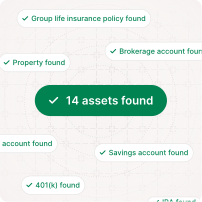
Elayne helps families identify which assets require court involvement and which transfer directly, then handles the specific steps each path requires: filing paperwork, notifying agencies, closing or transferring accounts, and tracking deadlines across both processes simultaneously. Elayne also helps locate forgotten accounts and unclaimed assets that might otherwise go unnoticed, helping families feel confident that nothing has been overlooked before the estate closes.
Whether an asset moves through probate or bypasses it entirely, every step has a place in one shared dashboard.
FAQ
Can you avoid probate without setting up a trust?
Yes. Beneficiary designations on retirement accounts, life insurance, and bank accounts (POD) or brokerage accounts (TOD) all transfer directly to named recipients without court involvement. Joint ownership with right of survivorship on property also bypasses probate automatically.
How long do probate assets stay frozen compared to non-probate transfers?
Probate assets typically remain frozen for 9 to 18 months in uncontested cases, sometimes over two years if contested. Non-probate assets like life insurance or TOD accounts usually transfer within 2 to 6 weeks after presenting a death certificate and completing the required paperwork.
What happens if I never updated my beneficiary designation after a divorce?
The financial institution follows the beneficiary designation on file, even if your will says something different. An ex-spouse named on a 401(k) or life insurance policy will receive those funds regardless of what your will directs, and courts consistently uphold this.
Probate vs non-probate assets: what's the actual cost difference?
Probate costs typically run 3% to 7% of an estate's gross value, including court fees, executor compensation, and attorney fees: that's $15,000 to $35,000 on a $500,000 estate. Non-probate transfers usually cost only a few hundred dollars total for death certificates and standard transfer paperwork.
How does Elayne help families manage both probate and non-probate assets at the same time?
Elayne identifies which assets require court involvement and which transfer directly, then handles the specific steps each path requires: filing paperwork, notifying agencies, closing or transferring accounts, and tracking deadlines across both processes in one shared dashboard. The service also helps locate forgotten accounts and unclaimed assets, helping families feel confident that nothing has been overlooked before the estate closes.
*Disclaimer: This article is for informational purposes only and does not provide legal, medical, financial, or tax advice. Please consult with a licensed professional to address your specific situation.










.svg)