.webp)

Probate is the court-supervised process for transferring solely owned assets after death. Families learning about probate may be planning ahead or managing the details while grieving a death. However, several types of assets bypass probate automatically: accounts with payable-on-death designations, retirement accounts and life insurance with named beneficiaries, jointly owned property with right of survivorship, and assets held in a revocable living trust. This guide covers what probate is, which assets bypass it automatically, and other key details related to the process that families should be aware of.
Key Takeaways:
- Probate can take 12 to 18 months, or longer.
- Named beneficiaries, POD/TOD accounts, and revocable living trusts bypass probate entirely.
- Small estate affidavits avoid formal probate in some states.
- A will does not avoid probate; it directs how the court distributes assets during probate.
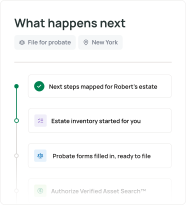
- Elayne helps families identify which assets transfer automatically and which require court involvement.
What Probate Is
Probate is the court-supervised process of validating a will, paying debts, and distributing assets to heirs after someone dies. The timing and costs vary by state and estate:
- Court and attorney fees can vary widely by state and estate complexity, with some estimates placing combined costs in the range of roughly 3% to 7% of the gross estate value.
That delay and cost are why so many families look for ways to plan around it. Assets transferred outside of probate can reach heirs faster, with less expense, and without the court filings becoming part of the public record.
Which Assets Automatically Avoid Probate
Not every asset has to pass through probate. Some transfer automatically by operation of law without a probate filing or executor approval, though documentation and processing time may still be required.
Here are the main categories that typically bypass probate:
- Accounts with named beneficiaries, such as IRAs, 401(k)s, and life insurance policies, pass directly to the person named on the beneficiary designation form.
- Bank and investment accounts set up as payable-on-death (POD) or transfer-on-death (TOD) go straight to the named recipient upon presenting a death certificate.
- Jointly owned property held with right of survivorship, including homes titled as joint tenants, passes to the surviving owner automatically.
- Assets held inside a revocable living trust are distributed according to the trust's terms.
- Retirement accounts with proper beneficiary designations, including Roth IRAs and pension plans, follow the same direct-transfer rules as other named-beneficiary accounts.
The common thread across all of these is that ownership or entitlement was already determined before death. Probate applies only to assets that were solely owned by the person who died and had no surviving co-owner, named beneficiary, or trust holding them at the time of death.
How to Determine If a Small Estate Affidavit Applies
Small estate affidavits let heirs collect assets without opening a formal probate case, but qualifying depends on two things: the total value of the estate and which assets are included in that count.
Every state sets its own threshold and rules for which assets count. These selected examples show how eligibility for small estate affidavits and related procedures varies:
| State and Procedure | Value Limit | What Counts | |
|---|---|---|---|
| California personal-property affidavit, for deaths on or after April 1, 2025 | $208,850 or less | California real and personal property, subject to the exclusions listed in California Courts' small-estate limits. | |
| Texas small estate affidavit | $75,000 or less | Estate assets excluding the homestead and exempt property, with additional eligibility conditions described by the Texas State Law Library. | |
| New York voluntary administration | Less than $50,000 | Personal property, as described in New York Courts' small-estate guidance. |
In practice, a low estate value alone does not determine eligibility; the types of assets and the state's other requirements also matter.
What to Check Before Using an Affidavit
A few conditions typically apply across most states:
- A minimum waiting period after the death usually applies before an affidavit can be presented, and its length varies by state.
- Real estate is usually excluded from small estate affidavit procedures, even when the rest of the estate qualifies.
- The person signing the affidavit takes on personal liability for any debts the estate owes.
- Some institutions, particularly financial firms and brokerage accounts, may still require formal court authorization even when state law allows an affidavit.
If the estate includes real property or exceeds the state dollar limit, a full probate filing is likely required. A hypothetical New York estate illustrates how the value limit applies:
- Personal property subject to administration: $75,000.
- Voluntary administration limit: Less than $50,000, as described in New York Courts' small-estate guidance.
- Consequence: The estate exceeds the limit, generally requiring a probate proceeding if there is a will or an administration proceeding if there is not.
Understanding Joint Ownership and Rights of Survivorship
Joint ownership is one of the most straightforward ways to keep property out of probate. When two or more people own an asset together with rights of survivorship, the surviving owner automatically inherits the deceased owner's share without court involvement.
There are a few forms this can take, and each works a little differently:
Common Types of Joint Ownership
- Joint tenancy with right of survivorship (JTWROS) is the most widely used form. When one owner dies, their share passes directly to the surviving owner or owners by operation of law, bypassing probate entirely.
- Tenancy by the entirety is available only to married couples in many states. It functions like joint tenancy but also offers some protection against individual creditors, since both spouses must agree to any transfer.
- Community property with right of survivorship applies in states like California, Arizona, and Nevada. Married couples can hold property this way and receive a full step-up in tax basis on the entire property at death, which can reduce capital gains taxes if the property is later sold.
| Ownership Type | Who Can Use It | Probate Avoided? | Creditor Protection |
|---|---|---|---|
| Joint tenancy (JTWROS) | Any two or more people | Yes | Limited |
| Tenancy by the entirety | Married couples only | Yes | Yes, in many states |
| Community property w/ survivorship | Married couples in community property states | Yes | Varies by state |
Beneficiary Designations That Bypass Probate
Naming a beneficiary on a financial account is one of the most straightforward ways to keep assets out of probate. When a beneficiary is designated, the account passes directly to that person after death, without going through the court process at all.
There are two common forms this takes:
- Payable on Death (POD) accounts apply to bank accounts and certificates of deposit. The named beneficiary presents a death certificate to the financial institution and receives the funds directly.
- Transfer on Death (TOD) accounts work the same way for brokerage and investment accounts, letting securities pass outside of probate to whoever is named.
What to Know Before Relying on Beneficiary Designations
Beneficiary designations are powerful, but they carry real limitations worth understanding:
- If the named beneficiary dies before the account holder and no contingent beneficiary is listed, the account may still end up in probate.
- Account designations override a will. A will cannot redirect an account that already has a living beneficiary named.
- Accounts with no beneficiary on file, or those made payable to "the estate," are pulled into probate regardless of other planning in place.
Keeping designations current after major life events, like a marriage, divorce, or death in the family, helps prevent unintended outcomes. Reviewing them periodically is a key part of maintaining any estate plan.
What to Do When Assets Were Placed in a Trust
When assets are held in a revocable living trust, they generally bypass probate entirely. The assets are placed in the trust during the trust creator's lifetime, so there is no need for a probate court to transfer them after death. A successor trustee steps in, follows the instructions in the trust document, and distributes assets directly to beneficiaries.
What the Process Looks Like
The successor trustee typically needs to gather a few things before distributions can happen:
- A certified copy of the death certificate to present to financial institutions and title companies
- The original trust document, which outlines who receives what and under what conditions
- Any deeds, account statements, or titles showing the trust as the named owner
Once those are in hand, the trustee can work with banks, brokers, and real estate professionals to retitle or transfer assets according to the trust's terms. No probate filing is required, and no court approval is needed in most cases.
One Important Caveat
A trust only controls assets that were formally transferred into it. Property left outside the trust, whether accidentally or because it was acquired after the trust was created, may still be subject to probate. Periodic trust reviews help identify whether new assets, including real estate purchases and newly opened accounts, are titled in the trust's name.
{{blog-cta-legal}}
Simplified Probate Procedures for Qualifying Estates
Some estates fall between the small estate affidavit ceiling and full formal probate. Many states offer simplified or summary administration procedures for these situations, requiring limited court involvement but moving considerably faster than a standard case.
Here are a few examples of how states handle this middle ground:
- Florida's summary administration provides an alternative to formal administration under these conditions:
- The estate subject to administration in Florida is $150,000 or less, excluding property exempt from creditors' claims; or
- The person died more than two years ago.
- Under either route, if there is a will, it must not require formal administration.
- California offers a petition to determine succession to real property for probate estates that fall within the state's simplified threshold.
- Texas provides muniment of title when no unsecured debts exist and the primary asset needing transfer is real property.
- New York's voluntary administration procedure applies to smaller estates with limited asset types, allowing heirs to collect certain assets without full probate court involvement.
Eligibility generally depends on total estate value, the absence of contested creditor claims, and whether heirs agree on distribution. These procedures often resolve in weeks to a few months, with lower filing fees and fewer required hearings than formal probate.
How Elayne Helps Families Work Through Probate and Non-Probate Asset Transfers
Settling an estate often means sorting through two distinct categories of property: assets that pass through probate and those that transfer directly to beneficiaries outside of court. Elayne helps families understand where each asset falls and what steps are needed to move things forward.
For non-probate assets, such as bank accounts with payable-on-death designations, retirement accounts with named beneficiaries, and property held in a living trust, Elayne organizes the transfer steps and tracks what documentation each institution requires. For probate assets, Elayne helps families build a clear picture of what is subject to court oversight and who needs to be notified.
Families working through the settlement process can use Elayne to:
- Identify which accounts and properties transfer automatically versus which require court involvement, reducing the risk of missed steps or delayed transfers.
- Track beneficiary designations across multiple accounts and flag any that are outdated, missing, or inconsistent with the overall estate plan.
- Organize institution-specific requirements for claiming non-probate assets, so families are not left guessing what each bank, brokerage, or insurer needs.
- Keep the full settlement process in one place, from the initial asset inventory through final distributions.
FAQs
Does a will avoid probate?
No. A will tells the court how to distribute the deceased person's assets, but it does not bypass the probate process. Assets titled solely in that person's name and not held in a trust or with beneficiary designations may still require probate, even with a valid will.
Can you avoid probate without a trust?
Yes. Several strategies work without creating a trust, including naming beneficiaries on bank accounts and retirement plans, holding property jointly with rights of survivorship, and using payable-on-death or transfer-on-death designations on financial accounts.
How do you avoid probate on a home?
The most common methods are holding the property jointly with right of survivorship (so it passes automatically to the surviving owner), transferring the home into a revocable living trust, or using a transfer-on-death deed in states that allow it. Each approach keeps the property out of court and passes ownership directly.
How long do you have to transfer property after death?
Property with valid beneficiary designations, survivorship rights, or trust ownership generally avoids probate, but transfer timing depends on documentation and any required administration. Property that goes through probate generally takes much longer, as noted earlier.
What is a small estate affidavit and does it avoid probate court?
A small estate affidavit lets heirs collect assets without opening a full probate case when the estate meets the state's value limit and other eligibility requirements. The selected state examples above show how the limits and qualifying assets differ. It simplifies the process but does not eliminate court involvement entirely in all states.
*Disclaimer: This article is for informational purposes only and does not provide legal, medical, financial, or tax advice. Please consult with a licensed professional for guidance on your specific situation.








.svg)