

When a court appoints an executor, one of their first formal obligations is filing a probate inventory: a legal document that lists every asset the deceased owned at death that passes through the probate estate. Courts use it to confirm what the estate holds, and creditors use it to assess what funds are available.
Most states give the executor between 60 and 90 days from the date of appointment to file an inventory. The filing must include a list of assets, and documented values for each one. That requires knowing which assets belong on the inventory, which pass outside probate entirely, how to find accounts the family may not know about, and what documentation courts expect to see alongside each reported value.
This article provides an overview of the inventory process. It covers what to include, how each asset category is valued, state-specific rules, common filing mistakes, and what happens when the inventory is late or incomplete.
Key Takeaways
- Courts require a probate inventory to account for every asset the deceased owned at death, and most states set a filing deadline between 30 and 90 days after the executor is appointed.
- Asset values must reflect fair market value at the date of death, not purchase price or sentimental value, and supporting documentation such as appraisals or account statements is typically required alongside the inventory form.
- State requirements vary considerably: West Virginia uses a combined estate appraisement and non-probate inventory form, Texas probate courts require a sworn inventory and appraisement filed within 90 days, and Rhode Island applies specific rules to real estate held in the estate.
- Professional appraisals are generally required for real property, business interests, and collectibles, while financial accounts and publicly traded securities can often be valued using statements or published market prices.
- Most courts provide a standardized probate estate inventory form, though the level of detail required and the categories of assets covered differ by jurisdiction.
What a Probate Estate Inventory Is
A probate estate inventory is a formal legal document listing every asset owned by a person at the time of death that is subject to probate court oversight. Courts require it because the inventory sets the starting point for the entire administration process: creditors use it to assess what funds are available, beneficiaries use it to confirm what they are entitled to receive, and the court uses it to verify that the executor is accounting for everything properly.
The inventory typically covers assets held in the deceased person's name alone, without a named beneficiary or joint owner. That generally includes bank accounts, real estate, vehicles, personal property, investment accounts, and business interests.
Assets that pass outside of probate, such as life insurance with a named beneficiary or jointly held property with right of survivorship, are usually listed separately on a non-probate schedule, depending on the state.
{{blog-cta-financial}}
What Belongs on the Probate Inventory
Courts look for a fairly consistent set of asset categories, though form layouts and naming conventions vary by state.
- Real property: land and structures held solely in the decedent's name, including any fractional ownership interests.
- Bank and brokerage accounts: checking, savings, and investment accounts without a joint owner or payable-on-death designation.
- Retirement accounts: IRAs and 401(k)s where no valid beneficiary was named, or where the named beneficiary predeceased the decedent.
- Vehicles: cars, boats, motorcycles, and other titled personal property.
- Physical personal property: household furnishings, jewelry, art, and collectibles carrying more than nominal value.
- Business interests: sole proprietorships, partnership stakes, and closely held corporate stock.
- Notes receivable: personal loans or promissory notes owed to the decedent at the time of death.
- Life insurance payable to the estate: policies listing the estate itself as beneficiary instead of a named individual.
What Is Excluded from the Probate Inventory
Not every asset in an estate belongs on the probate inventory. Courts only require disclosure of assets that pass through the probate estate, so understanding what falls outside that scope helps executors avoid both over-reporting and missed filings.
Several categories of property are typically excluded:
- Assets held in a living trust pass directly to trust beneficiaries and do not go through probate, so they are not listed on the inventory.
- Accounts and policies with named beneficiaries, such as IRAs, 401(k)s, and life insurance, transfer outside the estate entirely.
- Property held in joint tenancy with right of survivorship passes automatically to the surviving owner and is excluded from the decedent's probate estate.
- Payable-on-death and transfer-on-death accounts function the same way, moving to the named recipient without court involvement.
West Virginia handles this distinction through a two-part filing: the WV estate appraisement and non probate inventory form requires executors to report both probate assets and certain non-probate transfers separately, giving the court a fuller picture of the overall estate even when those assets bypass the probate process itself.
Knowing what stays off the inventory is as useful as knowing what belongs on it. Executors who conflate assets exempt from probate with probate property can create confusion for the court, delay the proceeding, and expose themselves to correction filings down the line.
How to Find Assets to Inventory
Most families begin with personal property: furniture, vehicles, jewelry, collectibles, and household goods. From there, the search expands to financial accounts, which tax returns and old bank statements can help locate. Form 1099-INT and 1099-DIV filings may reveal interest-bearing accounts and brokerage holdings.
Real property is typically straightforward to locate through county recorder records, but confirming legal ownership and any encumbrances requires pulling the deed directly.
For harder-to-find assets, state unclaimed property databases are a useful starting point. Many states hold dormant accounts, uncashed checks, and forgotten deposits that belong to the estate. A structured approach to finding assets of a deceased person can help confirm nothing is overlooked.
How to Value Estate Assets for Probate
Each asset category in a probate inventory requires a valuation method the court will recognize. Using the wrong approach, or leaving valuation undocumented, can delay probate or lead to objections from beneficiaries and creditors. All values must reflect date of death valuation, not current market prices or original purchase prices.
There are several standard methods courts accept, depending on the asset type.
Real Property
Real estate is typically valued using a licensed appraisal as of the date of death. Some states accept a comparative market analysis from a real estate professional, but a formal appraisal carries more weight and is less likely to be challenged.
Financial Accounts and Securities
Bank accounts, money market funds, and certificates of deposit are valued at the account balance on the date of death. Publicly traded stocks and mutual funds use the mean of the high and low trading price on that date. For bonds, the fair market value includes accrued interest.
Retirement Accounts and Life Insurance
These are generally non-probate assets, but many states require them on a separate inventory. The value reported is the account balance or death benefit as of the date of death.
Personal Property and Vehicles
Vehicles are valued using a recognized pricing guide such as Kelley Blue Book, based on condition. Household furnishings and personal effects can be valued by a certified personal property appraiser, or by a qualified estate sale company.
Business Interests
Closely held business interests require a formal business valuation from a qualified appraiser. Courts will not accept estimated or informal figures for these assets.
Documentation matters as much as the number itself. For each asset, it's important to retain the source material used to arrive at the value: appraisal reports, account statements dated to the date of death, brokerage confirmations, and pricing guide printouts. Courts may request supporting documentation during the review process, and beneficiaries have the right to review the inventory in most states.
{{blog-cta-financial}}
How to Prepare and Format the Inventory Document
Most courts accept inventory documents in a structured list or table format, organized by asset category. A clear, readable layout helps the probate judge review values quickly and reduces the chance of follow-up requests from the court.
Organizing by Asset Category
This requires grouping assets under clear headings such as real property, financial accounts, personal property, and any business interests. Within each category, items are listed individually with a brief description, the date-of-death value, and the source of that valuation.
A typical entry might look like this:
Valuation Sources the Court Expects to See
Courts generally want documentation that connects each listed value to a credible source. Common supporting documents include:
- A licensed real estate appraisal for any real property, completed as of the date of death and not the filing date
- Bank and brokerage statements pulled as close to the date of death as possible, showing account balances
- A professional appraisal for jewelry, artwork, antiques, or collections where value is not self-evident
- A published guide such as Kelley Blue Book for vehicles, or a dealer estimate for specialty vehicles
Filing Deadlines and Court Requirements
Most states require the probate inventory to be filed within 60 to 90 days of the executor's appointment.
State-by-State Examples
Courts generally require the inventory to list each asset with a date-of-death fair market value. Some states, including Texas and West Virginia, have official forms that executors must use. Others accept a structured list that meets minimum content requirements.
How Elayne Supports Estate Organization and Inventory Preparation
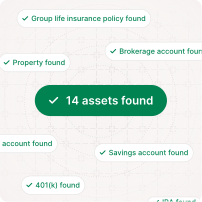
Elayne helps families organize estate information and prepare for the inventory process before probate begins. Instead of starting from scratch when a court deadline arrives, families can use Elayne to gather account details, locate financial institutions, and build a more complete view of what the estate holds.
Elayne coordinates across the kinds of accounts and assets that appear on probate inventory forms: bank accounts, investment holdings, real property, retirement accounts, and unclaimed property. Once located, that information can be organized in a format that supports the formal valuation and documentation steps the court requires.
FAQ
What goes on a probate estate inventory versus a non-probate inventory?
A probate estate inventory covers assets held solely in the deceased person's name with no named beneficiary or joint owner. Bank accounts, real property, vehicles, and business interests are common examples. Assets that transfer outside probate, such as jointly held property, beneficiary-designated retirement accounts, and life insurance payable to a named individual, belong on a separate non-probate schedule. West Virginia makes this distinction explicit: the WV estate appraisement and non probate inventory form requires executors to report both categories in a single combined filing, giving the court a fuller picture of the overall estate.
What is the correct way to value real estate on a Texas probate estate inventory form?
Real property must be reported at fair market value as of the date of death, not the purchase price or current tax assessment. For the Texas probate estate inventory form, a licensed appraisal completed as of the date of death carries the most weight and is least likely to draw a challenge from beneficiaries or the court. Some states accept a comparative market analysis from a real estate professional, but Texas courts expect documented, defensible figures. So, it's important to retain the appraisal report alongside the filed inventory.
How do I inventory an estate for probate when I am not sure I have found every account?
It's often easiest to start with what is visible: property, vehicles, and financial accounts you know about. Then, expanding outward using tax records. Form 1099-INT and 1099-DIV filings from prior years often surface interest-bearing accounts and brokerage holdings families may not know existed. State unclaimed property databases can also hold dormant accounts, uncashed checks, and forgotten deposits that belong to the estate. For harder-to-find assets, document analysis of bank statements and tax returns can identify which financial institutions hold accounts by tracing recurring deposits, dividend income, or retirement distributions.
Rhode Island probate inventory real estate: does my estate need a licensed appraisal?
Yes. Rhode Island requires a sworn inventory filed with the probate court, and real estate must be listed at fair market value, which courts expect to be supported by a licensed appraisal. A formal appraisal is particularly important when the property affects creditor claims or inheritance shares, since those figures are subject to review by interested parties. Also, it's important to obtain the appraisal as of the date of death and not the filing date to meet the court's documentation standard.
What happens if a probate estate inventory is filed late or lists the wrong values?
Missing the filing window (most states set it between 60 and 90 days after the executor's appointment) can lead to court sanctions and delay distributions to beneficiaries. Undervalued assets carry a separate risk: if an appraisal is later contested and the court finds it was too low, the executor can face surcharge liability, meaning personal financial responsibility for any harm to the estate. Most courts will grant an extension when asked in advance, but a deadline that passes without communication is harder to recover from than one handled proactively.
*Disclaimer: This article is for informational purposes only and does not provide legal, medical, financial, or tax advice. Please consult with a licensed professional to address your specific situation.










.svg)