

Probate costs are typically 3% to 8% of an estate's gross value, but the total varies a lot by state. Court filing fees, attorney fees, executor compensation, appraisals, and bonds all come out of the estate before distributions are made to beneficiaries. The amount owed depends on where the estate is, what it holds, and whether any disputes arise.
Key Takeaways:
- Probate costs are generally 3% to 8% of the estate's gross value, covering attorney fees, executor fees, court filings, and appraisals.
- California charges statutory percentages on gross value: $26,000+ combined on a $500K estate, even if heavily mortgaged.
- Probate fees are paid from estate assets before heirs receive distributions.
- Elayne helps families track court deadlines, creditor timelines, and settlement steps.
What Is Probate?
Probate is the court-supervised process of validating a will, paying outstanding debts, and transferring remaining assets to heirs. Courts oversee the process to protect creditors and beneficiaries alike.
The costs associated with the process arise from several sources. Courts charge filing fees to open and close the case. Attorneys typically bill either by the hour or as a percentage of the estate's gross value. Executors are often entitled to compensation under state law. Appraisers, accountants, and bond providers may be involved in the process as well.
For most families, probate costs are somewhere between 3% and 8% of the gross estate value, though complex estates in high-fee states can be higher.
How Much Does Probate Cost by State?
The table below shows the states families most frequently ask about, with typical fee structures and rough cost ranges for a $500,000 estate.
| State | Fee Structure | Estimated Cost on $500K Estate |
|---|---|---|
| California | Statutory percentage (attorney + executor) | $26,000+ (combined) |
| Florida | Reasonable fee standard; some statutory guidance | $15,000 to $30,000+ |
| Texas | Reasonable fee standard; relatively straightforward process | $5,000 to $15,000 |
| New York | Reasonable fee standard; court filing fees add up | $15,000 to $40,000+ |
| New Jersey | Reasonable fee standard; surrogate court fees apply | $10,000 to $25,000+ |
California stands out because the state sets attorney and executor fees by statute as a percentage of the gross estate value, not the net. A $500,000 house with a $400,000 mortgage still generates fees based on the full $500,000.
Texas runs on the lower end partly because its independent administration process reduces court involvement after the initial appointment. The costs in New York and New Jersey tend to be higher due to court costs, filing fees, and the complexity common in those jurisdictions.
California Probate Costs: Statutory Fee Breakdown
California sets attorney and executor fees by statute under Probate Code Section 10810, applying a tiered percentage to the estate's gross value.
| Estate Value (Gross) | Statutory Rate |
|---|---|
| First $100,000 | 4% |
| Next $100,000 | 3% |
| Next $800,000 | 2% |
| Next $9,000,000 | 1% |
| Above $10,000,000 | 0.5% |
Both the attorney and the executor each collect the full statutory amount independently. Running the tiered schedule on a seven-figure estate produces a combined fee well into the tens of thousands of dollars, before court costs, appraisals, or extraordinary compensation for contested matters. For context, concierge estate settlement services like Alix charge 1% of estate value (with a minimum of roughly $9,000), so a $500,000 estate would cost around $9,000 for that type of service alone, separate from court and attorney fees.
Also, it's important to note that debt doesn't offset the base. Mortgages, liens, and other obligations aren't subtracted from gross value before fees are calculated.
Probate Attorney Fees
Probate attorneys typically work under one of three billing arrangements:
- Hourly billing: $200 to $500 per hour nationally, common for complex or contested estates.
- Flat fees: $3,000 to $7,000 for simple, uncontested estates.
- Percentage-based fees: 2% to 5% of estate value in statutory states or through negotiated agreements.
In statutory states, the percentage is fixed by law. Elsewhere, attorneys negotiate the fee directly, and hourly billing is common for anything beyond a routine case.
Extraordinary services sit outside the base arrangement. Litigation, real estate sale oversight, and tax preparation each carry separate charges on top of the structure that has been agreed to.
Executor Fees and Compensation by State
Executors are entitled to compensation in most states. The structure:
- Statutory percentage states (California, New York): executor fees follow the same tiered schedule as attorney fees, paid independently from the attorney's portion
- Reasonable compensation states (Texas, Florida, most others): courts apply a standard based on estate complexity and time involved, with no fixed formula
All executor fees come out of estate assets before any distributions.
Court Costs, Filing Fees, and Administrative Expenses
- Court filing fees to open probate run $200 to $500, with separate fees charged again to close the case.
- Certified copies of death certificates and court orders cost $10 to $25 each and are often needed in multiples across banks, agencies, and title companies.
- Creditor notice publication costs $100 to $300 and is required by most states even when no creditors respond.
- Probate bonds run 0.5% to 1% of estate value per year when the court requires one; a will can waive this requirement, but not all do.
- Appraisal fees run $300 to $600 per residential property, or 0.1% to 0.5% of real property value in states that use a probate referee.
On a $500,000 estate, these costs can reach $3,000 to $6,000 or more in administrative overhead alone, and that number increases with each additional property or account that needs valuation.
Who Pays for Probate: Estate, Executor, or Beneficiaries?
Probate costs are paid from the estate itself, not out of pocket by the executor or beneficiaries. The estate's assets cover court filing fees, attorney fees, appraiser fees, and any other administrative expenses before distributions are made to heirs.
Executors are generally not personally responsible for these costs, as long as they act in good faith and follow proper procedures. If an executor mismanages the estate or incurs unnecessary expenses, a court can hold them personally liable in some circumstances.
Beneficiaries receive their share after all valid probate costs are settled.
Do You Have to Pay Probate Fees Up Front?
Court filing fees are payable when the petition is filed, and attorney retainers are typically collected at engagement before any work begins.
Most professional fees are approved and paid at probate's close, after the court reviews the final accounting. If the estate lacks accessible funds early on, the executor may advance these costs personally and seek reimbursement from estate assets, which is standard practice.
Factors That Increase Probate Costs
Several variables can push probate costs well above typical estimates, and knowing them in advance helps executors plan accordingly.
Estate Size and Complexity
States that calculate attorney and executor fees as a percentage of the gross estate value mean that larger estates pay more by default. A $2 million estate in California will generate roughly twice the statutory fees of a $1 million estate, before any additional charges for extraordinary work.
Contested Wills and Litigation
When heirs dispute a will or creditors file claims, legal fees climb quickly. Contested probate cases can require depositions, court hearings, and extended attorney hours that fall entirely outside the standard fee structure.
Real Property in Multiple States
Owning real estate in more than one state triggers ancillary probate, a separate court proceeding in each state where property is held. Each proceeding carries its own filing fees, attorney costs, and timeline.
Hard-to-Value or Hard-to-Sell Assets
Business interests, mineral rights, and collectibles require professional appraisals before moving forward.
Missing or Outdated Documents
When a will is unclear, beneficiary designations conflict, or key records are missing, the court requires additional filings and hearings to resolve the gaps. Each resolution step adds both time and cost.
Back Taxes or Unresolved Debts
Estates with outstanding tax liabilities or disputed creditor claims require additional legal and accounting work before distribution can occur, extending both the timeline and the fee total.
{{blog-cta-legal}}
How to Minimize Probate Costs
Probate costs are largely set by state law, but planning decisions made before death, such as setting up a revocable living trust or naming beneficiaries on accounts, can reduce what the estate pays in the end.
Avoiding Probate Altogether
- Placing assets in a revocable living trust keeps them outside the probate estate entirely, bypassing court fees and attorney percentages on those assets.
- Naming beneficiaries directly on retirement accounts, life insurance policies, and payable-on-death bank accounts removes those assets from probate without any court involvement.
- Holding property in joint tenancy with right of survivorship transfers ownership automatically at death in most states.
- Some states offer simplified procedures for small estates, with dollar thresholds ranging from $20,000 to $184,500 depending on the state, which can reduce or eliminate standard probate fees.
Planning ahead is the most reliable way to lower costs. Once a loved one has died and assets need to go through probate, the options narrow considerably. The court fees, publication costs, and statutory attorney percentages built into state law are largely fixed at that point, leaving less room to reduce what the estate owes.
How Elayne Simplifies Estate Settlement and Reduces Administrative Burden
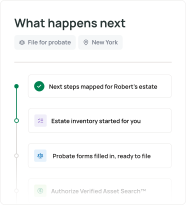
Elayne can help families work through the settlement process step by step, covering court filings, creditor deadlines, and distribution requirements. Instead of having to piece together requirements from multiple sources, families receive a structured sequence of steps organized by their specific estate's circumstances, including state-specific probate rules, outstanding debts, and the types of assets involved.
For example, California estates carry a mandatory creditor claim period after the notice to creditors is published. Elayne tracks that window and surfaces it as a concrete deadline in the settlement sequence, so the executor knows when the period opens, when it closes, and what distribution steps become available afterward. Missing that deadline, or distributing assets before it closes, can create personal liability for the executor. Having it surfaced explicitly instead of buried in state statutes reduces the risk of a costly misstep.
FAQs
How are probate costs calculated?
Probate costs are calculated based on the estate's gross value, not what's left after debts. In statutory states like California and New York, fees follow fixed percentage schedules that apply to the full estate value. In reasonable-fee states like Texas and Florida, courts determine costs based on time spent and complexity, which can run lower on straightforward estates.
Do you have to pay probate fees up front?
Court filing fees are due when you file the petition, and attorneys typically collect a retainer before starting work. Most professional fees are approved and paid at probate's close after court review, though executors may need to advance costs personally if the estate lacks accessible funds early on.
Why does California probate cost more than Texas?
California uses a statutory fee schedule tied to the estate's gross value, as detailed in the California Probate Costs section above. Texas uses a reasonable-fee standard with independent administration that reduces court involvement, typically costing $5,000 to $15,000 on the same estate.
Can you avoid probate after someone has died?
Once someone has died, it's too late to avoid probate through estate planning tools. Planning ahead with a revocable living trust, beneficiary designations, joint tenancy, or transfer-on-death deeds keeps assets outside probate, but these must be in place before death.
What platform helps executors and family members organize estate paperwork and collaborate on settlement?
Elayne is a platform built for executors and family members to manage estate settlement together. It organizes the required steps (court filings, creditor deadlines, agency notifications, and asset tracking) into a structured sequence tailored to the estate's specific circumstances, including state probate rules and the types of assets involved. Family members can access the same information, reducing back-and-forth and keeping everyone aligned on what has been done and what remains. For families working through probate costs, having a clear picture of each required step also helps avoid missed deadlines that can generate additional fees.
Does the state take a percentage of my estate if I go through probate?
No. The state does not claim a share of estate assets through probate. Court filing fees (paid to the court to open and close the case) are typically flat fees in the range of $250 to $500 on a $500,000 estate.
In some states, attorney and executor fees are set by statute as a percentage of the estate's gross value. That percentage goes to the attorney and executor, not to the state. California is the most common example: the combined statutory fee on a $500,000 estate is roughly $26,000, paid to the professionals who handled the work.
Estate taxes are a separate matter entirely. Federal estate tax applies only to estates above a threshold that exceeds $15 million for 2026, and a smaller number of states impose their own estate or inheritance taxes with varying thresholds. Probate court fees and estate taxes are different obligations with different rules. Going through probate does not trigger estate taxes, and estate taxes are not a probate cost.
This content is for informational purposes only and does not constitute legal, financial, medical, or tax advice. Laws and regulations vary by state and individual circumstances differ. Consult a licensed attorney, financial advisor, or other qualified professional for guidance specific to your situation.







.svg)