.webp)

Probate court is the court that oversees what happens to a person's property after they die. It confirms the will is valid, appoints someone to manage the estate, gives creditors a chance to file claims, and approves the final distribution of assets. Not every estate goes through probate, and what the process looks like depends on the state, the size of the estate, and whether the will is contested.
Key Takeaways:
- Probate court validates wills, appoints executors, and supervises asset transfer after someone dies.
- You can skip probate for assets with beneficiaries, jointly owned property, and trusts that transfer automatically.
- Simple estates close in 3 to 6 months; complex or contested cases can take 2+ years depending on your state.
- Small estate affidavits let you bypass full probate in many states if the estate falls below set dollar limits.
What Is Probate Court?
Probate court is the specialized branch of the judicial system that oversees the legal transfer of a deceased person's assets to heirs and creditors. When someone dies, their estate often cannot pass to family members without court supervision. Probate court provides that oversight, confirming the validity of a will, appointing an executor or administrator, and authorizing the distribution of property.
Not every asset goes through probate. Assets with beneficiaries, joint ownership, or trusts typically pass outside of court entirely.
What Probate Court Actually Does
The court serves several functions that protect both the estate and the people who have a claim on it:
- It validates the will, or if no will exists, applies the state's intestacy laws to determine who inherits.
- It appoints a personal representative to carry out the process, called an executor when named in a will or an administrator when appointed by the court.
- It provides a formal process for creditors to submit claims against the estate before assets are distributed.
- It supervises the final distribution of property, giving legal authority to transfers that banks, title companies, and other institutions require before they will act.
Probate courts operate at the county level in most states. Families in Arizona work through courts like Maricopa County probate court or the probate court in Phoenix. In Connecticut, each district has its own probate court, covering areas like Hartford, Waterbury, Middletown, Stamford, Norwalk, and Bridgeport, among others. In Ohio, Cuyahoga County probate court serves the Cleveland area.
When Does an Estate Need to Go Through Probate Court?
The answer depends on how assets were titled and whether beneficiary designations were in place at the time of death. Not every estate requires probate court. Assets that typically bypass probate include:
- Accounts with named beneficiaries, such as life insurance policies, IRAs, and 401(k)s, where the funds pass directly to the named person without court involvement.
- Jointly held property with right of survivorship, where ownership transfers automatically to the surviving co-owner.
- Assets held in a living trust, which are distributed according to the trust document outside of the court process.
When assets were held in the deceased person's name alone, with no beneficiary designation or joint owner, those assets generally need to go through probate before they can be transferred. A home titled solely in one person's name, a bank account without a payable-on-death designation, or personal property left only by a will all fall into this category.
When a Small Estate Shortcut May Apply
Many states offer simplified procedures for smaller estates. Arizona, Connecticut, and Ohio each have affidavit or summary administration options that allow families to transfer certain assets without full probate court proceedings, provided the estate falls below a set value threshold. In Arizona, for example, personal property can often be claimed by affidavit if the total value is below the state limit, and real property may qualify for simplified court procedures depending on the circumstances.
Whether the full process is required comes down to what the person owned, how it was titled, and which state's rules apply.
How Probate Court Works: The Step-by-Step Process
The probate process follows a general sequence, though timelines and requirements vary by state and by the size of the estate involved.
Several stages that most estates move through:
- Filing a petition with the probate court in the county where the person died opens the case. In Arizona, that means filing with the Superior Court in the relevant county, such as Maricopa County Probate Court for estates in the Phoenix area. In Connecticut, cases go to the district probate court serving the town where the person lived, whether that is Hartford, Waterbury, Middletown, or another district.
- The court issues Letters Testamentary or Letters of Administration, which give the executor or administrator legal authority to act on behalf of the estate.
- The executor notifies creditors, typically through a public notice, and gives them a window to submit claims against the estate.
- Estate assets are gathered, inventoried, and appraised. This step can take considerable time depending on the complexity of the estate.
- Valid debts, taxes, and administrative costs are paid from estate funds before anything is distributed to beneficiaries.
- Once obligations are settled, remaining assets are distributed according to the will or, if there is no will, according to state intestacy law.
- The executor files a final accounting with the court and petitions to close the estate.
How Long Does Probate Take?
Timelines vary. Straightforward estates in states with simplified procedures can move through the process in a few months. More complex estates, or those in states with longer creditor notice windows, often take a year or more from filing to final distribution.
{{blog-cta-legal}}
What Executors and Personal Representatives Are Responsible For
Once probate is opened, the court appoints an executor or personal representative (appointed when there is no will) to manage the estate settlement process. This role carries legal responsibility and can span months or longer depending on the estate's size and complexity.
Executors are generally responsible for:
- Locating and filing the original will with the probate court, along with a certified copy of the death certificate and any required court forms, which vary by jurisdiction
- Notifying creditors, beneficiaries, and relevant government agencies of the death within court-mandated timeframes
- Taking inventory of the estate's assets, including bank accounts, real property, investments, and personal property, then filing that inventory with the court
- Paying valid debts, taxes, and final expenses from estate funds before any distributions are made to beneficiaries
- Filing the decedent's final income tax return and, if the estate generates income during the settlement period, a separate estate income tax return
- Distributing remaining assets to beneficiaries according to the will or, in the absence of one, the state's intestacy laws
- Petitioning the court for a final accounting and formal discharge once all steps are complete
Courts expect executors to act in the best interest of the estate and its beneficiaries at every step. Mismanaging funds, missing creditor deadlines, or distributing assets prematurely can expose an executor to personal liability.
How Long Does Probate Court Take?
Probate timelines vary considerably depending on the state, the size of the estate, and whether anyone contests the will. A straightforward case in an uncomplicated estate may be completed in a few months. More complex situations often last a year or longer.
Several factors impact the length of the process:
- Contested wills or disputed asset claims can add months of litigation before the court moves forward with distribution.
- Real property, business interests, or assets held across multiple states require additional legal steps that extend the timeline.
- Court backlogs vary by jurisdiction. Busy courts like Maricopa County probate court or Cuyahoga County probate court may schedule hearings weeks out.
- Outstanding debts, unresolved tax filings, or creditor claim periods must run their course before the estate closes.
Average Timelines by Complexity
| Estate Type | Typical Timeline |
|---|---|
| Small, uncontested estate | 3 to 6 months |
| Moderate estate with real property | 9 to 18 months |
| Large or contested estate | 2 years or more |
| Multi-state assets involved | Add 6 to 12 months |
Executors should plan for the longer end of these ranges when the estate includes complex assets or disputed wills. Filing deadlines, creditor notice periods, and court scheduling all run on their own clocks, largely outside the executor's control.
Probate Court Fees and Costs
Probate costs are paid from estate assets before beneficiaries receive distributions. The amounts vary by state, county, and estate complexity, but the expense categories are consistent:
| Fee Type | How It's Calculated |
|---|---|
| Court filing fee | Set by the jurisdiction; varies by state and county |
| Executor compensation | Percentage of estate value or flat fee; many states set it by statute |
| Attorney fees | Hourly rate or percentage of estate value, depending on state law |
| Professional appraisals | Per property or asset category requiring formal valuation |
| Accounting fees | Based on the complexity of tax filings the estate requires |
| Creditor notice publication | Per publication, as required by applicable state law |
Attorney fees tend to be the largest variable cost. Some states cap them by statute; others allow "reasonable" compensation without defining a specific figure. Executor fees follow the same pattern. Because all of these costs reduce the estate before distribution, tracking them from the start helps protect both the estate and the executor.
Probate Court in Arizona (Maricopa County)
Arizona handles probate through the Superior Court system, with Maricopa County managing the highest volume of cases in the state. The Maricopa County Probate Court operates out of Phoenix and covers estates, guardianships, and conservatorships for residents across the county.
Executors in Arizona can search for existing probate cases, locate filed wills, and access court forms through the Maricopa County Superior Court's online records system. The Arizona probate forms available online cover petitions for informal and formal probate, personal representative appointments, and inventory filings.
What Arizona Probate Requires
Arizona follows the Uniform Probate Code, which gives executors the option of informal probate for straightforward estates or formal probate when disputes arise or court supervision is needed. Informal probate moves faster and requires less court involvement, while formal probate goes before a judge.
Key filing requirements in Arizona include:
- Filing the original will and a petition to open probate with the Superior Court in the county where the person died
- Paying a filing fee, which varies by county but generally runs between $200 and $400 in Maricopa County
- Publishing a notice to creditors for a minimum of three consecutive weeks
- Waiting at least four months from the date of publication before closing the estate and distributing assets
Arizona sets a simplified affidavit process for small estates valued under $75,000 in personal property or $100,000 in real property, which can bypass formal probate entirely.
Probate Court in Connecticut (54 District System)
Connecticut's probate system works differently from most states. Instead of organizing courts by county, Connecticut divides the state into 54 probate districts, each serving specific towns. Judges are elected to four-year terms and handle estates, trusts, conservatorships, guardianships, adoptions, and name changes within their district.
The current structure dates to 2009, when Public Act 09-114 consolidated 117 districts into the present 54. To find the correct court, families look up their town instead of their county. A district-to-town lookup tool is published by the Connecticut State Library and searchable online. Hartford Probate Court serves Hartford, Waterbury serves Waterbury, and so on down the list, with each district tied to its geographic jurisdiction instead of a broader county structure.
{{blog-cta-legal}}
Common Probate Court Challenges and How to Handle Them
Will Contests
A beneficiary or heir may challenge the validity of a will by claiming the person who died lacked mental capacity or was under undue influence. Courts take these claims seriously, and contested estates can take considerably longer to resolve.
Missing or Outdated Documents
Courts require original wills in most jurisdictions. A lost original, an unsigned amendment, or a will that predates major life changes can create procedural challenges.
Creditor Claims
Creditors have a window to file claims against the estate, and executors must review each one carefully. Paying invalid claims reduces what beneficiaries receive.
Unlocated Beneficiaries
If a named beneficiary cannot be found, the court may require a formal search before assets can be distributed. This adds time and cost to the process.
Probate Court Records and Case Lookups
Probate court records are public in most jurisdictions. The petition, filed will, asset inventories, creditor notices, court orders, and final accountings are all part of the record anyone can review, though courts may restrict access to certain sensitive matters involving minors or mental health proceedings.
Online access varies by location:
- Maricopa County Superior Court offers an online docket search where cases can be looked up by name or case number.
- Connecticut probate districts handle case lookups through individual district court websites, with access varying slightly by district.
Certified copies of filed documents can be ordered from the clerk's office, in person or by mail, for a per-page fee set by the court.
Small Estate Procedures and Alternatives to Full Probate
Not every estate requires a full probate proceeding. Most states offer simplified procedures for smaller or straightforward estates, and understanding which options apply can save families considerable time and expense.
Affidavit Procedures
Many states allow heirs to collect assets using a sworn affidavit instead of opening a formal probate case. This works when the estate falls below a set dollar threshold, which varies widely by state. In Arizona, for example, the limit for personal property is $75,000. In Connecticut, simplified procedures are available for estates under $40,000.
Summary Administration
Some courts offer summary administration, a shortened probate process for estates that meet certain size or composition requirements. Cuyahoga County Probate Court in Ohio, for instance, offers summary release from administration for qualifying small estates.
Assets That Pass Outside Probate
Certain assets never enter the probate estate at all:
- Accounts with named beneficiaries, such as IRAs, 401(k)s, and life insurance policies, transfer directly to the named individual.
- Jointly held property with right of survivorship passes automatically to the surviving owner.
- Assets held in a living trust bypass probate entirely and are distributed according to the trust terms.
Families who want to reduce what passes through probate court can often do so through careful estate planning, including beneficiary designations and trust structures.
How Elayne Supports Families Through Probate Court and Estate Settlement
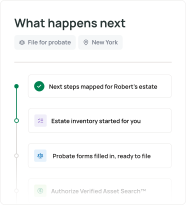
Probate court is one of the more administrative-heavy parts of estate settlement, and families often find themselves managing court deadlines, asset searches, and paperwork simultaneously while still grieving. Elayne supports families through this process by helping organize the steps that follow a loved one's death, from locating assets to tracking outstanding steps.
FAQs
Can I search for probate court records online in Connecticut?
Yes. Connecticut probate court case lookup options vary by district, with some offering online searches through individual district court websites. You can look up cases by name or case number where online access is available, though access levels differ by district.
What's the difference between informal and formal probate in Arizona?
Informal probate moves faster with less court involvement and works well for straightforward estates where no one disputes the will, while formal probate requires appearances before a judge and is necessary when disputes arise or court supervision is needed. Arizona follows the Uniform Probate Code, giving executors the choice based on the estate's circumstances and whether beneficiaries or creditors are likely to contest something.
Probate court vs small estate affidavit: when does each apply?
Small estate affidavits allow heirs to claim assets without opening a full probate case when the estate falls below your state's dollar threshold, typically processing in weeks instead of months. Full probate court proceedings are required for larger estates or when real property needs to be transferred. Arizona sets the limit at $75,000 for personal property, Connecticut at $40,000, and each state defines what qualifies differently.
*Disclaimer: This article is for informational purposes only and does not provide legal, medical, financial, or tax advice. Please consult with a licensed professional to address your specific situation.









.svg)