
If you're settling someone's estate, you've probably checked bank statements, talked to their financial advisor, and gone through file cabinets looking for account records. But there's another place money can be: state unclaimed property databases. Accounts go dormant, policies are forgotten, and eventually those assets get transferred to the state. Searching for unclaimed property and inheritance takes maybe an hour, costs nothing, and sometimes turns up thousands of dollars families didn't know existed.
Key Takeaways:
- 33 million Americans have unclaimed property in state databases, often from deceased relatives
- Search MissingMoney.com and state treasury sites free to find dormant accounts and insurance proceeds
- Life insurance policies are commonly missed; use the NAIC Life Insurance Policy Locator at no cost
- Claims require death certificates, proof of relationship, and executor letters if filing for estates
- Elayne automates asset discovery across databases and tracks claim deadlines during estate settlement
What Is Unclaimed Property and How Does It Become Lost?
Unclaimed property is money or assets that have gone dormant, meaning no contact with the owner has occurred for a set period, typically between one and five years depending on the state. When that happens, banks, insurers, and other financial institutions are legally required to transfer those assets to the state government. This process is called escheatment.
Common Types of Unclaimed Assets in Estates
Here are the most common types of unclaimed property found in estates:
- Dormant bank and savings accounts that stopped receiving activity and were eventually turned over to the state
- Uncashed checks, including final paychecks and tax refunds that were never deposited
- Life insurance and annuity proceeds where the insurer could not locate the beneficiary
- Stocks, bonds, and dividends held by brokerages or transfer agents
- Pension and retirement account balances from former employers
- Utility and security deposits never returned after a move
- Safe deposit box contents surrendered to the state
- Mutual fund distributions and matured savings bonds
The amounts vary widely. A forgotten savings account might hold $50, while a life insurance policy or pension payout could be worth tens of thousands.
| Property Type | Where to Search | Typical Documentation Required |
|---|---|---|
| Dormant bank accounts, uncashed checks, savings bonds | MissingMoney.com or state treasury websites for state databases; TreasuryDirect.gov for federal savings bonds | Death certificate, government-issued ID, proof of relationship, executor letters if filing for estate |
| Life insurance policies and annuity proceeds | NAIC Life Insurance Policy Locator at eapps.naic.org; state unclaimed property databases; former employer HR records | Death certificate, policy number if known, beneficiary designation documents, government-issued ID |
| Stocks, bonds, dividends, mutual funds | State unclaimed property databases; brokerage account records; transfer agent searches | Death certificate, proof of ownership, executor letters, government-issued ID |
| Pension and retirement account balances | Former employer HR departments; state unclaimed property databases; Department of Labor's Abandoned Plan Search | Death certificate, employment records, beneficiary designation forms, executor letters |
| Tax refunds and federal payments | IRS Where's My Refund tool; ClaimItGov.gov for other federal payments | Death certificate, copy of tax return, executor letters, government-issued ID |
| Veterans benefits and compensation | VA.gov; contact local VA office or veterans service organization | Death certificate, DD-214 discharge papers, marriage certificate for survivor benefits, government-issued ID |
| Utility deposits and rental security deposits | State unclaimed property databases; direct contact with utility companies or former landlords | Death certificate, proof of service or lease, government-issued ID, executor letters |
How to Search State Unclaimed Property Databases for Free
Every state runs its own unclaimed property database, and each one is free to search. No fees, no registration required. Often, families will need to search multiple states, especially if the deceased lived or worked in different places over the years.
The easiest starting point is MissingMoney.com, a multi-state search tool managed by NAUPA. One search pulls results from dozens of participating state databases at once.
For states not covered there, go directly to the state treasury or controller's website.
{{blog-cta-financial}}
Tips for a Thorough Search
Here are a few ways to get the most out of your search before filing any claim.
- Search every state where the deceased lived, since property is reported to the state of the owner's last known location
- Try name variations including full legal name, nicknames, maiden names, and initials
- Search under any business name the deceased used if they ran their own business
- Run a search under your own name too, since beneficiaries sometimes have unclaimed funds waiting in their name
If a result appears, the database will show the property type and holding institution. From there, the state's website walks through how to file a claim. No third-party service is needed, and no legitimate search will ever ask for payment upfront.
Searching for Lost Life Insurance Policies and Annuities
Life insurance is one of the most valuable assets that's commonly missed, and one of the hardest to locate without knowing where to look.
The NAIC Life Insurance Policy Locator is a free tool that submits a search request to participating insurers on your behalf. If a match is found, the insurer contacts you directly.
Beyond that, other records worth reviewing:
- Bank statements showing recurring premium payments to an insurer can confirm a policy was active and point to which company held it.
- Tax returns may reference deductions or policy-related transactions that reveal coverage the family didn't know about.
- HR records or former employer documents can surface group life coverage that was never separately documented at home.
- Mail from insurance companies, even routine-looking correspondence, sometimes contains policy numbers or benefit summaries.
For annuities, if the deceased received regular payments from a financial institution, an annuity contract may still hold a remaining balance with a named beneficiary.
Federal Resources for Unclaimed Funds and Benefits
State databases are a good starting point, but some unclaimed funds sit with federal agencies entirely. These require separate searches.
- TreasuryDirect covers matured, unredeemed savings bonds. The Treasury also runs ClaimItGov.gov for other federal payment recoveries.
- The IRS holds undelivered tax refunds. The "Where's My Refund" tool can confirm if a return was filed but a check never cashed.
- The Department of Veterans Affairs may have unpaid compensation, pension amounts, or burial benefits owed to veterans or their survivors.
- HUD's mortgage insurance refund search locates funds owed to homeowners who paid FHA mortgage insurance premiums.
- Federal bankruptcy courts sometimes hold unclaimed creditor distributions.
How to Claim Unclaimed Property: Documentation and Verification
Most states require a similar set of materials:
- Government-issued photo ID for the claimant
- The deceased's death certificate
- Proof of relationship, such as a birth certificate, marriage certificate, or trust documents
- Letters testamentary or letters of administration if filing as an executor appointed by probate court
Some states ask for additional documentation depending on the property type or claim size. Reviewing the specific state's claim instructions before submitting helps avoid back-and-forth delays.
How Long Does the Process Take?
Processing times vary. Some states resolve claims in under 30 days. Others take 90 days or longer, particularly if the claim involves a larger balance or requires additional verification. Submitting everything in one complete package tends to move things along faster.
Avoiding Scams and Protecting Yourself During the Search
Scammers know that grieving families are searching for assets, and they try to exploit that. If someone contacts you unsolicited claiming they have found unclaimed property in your name and need a fee to release it, that is a scam.
A few red flags to watch for:
- Any request for upfront payment before a claim is processed
- Unsolicited texts or calls claiming a deadline is approaching
- Requests for Social Security numbers, bank account details, or wire transfers
- Websites that mimic official state pages but end in .com instead of .gov
Legitimate state unclaimed property programs are free to use. They never cold-call claimants, never charge fees, and never pressure you to act quickly. If any communication feels off, go directly to your state treasury's official .gov site to verify. Do not click links in unsolicited emails.
{{blog-cta-financial}}
Why Property Goes Unclaimed and How to Prevent It
Common causes include outdated beneficiary designations on retirement accounts, moving without updating contact information with a brokerage, a name change after marriage that creates a mismatch in institutional records, or a will that was never registered or shared with anyone who could act on it.
To help prevent this, it's important to:
- Review beneficiary designations on all financial accounts every few years to catch outdated names or missing entries.
- Keep a written record of all accounts somewhere secure but accessible to the right people.
- Tell a trusted family member where key documents are stored so nothing gets overlooked.
- Update contact information across all financial accounts after any move to avoid mail going to a previous residence.
How Elayne Helps Families Locate and Claim Hidden Assets
Searching manually across state and federal databases is doable. But it takes time, requires careful organization, and is easy to do incompletely, especially when someone is also managing probate, closing accounts, notifying agencies, and grieving at the same time.
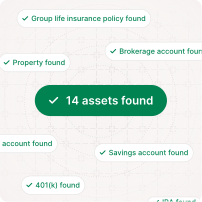
Elayne's asset and benefit discovery goes further than a manual search. Using document analysis and direct database searches, Elayne uncovers insurance policies, pension balances, survivor benefits, and eligible programs families may not have known existed. It also tracks claim deadlines to help ensure that nothing gets missed while other estate steps are in motion.
The goal is helping families feel confident that they haven't overlooked anything that's rightfully theirs. If you're settling an estate and would like support, see how Elayne works at elayne.com.
FAQ
Can I search for unclaimed property without paying a fee?
Yes. Every state runs a free unclaimed property database, and no legitimate search will ever ask for payment upfront. The easiest starting point is MissingMoney.com, which pulls results from dozens of participating state databases at once, or you can go directly to your state treasury's .gov website.
What's the difference between state unclaimed property databases and the NAIC Life Insurance Policy Locator?
State databases hold dormant bank accounts, stocks, bonds, and other assets turned over after a period of inactivity, while the NAIC Life Insurance Policy Locator submits a search request to participating insurers to locate lost life insurance policies and annuities. Both are free, but they search different systems and require separate queries.
How long does it take to get unclaimed property after filing a claim?
Processing times vary by state. Some states resolve claims in under 30 days, while others take 90 days or longer, particularly if the claim involves a larger balance or requires additional verification. Submitting all required documentation in one complete package tends to move the process along faster.
Should I search multiple states for unclaimed property after a death?
Yes. Property is reported to the state of the owner's last known location, so if the deceased lived or worked in different states over the years, it's important to search each one. Try name variations including full legal name, nicknames, and maiden names to help make sure that nothing gets missed.
How does Elayne help with unclaimed property and asset discovery?
Elayne's asset and benefit discovery uses document analysis and direct database searches to uncover insurance policies, pension balances, survivor benefits, and eligible programs families may not have known existed. It also tracks claim deadlines to help ensure that nothing gets missed while other estate steps are in motion, helping families feel confident that they haven't overlooked anything that's rightfully theirs.
*Disclaimer: This article is for informational purposes only and does not provide legal, medical, financial, or tax advice. Please consult with a licensed professional to address your specific situation.










.svg)