

When someone dies without a will, no one has automatic authority to distribute personal property until the court appoints an administrator. That includes furniture, jewelry, family heirlooms, and everything else in the home. Understanding the legal process for handling personal belongings, which assets must go through probate, and how state intestacy laws determine who receives what can prevent disputes and protect everyone involved from unintended legal consequences.
Key Takeaways:
- Dying intestate means state law decides who inherits
- Spouses don't automatically get everything; children often share the estate under state rules
- Probate without a will costs 4-7% of estate value and takes 9-20 months on average
- Billions in life insurance, retirement accounts, and benefits go unclaimed when no will exists
- Elayne automates estate settlement steps, locates missing assets, and guides families through probate
Understanding What Intestate Succession Means
When someone dies without a will, the law calls it dying "intestate." At that point, the state steps in with its own default rules for who inherits what.
These rules are called intestate succession laws, and they vary by state. Every state has its own version, meaning what a surviving spouse receives in Texas may look very different from what that same spouse would receive in Illinois.
Who Inherits When There Is No Will
Most states follow a similar priority order when distributing an estate without a will.
The General Inheritance Hierarchy
- Surviving spouse
- Children (biological and legally adopted)
- Parents
- Siblings
- Extended relatives (grandparents, aunts, uncles, cousins)
- The state, if no relatives exist at all
Common Misconceptions
If a husband dies without a will, the wife does not automatically receive everything. Children often share in the estate depending on state law. If someone dies with no family at all, their assets typically pass to the state through a process called escheatment.
What a child is entitled to when a parent dies without a will also depends on state rules. Stepchildren and unmarried partners generally don't receive inheritance under intestate laws; they must be named in either the will or another legal document.
Which Assets Are Subject to Intestate Succession
Not everything a person owns goes through intestate succession. Understanding the difference between probate vs. non-probate assets can help families anticipate which parts of the estate move quickly and which require court involvement.
{{blog-cta-legal}}
Assets That Bypass Intestate Laws
- Accounts with named beneficiaries (life insurance, IRAs, 401(k)s) transfer directly to the designated person.
- Jointly owned property with right of survivorship passes automatically to the surviving co-owner.
- Assets held in a trust are governed by the trust document, not state intestacy law.
- Payable-on-death (POD) bank accounts and transfer-on-death (TOD) investment accounts go straight to the named recipient.
Assets That Do Go Through Intestate Succession
Property owned solely in the deceased's name with no beneficiary designation follows state distribution rules. This includes individually owned real estate, personal belongings, vehicles titled only in the deceased's name, and financial accounts with no designated beneficiary. If a parent dies without a will and the house was titled solely in their name, that property enters probate and gets distributed according to state law.
The Probate Process Without a Will
Without a will naming an executor, the court appoints someone called an administrator to manage the estate. That person takes on the same responsibilities an executor would, but the court supervises every step more closely.
The process generally follows this order:
- A family member petitions the probate court to open the estate
- The court appoints an administrator (often the surviving spouse or an adult child), who takes on power of estate after death
- The administrator inventories assets, notifies creditors and manages estate debt, and pays outstanding obligations
- Remaining assets are distributed according to state intestacy law
- The court closes the estate once everything is settled
Unclaimed Assets and Benefits That Often Go Missing
Common categories that go unlocated include: life insurance policies, retirement accounts, old bank accounts, pension and survivor benefits, and uncashed checks or refunds.
Each of these categories requires its own search process. Elayne helps families feel confident that nothing has been overlooked. Elayne locates unclaimed assets and guides families through each of the processes that follow to claim what is rightfully theirs.
Personal Property and Belongings Without a Will
Personal belongings such as furniture, jewelry, family heirlooms, vehicles, and clothing are all part of the estate and subject to state intestacy laws when there is no will. No family member has the automatic right to remove items from the home before an administrator is appointed.
Removing items from the house after death without authorization can create legal liability, even for close relatives. The administrator holds the legal authority to inventory and distribute personal property.
When multiple heirs share equal claims, disputes over who receives what are common. Some families resolve this through a written agreement, while others end up in court. A personal property memorandum, sometimes attached to a will, lets someone specify who receives specific items. Without a will, no such document exists, and state law governs the distribution instead.
Who Cannot Inherit Under Intestate Laws
- Unmarried partners, including long-term companions and domestic partners in most states, have no inheritance rights regardless of how many years the relationship lasted
- Stepchildren who were never legally adopted are treated as legal strangers to the estate
- Friends, neighbors, or chosen family members have no standing under intestate law
- Charitable organizations or causes the deceased cared about
- Estranged relatives may inherit while close friends will not
A partner of twenty years can be left with no legal claim while a distant cousin may. Only a valid will can override that outcome. For families dealing with a serious illness, hospice and palliative care teams often play a role in prompting these conversations before it's too late.
{{blog-cta-legal}}
Illinois-Specific Intestate Succession Rules
Illinois follows the Probate Act of 1975 to govern how estates are distributed without a will.
How Illinois Distributes an Estate
| Surviving Relatives | Distribution |
|---|---|
| Spouse only (no children) | 100% to spouse |
| Children only (no spouse) | 100% split equally among children |
| Spouse and children | 50% to spouse, 50% split among children |
| No spouse or children | Parents, then siblings, then extended relatives |
Illinois uses per stirpes distribution, meaning if a child predeceases the parent, that child's share passes to their own children. The state also requires heirs to survive the deceased by 120 hours to inherit.
For property transfers after death without a will in Illinois, real estate without a will held solely in the deceased's name must go through probate before the title can transfer. A surviving spouse does not automatically receive the house if children from any relationship are also heirs.
How Elayne Helps When Someone Dies Without a Will
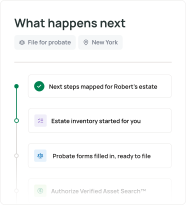
Without a will, the process of settling an estate can become considerably more challenging for families. For anyone who's trying to manage this situation, Elayne is designed to help. From locating unknown assets and filing court paperwork to notifying agencies and tracking deadlines, Elayne manages the administrative steps required at each stage. When no will exists, estate settlement can last longer and become less clear. Elayne brings structure to that process: a personalized checklist that updates as steps are completed, automated notifications, and a shared dashboard that keeps everyone aligned.
If you're facing this process, see how Elayne works.
Final Thoughts on Estate Distribution Without a Will
When no will exists after death, state law governs the process, and settlements can become more difficult to manage. Assets that families assumed would pass simply may end up frozen in probate for months. Personal belongings can become a source of conflict. Probate can stretch on for months, racking up fees and requiring court approval at every turn. If you're currently managing an estate that doesn't have a will, Elayne can help.
FAQ
What is the practical difference between probate and non-probate assets for a family settling an estate?
Probate assets are owned solely in the deceased's name with no beneficiary designation: bank accounts without a POD designation, individually titled real estate, vehicles, and personal property. These go through the court-supervised probate process before any family member can receive them, which takes months and costs 4 to 7% of estate value on average. Non-probate assets (life insurance policies, retirement accounts with named beneficiaries, jointly owned property with right of survivorship, and payable-on-death accounts) transfer directly to the named person, often within weeks, without court involvement. For a family without a will, the practical difference is timing and control: non-probate assets can reach the right person quickly, while probate assets are frozen until the court appoints an administrator and completes the process.
What happens to credit card debt when someone dies, and who is responsible for paying it?
Credit card debt becomes a liability of the estate, not of the surviving family members. The administrator is required to notify creditors and use estate assets to pay valid debts before distributing anything to heirs. Family members are generally not personally responsible for a deceased person's credit card debt unless they were a joint account holder; being an authorized user does not create personal liability. If the estate does not have enough assets to cover all debts, creditors may receive partial payment or nothing, depending on state priority rules. Heirs do not inherit unpaid credit card balances.
How does estate settlement actually work when there is no will?
When there is no will, estate settlement follows a court-supervised process called intestate probate. A family member petitions the court to open the estate. The court appoints an administrator (typically the surviving spouse or an adult child) who takes on the legal authority to manage the estate. The administrator inventories all assets, notifies creditors, pays outstanding debts and taxes, and then distributes remaining assets according to state intestacy law. The court reviews and approves major steps throughout. The process typically takes 9 to 20 months and costs 4 to 7% of estate value in fees. Without a will naming specific beneficiaries or an executor, every distribution decision is subject to state default rules instead of the deceased's wishes.
How long do I have to transfer property after someone dies, and what happens if I miss the deadline?
There is no single universal deadline for transferring property after death, but several time-sensitive rules apply. Creditors must typically be notified within 30 to 90 days of opening the estate, depending on state law; failure to do so can expose the estate to extended liability. Some states require probate to be opened within a set period (often two to three years from the date of death), and waiting too long can complicate or prevent the transfer of real estate. For property with a deed, the title cannot transfer until probate closes and a court order or deed of distribution is recorded. Missing creditor notification windows can mean personal liability for the administrator. Missing state filing windows can mean the estate loses the ability to clear title entirely. The safest approach is to open the estate promptly and work with a probate attorney or an estate settlement platform to track jurisdiction-specific deadlines.
What happens to a bank account when someone dies without a will?
Bank accounts with no named beneficiary become part of the probate estate and are distributed according to state intestate succession laws, typically to the spouse and children first. Accounts with payable-on-death designations transfer directly to the named person without going through probate.
If a parent dies without a will, who gets the house?
The house becomes part of the probate estate and is distributed according to state law, usually shared between the surviving spouse and children. The property cannot transfer until probate is complete, and no single heir can claim it automatically.
Can I remove personal belongings from the house after death if there is no will?
Removing items before the court appoints an administrator creates legal liability, even for close family members. The administrator holds the legal authority to inventory and distribute all personal property according to state law.
How long does probate take when there is no will?
Intestate estates often take longer than average because disputes among heirs are more common when there is no will, pushing timelines toward the higher end of the 9 to 20 month range.
Does a surviving spouse inherit everything if there is no will?
No. In most states, children share in the estate. The exact division depends on state law. In Illinois, for example, the spouse receives 50% and children split the remaining 50%.
*Disclaimer: This article is for informational purposes only and does not provide legal, medical, financial, or tax advice. Please consult with a licensed professional for guidance specific to your situation.










.svg)