

When a parent dies, financial accounts and other assets they held can go unclaimed if no one searches for them. Whether property has already been transferred to a state treasury or is still sitting dormant at a financial institution depends on how long it has gone inactive. This guide covers key points for families to be aware of, including: what types of assets commonly go unclaimed, searching state and federal databases, how to find a lost life insurance policy, who has legal authority to file a claim, what documents are required, and more.
Key Takeaways
- Over $100 billion sits in state treasuries; roughly 1 in 7 Americans holds a claim they don't know about.
- State unclaimed property databases are free to search; MissingMoney.com covers multiple states at once.
- Federal resources like PBGC and TreasuryDirect can hold assets that never appear in any state registry.
- Filing as an heir requires certified death certificates and proof of legal authority, not photocopies or affidavits alone.
- Elayne's Verified Asset Search pulls from 100+ financial sources, including accounts that haven't yet reached state dormancy thresholds.
What Unclaimed Property Is
Unclaimed property is a financial asset whose owner has had no contact with the holding institution for a set period of time, typically between one and five years depending on the asset type and state. When that dormancy period ends, the institution is legally required to transfer the property to the state, a process called escheatment. The state then holds it in custody indefinitely, waiting for the rightful owner or heir to claim it.
{{blog-cta-financial}}
Common Types of Unclaimed Assets in Estates
Several categories of property commonly go unclaimed in estates after a death:
- Dormant checking, savings, and money market accounts
- Uncashed checks from tax refunds, payroll runs, insurance payouts, or stock dividends
- Brokerage accounts, mutual funds, or stock certificates held under an old mailing location
- IRA or 401(k) balances with no named beneficiary
- Life insurance policies and annuities
- Pension or employer benefit balances at former jobs
- U.S. savings bonds that were purchased but never redeemed
- Security deposits from utilities, landlords, or phone carriers
- Real property with unclear title or interests that were never formally probated
How to Start: Searching a Parent's Paperwork and Records as an Authorized Heir
Tax returns from the past two to three years are a strong starting point. Form 1099-INT reveals interest-bearing accounts; 1099-DIV points to brokerage or mutual fund holdings; 1099-R shows retirement distributions. Each form names the institution that issued it, which is a direct lead.
Other records worth reviewing:
- Recent bank and credit card statements, including paper mail that may have accumulated
- Insurance premium payment records, whether by check or automatic transfer
- Employment documents, union cards, or HR correspondence that might indicate pension or profit-sharing eligibility
- Safe deposit box contents, which sometimes hold certificates, old policies, or deeds to property
How to Search State Unclaimed Property Databases
Searching state unclaimed property databases costs nothing through official channels. MissingMoney.com, the official multi-state search tool run by NAUPA, lets you search multiple states at once and links directly to each state's official program if a match appears. Individual state treasurer websites also host their own free search portals.
Because a parent may have lived, worked, or held accounts in more than one state, finding accounts after death can require searching beyond just the current state of residence. Each state holds unclaimed property reported by institutions operating within its borders, so a brokerage based in a different state may have escheated to that state's treasury instead of the parent's home state.
How to Find a Lost Life Insurance Policy
Searching for a decedent's life insurance policies is one of the largest unclaimed asset categories in estate settlement. The NAIC's Life Insurance Policy Locator has connected consumers with more than $16 billion in lost and unclaimed benefits since its launch in November 2016.
The NAIC life insurance locator is free. Submitting a request requires the decedent's full legal name, Social Security number, date of birth, and date of death. Participating insurers then search their records and contact you directly if a match is found. Responses can take up to 90 days.
A few things to know before submitting:
- The search covers only participating insurers, so no match does not automatically mean no policy exists
- Searching the decedent's state unclaimed property database separately is worth doing, since some life insurance proceeds may have already escheated to the state
- Premium payment records, employer benefits correspondence, or automatic bank transfers labeled to an insurance carrier are all leads worth investigating
Federal Databases and Resources
- TreasuryDirect and the Treasury Hunt tool cover unredeemed U.S. savings bonds
- The Pension Benefit Guaranty Corporation (PBGC) maintains a database of unclaimed pension benefits from terminated private-sector pension plans
- The Social Security Administration handles survivor benefits
Who Has the Legal Authority to File a Claim for a Deceased Person's Property
States require proof that the claimant has the right to receive the funds, and what that proof looks like depends on the situation.
Named beneficiaries generally have the simplest path. If the decedent listed you directly on an account or policy, most states accept a death certificate alongside proof of identity.
Heirs without a named beneficiary designation face more documentation:
- An executor with Letters Testamentary can file on behalf of the estate, which also applies when filing a life insurance claim.
- An administrator appointed by a probate court can file when no will exists.
- Some states accept a small-estate affidavit when the total property value falls below a set threshold, bypassing full probate.
Intestate situations, where a parent died without a will, require the court to appoint an administrator before most states will release funds. That process varies considerably by state and can add months to the timeline.
The value of the property being claimed often shapes how much documentation a state requires. A $200 uncashed check may need only a death certificate and a simple affidavit. A $40,000 brokerage account will likely require Letters Testamentary or Letters of Administration.
Documents Needed to File an Heir Claim
Requirements vary by state and claim size, but heir claims generally draw from the same core document set:
- Certified death certificate (most states require a certified copy, not a photocopy)
- Your government-issued photo ID
- Proof of relationship: a birth certificate linking you to the decedent, or a marriage certificate if you are the surviving spouse
- Legal authority document: Letters Testamentary if there is a probated will, Letters of Administration if there is no will, or a small-estate affidavit if the state permits it for lower-value claims
- The claim form from the state's official unclaimed property portal
{{blog-cta-financial}}
How Elayne Supports Unclaimed Property and Asset Discovery
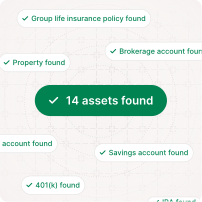
Elayne's Verified Asset Search™ pulls from 100+ financial sources using government-credentialed access, surfacing accounts, life insurance policies, unclaimed state property, real property and deeds, vehicle and vessel records, and credit-bureau trade-line data from all three major bureaus, all returned in one source-linked estate record.
In addition, Elayne scans tax returns, bank statements, and financial records to surface interest-bearing accounts, retirement distributions, and dividend income sources, identifying which institutions held assets before anything was ever escheated to a state.
Elayne has supported over 1,000 families and attorneys settling estates, drawing on approaches outlined in the complete guide to finding deceased accounts, with the typical matter capable of reducing hundreds of hours of estate administration work.
FAQ
How do you find unclaimed property from a deceased parent in 2026?
Tax returns, bank statements, and insurance records can name specific institutions and surface accounts. MissingMoney.com (the free NAUPA multi-state tool) covers multiple states at once, and each state where a parent lived, worked, or held accounts can be searched individually. The NAIC Life Insurance Policy Locator accepts requests for policy searches, and the PBGC database and TreasuryDirect cover pension balances and unredeemed savings bonds separately.
Can you claim a deceased parent's unclaimed property without going through probate?
Sometimes. Named beneficiaries typically need only a death certificate and proof of identity to file a claim directly through a state's unclaimed property portal. Without a beneficiary designation, most states require either Letters Testamentary from a probated will, Letters of Administration when there is no will, or a small-estate affidavit when the total value falls below the state's threshold. The size and type of property usually determines how much court documentation a state will require before releasing funds.
What documents do I need to file an heir claim for a deceased parent's unclaimed property?
Most states require a certified death certificate (not a photocopy), your government-issued photo ID, proof of your relationship to the decedent such as a birth certificate, and a legal authority document: Letters Testamentary, Letters of Administration, or a small-estate affidavit depending on the estate's circumstances.
How long does it take to receive funds after filing an unclaimed property claim for a deceased parent?
Processing time depends on claim type and documentation. A named beneficiary with a complete document package typically sees resolution in 4 to 12 weeks. An heir claim with probate authority already in place runs roughly 2 to 6 months. When probate still needs to open before a state will release funds, the full timeline can stretch past a year.
*Disclaimer: This article is for informational purposes only and does not provide legal, medical, financial, or tax advice. Please consult with a licensed professional to address your specific situation.










.svg)