.webp)

After someone dies, their online accounts and active subscriptions become part of what needs to be managed during estate settlement. How quickly accounts are closed and in what order can affect access to estate funds, exposure to identity theft, and recovery of irreplaceable content. This guide covers key topics for families and executors to be aware of, including: access to email and financial accounts, cancelling recurring subscriptions, cryptocurrency and digital assets, and more.
Key Takeaways
- Roughly 2.5 million deceased Americans have their identities stolen each year. Notifying all three credit bureaus—Equifax, Experian, and TransUnion—places a deceased indicator on the credit file, making it harder for fraudsters to open new credit in that person's name.
- Phone numbers and email accounts are the foundation of digital access after a death.
- Elayne scans financial records to surface recurring charges, manages cancellation communications with each provider, and logs confirmations through a shared dashboard for families and executors.
What Counts as a Digital Account or Asset After Death
A digital account is an account accessed online with a username and password. A digital asset is anything stored or held in those accounts that carries sentimental or financial value.
A key part of this process is demonstrating the legal authority to act. For financial accounts, that typically means court-issued Letters Testamentary or Letters of Administration. Social media platforms and subscription services generally require a death certificate and proof of relationship, though some also ask for executor documentation before taking action.
Common sentimental and communication accounts:
- Email accounts (Gmail, Outlook, Yahoo)
- Social media profiles (Facebook, Instagram, X, LinkedIn, TikTok)
- Cloud photo and video storage (Google Photos, iCloud, Dropbox)
- Personal blogs, YouTube channels, or creative portfolios
Common financial and transactional accounts:
- Online bank and brokerage accounts
- PayPal, Venmo, Cash App, and other payment apps
- Cryptocurrency wallets and exchange accounts
- Rewards points, airline miles, and store loyalty programs
- Domain names and monetized online businesses
Common subscription-based services:
- Streaming (Netflix, Spotify, Hulu, Disney+)
- Software subscriptions (Adobe, Microsoft 365, cloud storage tiers)
- Gym memberships and app subscriptions billed to a card on file
{{blog-cta-financial}}
Why Unmanaged Digital Accounts Can Create Real Problems
Digital accounts that remain open after a death can have financial, legal, and personal consequences for the estate and surviving family members.
On the financial side, streaming services, software subscriptions, and app memberships may continue billing until someone cancels them. Those charges come out of estate funds, and they can accumulate for months before anyone reviews the statements.
Some digital accounts also hold content that cannot be recovered once lost. Cloud photo libraries, personal emails, and private messages may become permanently inaccessible if accounts lapse or are closed for inactivity before anyone has retrieved them.
For executors, managing digital accounts is part of administering the estate. This includes identifying recurring charges, securing accounts against unauthorized access, and closing accounts in an orderly way. Fiduciary responsibilities apply to digital assets in the same way they apply to physical property.
Financial Platforms and Online Banking
Online bank and brokerage accounts are estate assets. Accessing them requires legal authority—typically Letters Testamentary or Letters of Administration issued by a probate court. Most financial institutions require those documents along with a certified copy of the death certificate and a government-issued ID before discussing account balances, transfers, or closures with anyone.
How this works varies by account type:
- Traditional banks and credit unions generally require an in-person branch visit with executor documents, a death certificate, and ID. Most freeze accounts to new transactions as soon as they are notified of a death.
- Brokerage accounts at FINRA-member firms follow transfer-on-death designations and named beneficiaries first. When a beneficiary is on file, that designation typically controls the account and the assets pass outside of probate.
- PayPal and Venmo both require a formal written request with a death certificate and executor authorization. Balances are released to the estate rather than transferred directly to family members.
Cryptocurrency and Digital Financial Assets
Custodial accounts held on exchanges like Coinbase, Kraken, or Gemini work similarly to brokerage accounts. The exchange controls the private keys, so an executor can contact it with Letters Testamentary, a death certificate, and government-issued ID to request access, claim the balance, or transfer the assets to the estate.
Non-custodial wallets work differently. In a non-custodial wallet, the assets are controlled by a private key or seed phrase, typically 12 to 24 words. No exchange or institution holds those credentials. If the seed phrase is not found, the assets in that wallet are permanently inaccessible. No court order can override this, because access is controlled by cryptographic keys, not by an institution. NFTs follow the same logic: ownership is recorded on the blockchain, but access to those assets requires the private key to the wallet holding them.
Safety deposit boxes, physical notebooks, and encrypted storage files are all places where seed phrases or hardware wallet credentials may be stored. Hardware wallets, such as Ledger or Trezor devices, are physical storage devices that hold private keys offline. If any credentials are found, an attorney familiar with digital assets is the appropriate contact before any transfer action is taken.
{{blog-cta-financial}}
How Elayne Supports Digital Account and Subscription Management After Death
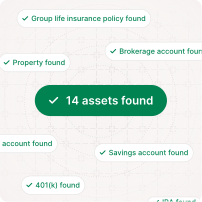
Elayne handles the subscription cancellation work directly. After scanning financial records to surface recurring charges across streaming, software, gym memberships, and app subscriptions, Elayne manages cancellation communications with each provider, monitors subsequent statements to confirm the charges have stopped, and logs every confirmation for estate accounting.
The digital estate inventory goes further. Elayne surfaces accounts the deceased may not have documented, following the same approach outlined in the complete guide to finding deceased accounts, covering email, social media profiles, subscription services, cryptocurrency wallets, rewards programs, and cloud storage.
All of this coordinates through a shared dashboard where authorized family members, co-executors, and attorneys work from the same view. To learn more about our work and mission, visit elayne.com.
FAQ
What does RUFADAA mean for executor access to online accounts?
RUFADAA, the Revised Uniform Fiduciary Access to Digital Assets Act, is the legal framework many U.S. states use to govern whether an executor can access a deceased person's online accounts. Executors do not receive automatic access under this framework.
Instead, access follows a priority order. Online tool designations, such as Google's Inactive Account Manager, come first. Estate planning documents that explicitly grant digital access come next. The platform's own terms of service apply after that, when neither of the above is in place.
What happens to a deceased person's crypto when the seed phrase is lost?
If the private key or seed phrase to a non-custodial wallet is lost, the assets in that wallet become permanently inaccessible. Access is controlled by cryptographic keys rather than by an institution, so no court order can restore entry to the wallet. For crypto held on exchanges like Coinbase or Kraken, an executor can contact the exchange with Letters Testamentary and a death certificate to claim or transfer the balance. Safety deposit boxes, physical notebooks, and encrypted storage files are places where seed phrases or hardware wallet credentials are sometimes found.
What is a digital account and what is a digital asset?
A digital account is any account accessed online with a username and password. A digital asset is anything stored in or held by those accounts that has sentimental or financial value—photographs, personal messages, cryptocurrency, domain names, or rewards points. Both can be part of an estate after a death.
Does an executor have the legal authority to access a deceased person's online accounts?
Not automatically. Under RUFADAA (the Revised Uniform Fiduciary Access to Digital Assets Act), which many U.S. states have adopted, access follows a specific priority order. Online tool designations set up by the account holder during their lifetime come first. Estate planning documents that explicitly grant digital access come next. The platform's own terms of service apply last.
What legal documents does an executor typically need to access financial accounts online?
Many financial institutions require court-issued Letters Testamentary or Letters of Administration, a certified copy of the death certificate, and a government-issued photo ID. These documents confirm the executor's legal authority to act on behalf of the estate. Requirements vary by institution, and some may ask for additional documentation.
Can recurring subscriptions keep charging an estate after someone dies?
Yes. Streaming services, software subscriptions, app memberships, and gym memberships generally continue billing until someone formally cancels them. Those charges come out of estate funds and can accumulate for weeks or months before anyone reviews the account statements.
What happens to a deceased person's social media accounts?
Each platform has its own policy. Facebook and Instagram allow accounts to be memorialized or permanently removed. A verified family member or designated legacy contact can typically request either option by submitting a death certificate. X (formerly Twitter) and LinkedIn generally remove accounts upon a formal request.
*Disclaimer: This article is for informational purposes only and does not provide legal, medical, financial, or tax advice. Please consult with a licensed professional to address your specific situation.










.svg)