.webp)

Probate records are public court filings, and can generally be searched by name through official court portals, state archives, or digitized repositories. Access methods, search logic, and online availability vary by state and county. This guide covers key points for attorneys to be aware of, including: how to search probate records by name, what documents are found in probate records, examples of probate court search portals, and more.
Key Takeaways
- Probate records are public court filings.
- Free searches are available through official court portals, state archives, and FamilySearch; certified copies carry per-page fees.
- No unified portal exists for several states, including South Carolina, where each county probate court operates its own separate system.
- Elayne runs a government-credentialed search across 100+ financial sources, surfacing assets that may not be captured in court inventories, billed per matter as an eligible estate expense.
What Probate Records Are and Why They Matter
Probate records are the official court documents generated when an estate moves through the probate court process. They are created by and filed with the probate court and become part of the court's permanent public record once a proceeding opens.
As the Colorado State Archives describes, a probate record generally includes information such as the name of the estate, case number, date of death, names of next of kin, and any will. A probate file typically also contains creditor notices, petitions, bonds, accountings, and final distribution orders.
For estate attorneys, these records confirm whether a prior estate administration exists for a decedent, verify the personal representative's authority, and surface asset and beneficiary information that may bear on a current matter.
{{blog-cta-attorneys}}
What Documents Are Found in Probate Records
A probate file accumulates as a proceeding moves through the court. What appears in any given file depends on the jurisdiction, the estate's size, and how far the matter progressed, but the core document categories are consistent across many filings:
- Petition for probate or administration: the opening filing naming the decedent, the proposed personal representative, and the nature of the proceeding. Confirms jurisdiction and the date the matter opened.
- Will (if admitted): the instrument the court accepted, showing testamentary intent, nominated executor, and beneficiary designations.
- Letters Testamentary or Letters of Administration: the court order granting the personal representative authority to act. Helpful for confirming who held authority on a prior matter.
- Estate inventory: the personal representative's sworn list of assets and values as of the date of death. Often the most useful document for identifying financial accounts, real property, and personal property.
- Notice to creditors and claims: filings showing which creditors received notice and which submitted claims against the estate.
- Accountings: periodic or final filings tracking receipts, disbursements, and distributions.
- Court orders and decrees: hearing outcomes, accounting approvals, and final distribution orders.
- Distribution records: documents confirming what each beneficiary or heir received and when.
For an attorney researching a decedent's prior estate history, the inventory and distribution records are especially helpful. They confirm what assets existed, who received them, and on what authority.
Are Probate Records Public?
Probate court records are generally public under state open-records law. When a proceeding opens, the file becomes part of the court's public record, accessible to anyone with a legitimate reason to search it.
Courts do restrict certain categories. Guardianship and conservatorship matters frequently carry partial or full seals, particularly when minors or incapacitated adults are involved. Settlement agreements, mental health evaluations, and records sealed by court order are other common exceptions.
Online availability is the more variable question. Some counties have built searchable public portals with decades of docket history. Others require an in-person or written request.
How to Search Probate Records by Name
Many court portals accept searches by decedent name, personal representative name, or case number.
A few considerations:
- Starting with the surname alone, before adding a first name, avoids the exact-match logic that many portals use, which causes middle names or suffixes in the wrong field to return nothing.
- Alternate spellings, hyphenated versus unhyphenated names, and maiden names are worth including, since the name in the court record reflects how it appeared on the filing.
- Date of death narrows results when a common name returns multiple records.
- Case number searches are often faster when available. A prior proceeding reference appearing in a deed, an account record, or a prior attorney's file can be used directly.
When a name search returns no results, the absence is not always conclusive. The decedent may have held property in a different county, used a trust to avoid probate, or had a matter filed under a variant name. The differences between probate vs. non-probate assets can help clarify why some estates never appear in court records at all.
How to Search Probate Records Online for Free
Free probate record searches fall into three main categories: official court portals, state archives, and digitized genealogical repositories.
Official county and state court portals are a key starting point for active or recent proceedings. They're generally free to search by name or case number. For example, Wisconsin's court access system, Massachusetts's MassCourts portal, and Minnesota's Court Records Online each allow public case searches at no charge. The search index is generally free; certified copies of individual documents carry per-page fees, typically ranging from a few cents to several dollars depending on the court.
State archives hold older records that predate electronic filing. The Colorado State Archives maintains probate files searchable through its online database for cases older than 1985. Availability varies by state and county, and some archives require a written request in place of an online search.
For historical matters, FamilySearch has digitized probate records from counties across the United States, many from the 1800s through the mid-twentieth century, with free access and no registration required. Coverage can surface historical estate records when official county archives are unavailable online.
{{blog-cta-attorneys}}
Examples of Probate Court Search Portals
| Jurisdiction | Portal / Office | Search Method |
|---|---|---|
| Texas (Harris County) | Harris County District Courts online docket | Case name or number; county-level courts handle probate |
| South Carolina (all counties) | Individual county probate court websites; no statewide unified portal | Name or case number; Richland, Lexington, Spartanburg, Horry, Berkeley, and Charleston each maintain separate systems |
| Arizona (Maricopa County) | Maricopa County Superior Court docket | Case name or number |
South Carolina has no centralized probate search portal. Each county probate court is independently administered, so a search covering multiple counties requires visiting each court's site separately.
How Elayne Supports Estate Attorneys with Asset Discovery and Estate Organization
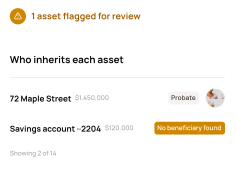
Elayne is the administrative layer estate attorneys can deploy on a per-matter basis, with no firm rollout required. An attorney signs up individually, invites a client, and Elayne handles intake, document collection, and asset discovery, returning a source-linked estate record organized for attorney review.
Elayne's Verified Asset Search™ runs a government-credentialed search across 100+ financial sources, covering real property, financial accounts, life insurance, and unclaimed state property. Elayne surfaces what it finds and flags open questions; the attorney reviews, advises, and files. Every fact in the record is traceable to its source, and Elayne is billed per matter as an eligible estate expense.
FAQ
What is a probate estate inventory and why does it matter for asset discovery?
The estate inventory is the personal representative's sworn list of assets and values as of the date of death, covering financial accounts, real property, and personal property. It is one of the few sworn records of what the decedent held at death, giving attorneys a reliable baseline for understanding the estate's composition.
Are probate records available to the public?
Probate court records are generally public records under state open-records law. Once a proceeding opens, the file becomes part of the court's public record and is accessible to anyone with a legitimate reason to search it. Certain categories, such as guardianship matters involving minors, may be sealed by court order.
Can you search probate records online for free?
Official county and state court portals typically allow free searches by name or case number. Certified copies of individual documents carry per-page fees. For historical records, FamilySearch offers free access to digitized probate filings from counties across the United States.
What is the difference between a probate record and a will?
A will is one document within a probate file. The probate record is the full court file, which includes the will (if one was admitted), the petition for probate, the estate inventory, creditor notices, accountings, court orders, and distribution records. The will shows the decedent's intentions; the probate record shows how the court carried them out.
What is a Letters Testamentary and where does it appear in a probate file?
Letters Testamentary is the court order granting the executor authority to act on behalf of the estate. It appears in the probate file after the court accepts the will and approves the named executor. The document shows the executor's name, the estate name, and the date authority was granted.
*Disclaimer: This article is for informational purposes only and does not provide legal, medical, financial, or tax advice. Please consult with a licensed professional to address your specific situation.


without more overhead
Organize and file with the court, find accounts other search tools miss, and pay from the estate, not your own pocket.








.svg)