

California has no inheritance tax and no state estate tax. Beneficiaries who inherit money, property, or accounts from a California estate owe no state-level tax at the moment of transfer. This guide covers key topics for families and executors, including: how the federal estate tax exemption works, how capital gains and step-up in basis rules apply to inherited assets, inherited IRAs and 401(k)s, how Proposition 19 affects inherited real estate, and more.
Key Takeaways
- California has no inheritance tax and no state estate tax.
- The federal estate tax exemption is $15 million per individual in 2026.
- Inherited IRAs and 401(k)s are taxed as ordinary income; non-spouse beneficiaries must empty the account within 10 years under SECURE Act 2.0.
- The step-up in basis rule resets an inherited asset's cost basis to its fair market value at the date of death, which can reduce or eliminate capital gains tax when the asset is sold.
- Elayne helps California families locate accounts and assets, track SECURE Act 2.0 distribution deadlines for inherited retirement accounts, and manage subscription cancellations during estate administration.
California Does Not Have an Inheritance Tax
California does not have an inheritance tax. Beneficiaries who receive property, money, or other assets from a California estate owe no state-level tax simply because they inherited. The state repealed its inheritance tax in 1982 and has not reinstated it since. Inheriting in California is not always entirely tax-free, though. Federal estate tax, capital gains tax, and rules around inherited retirement accounts can still apply depending on what is inherited and how it is held.
{{blog-cta-financial}}
Estate Tax vs. Inheritance Tax
An estate tax is paid by the estate itself before any assets are distributed to beneficiaries, calculated against the total value of everything the deceased owned. An inheritance tax, by contrast, is paid by the individual who receives assets after distribution. California has neither.
The Federal Estate Tax and What It Means for California Residents
The Working Families Tax Cuts Act, signed July 4, 2025, raised the federal estate tax exemption to $15 million per individual for 2026. Married couples can shield up to $30 million through portability, which lets a surviving spouse use any unused portion of their deceased spouse's exemption.
Do Beneficiaries Pay Taxes on Inherited Property in California?
Beneficiaries in California do not pay inheritance tax on what they receive. Assets transfer without a direct tax bill simply for inheriting.
What happens after inheritance depends on the asset type:
| Asset Type | Tax at Moment of Transfer | Tax After Inheritance |
|---|---|---|
| Cash or bank accounts | None | Generally none |
| Investment accounts or real estate | None | Capital gains tax applies when sold, calculated from stepped-up value at date of death |
| IRAs or 401(k)s | None | Distributions taxed as ordinary income |
| Real estate (California) | None | Potential property tax reassessment under Proposition 19 if occupancy conditions are not met |
Capital Gains and the Step-Up in Basis Rule
When an asset is inherited, its cost basis resets to the fair market value on the date of death. This is called a step-up in basis. Any increase in value that occurred during the original owner's lifetime is not subject to capital gains tax. For example, if a home was purchased for $200,000 and was worth $800,000 at the time of death, the heir's cost basis is $800,000. If the heir sells it for $800,000, no capital gains tax is owed on that sale. This applies to real estate, investment accounts, and most other appreciated assets.
It's important to note that how title was held matters: assets transferred into an irrevocable trust before death may not receive the same treatment.
Inherited Retirement Accounts
Inherited retirement accounts sit outside the step-up in basis rule. Withdrawals from an inherited IRA or 401(k) are taxed as ordinary income, both federally and in California.
Under SECURE Act 2.0 rules in effect in 2026, most non-spouse beneficiaries must empty the inherited account within 10 years under the inherited IRA distribution rules, with mandatory annual RMDs throughout that window.
How Proposition 19 Affects Inherited Real Estate in California
Under Prop 19, which took effect February 16, 2021, the reassessment exclusion for parent-to-child transfers requires the inheriting child to occupy the property as their primary residence within one year of transfer. Even when that condition is met, the exclusion applies only up to $1 million of value above the existing assessed value.
{{blog-cta-financial}}
Living Trusts in California
When a California resident holds property in a revocable living trust, those assets still count as part of their taxable estate. The step-up in basis still applies at death, Prop 19 reassessment rules still apply to real estate transfers to children, and federal estate tax exposure remains unchanged. The trust is a transfer mechanism, not a tax shelter.
Irrevocable trusts work differently. Once assets are moved into one, they generally leave the taxable estate, but the grantor loses control over those assets. Depending on how the trust was structured, the step-up in basis at death may not apply, potentially creating a larger capital gains bill if heirs eventually sell.
How Elayne Helps California Families Handle Estate Administration
For families in California, estate administration can include: locating accounts, tracking Prop 19 deadlines, managing SECURE Act 2.0 distribution requirements for inherited retirement accounts, and stopping recurring charges.
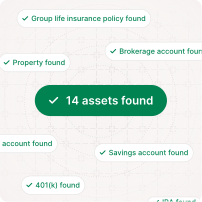
Elayne organizes the estate record and runs a Verified Asset Search™ to surface accounts and assets that might otherwise go unnoticed. For inherited retirement accounts, Elayne tracks RMD deadlines and distribution windows to help beneficiaries spread withdrawals across the 10-year period. Subscription and recurring charges are handled directly with providers, with each cancellation confirmed and logged for estate accounting.
For California families dealing with inherited real estate, including those working through a probate sale, Elayne helps map what has transferred and to whom, supporting the distribution picture families need before making property decisions. Survivor benefits, including Social Security, veterans' benefits, and pension entitlements, are surfaced as part of the same process.
FAQ
Does California have an inheritance tax or estate tax in 2026?
California has neither an inheritance tax nor a state estate tax. The state repealed its inheritance tax in 1982, and no replacement has been enacted. Beneficiaries who inherit property, money, or accounts from a California estate owe no state-level tax simply for receiving those assets, though federal estate tax, capital gains tax on appreciated assets sold after inheritance, and California income tax on inherited IRA withdrawals can still apply.
Do beneficiaries have to pay taxes on inheritance from a California trust or estate?
Beneficiaries generally do not owe tax at the moment of inheritance, but tax obligations can follow depending on what was inherited. Cash and bank accounts generally pass without immediate tax consequences; inherited real estate and investment accounts carry a stepped-up cost basis that clears capital gains accrued during the original owner's lifetime, while inherited IRAs and 401(k)s are taxed as ordinary income on every withdrawal, with mandatory annual distributions required under SECURE Act 2.0 rules now in effect in 2026.
Differences between inheritance tax and estate tax?
An estate tax is paid by the estate itself before assets reach beneficiaries; an inheritance tax is paid by the person receiving the assets. California has neither, and for most families, the federal estate tax also does not apply. The 2026 federal exemption is $15 million per individual, meaning only estates above that threshold owe federal estate taxes. The more common tax exposures for California heirs are capital gains on sold assets and ordinary income tax on inherited retirement account distributions.
How does Prop 19 affect inherited real estate in California, and how does it interact with a living trust?
Under Prop 19, which took effect on February 16, 2021, a child who inherits a parent's California home must occupy it as a primary residence within one year to qualify for any reassessment exclusion. Even when that condition is met, the exclusion applies only up to $1 million of value above the existing assessed value. Holding property in a revocable living trust does not change this analysis: the trust is a transfer mechanism, not a tax shelter.
What is the federal estate tax exemption in 2026?
The federal estate tax exemption is $15 million per individual in 2026. Married couples can shield up to $30 million through portability. An estate must exceed $15 million before federal estate tax is owed. Estates below that threshold owe no federal estate tax.
Does inheriting a home in California trigger property taxes?
Inheriting a home in California can trigger a property tax reassessment under Proposition 19, which took effect on February 16, 2021. A child who inherits a parent's home must move in and use it as their primary residence within one year to qualify for a reassessment exclusion. If that condition is not met, the property is reassessed at current market value, which can increase the annual property tax bill. Even when the condition is met, the exclusion applies only up to $1 million of value above the existing assessed value.
*Disclaimer: This article is for informational purposes only and does not provide legal, medical, financial, or tax advice. Please consult with a licensed professional to address your specific situation.









.svg)