.webp)

Florida summary administration is a faster, lower-cost probate track for estates that qualify by value or by time. It can close in weeks, skips the personal representative requirement, and costs less than formal administration. This article covers eligibility, the filing process, creditor exposure, homestead property, and when formal administration is the better choice.
Key Takeaways
- Florida summary administration is available for estates under $150,000 in non-exempt assets or where the person died more than two years ago.
- Most summary administration cases close within two to eight weeks, though court backlog in high-volume counties can extend that range.
- Beneficiaries in summary administration can bear personal liability for creditor claims, since the process does not provide the same creditor cutoff that formal administration does.
- Homestead property often requires a separate order determining homestead status before title companies will insure a subsequent sale.
- Elayne handles account searches, financial institution coordination, and post-order tracking after summary administration closes.
What Florida Summary Administration Is
Florida summary administration is a simplified probate process available under Florida Statutes Chapter 735 for estates where the decedent passed away more than two years ago, or where the total value of non-exempt assets does not exceed $75,000. It bypasses the lengthier formal administration process, meaning there is no personal representative appointed and no ongoing court supervision of the estate.
The court instead issues an order of summary administration directing how assets are distributed to beneficiaries directly.
{{blog-cta-legal}}
The 2026 Threshold Change: New $150,000 Eligibility Cap
Florida's summary administration eligibility threshold rose from $75,000 to $150,000 in 2026, doubling the cap under Florida Statutes Section 735.201. This change broadly expands access to the faster, lower-cost summary process for estates that previously had no choice but to go through formal administration.
The $150,000 figure applies to the value of assets subject to administration, meaning assets that pass outside probate entirely (joint tenancy property, payable-on-death accounts, life insurance with named beneficiaries) do not count toward that ceiling. A $400,000 estate can still qualify if most of its value moves through non-probate transfers and the probate estate falls under the threshold.
The second qualifying path remains unchanged: estates where the decedent passed away more than two years ago are eligible regardless of value, since creditor claims are time-barred by that point under Florida law.
The Two Qualifying Paths Under F.S. §735.201
Florida's summary administration statute lays out two distinct eligibility paths.
The first path covers estates where the decedent passed away more than two years ago. At that point, regardless of estate value, summary administration is available because the creditor claim period under Florida law has expired.
The second path applies when the decedent died within the past two years and the value of the entire estate subject to administration in Florida does not exceed $150,000 (as of 2026), excluding exempt property such as homestead real property.
What Counts Toward the $150,000 Threshold
Florida courts look at the gross value of non-exempt assets, not net equity after debts.
- Homestead real property is excluded from the $75,000 calculation, which often makes summary administration available even for estates that include a family home.
- Exempt personal property under Florida Statute §732.402, such as household furnishings up to $20,000, also falls outside the threshold count.
- Non-exempt assets like bank accounts, investment accounts, vehicles, and non-homestead real property all count toward the limit at their fair market value.
Summary Administration vs. Formal Administration: Key Differences
| Factor | Summary Administration | Formal Administration |
|---|---|---|
| Estate value threshold | $150,000 or less (excluding exempt property) | Over $150,000, or when required by law |
| Decedent's death | Must have passed away more than 2 years ago, or estate qualifies by value | Any time after death |
| Personal representative | Not appointed | Required |
| Court supervision | Minimal | Ongoing throughout |
| Typical timeline | Weeks to a few months | Six months to two or more years |
| Attorney requirement | Not required, though common | Generally required |
Summary administration works for smaller estates or those where the decedent died more than two years ago, because Florida's statute of limitations on creditor claims has expired by that point. Formal administration is the standard track for larger or more complex estates, and it requires a personal representative to manage assets, notify creditors, and report to probate court throughout the process.
The core practical difference is creditor exposure. In formal administration, the personal representative actively notifies creditors and works through claims. In summary administration, the court issues an order directing who receives what, but beneficiaries may bear personal liability for valid creditor claims up to the value of what they received.
What the Petition for Summary Administration Must Include
Florida's petition for summary administration must meet the requirements set out in Florida Statute § 735.203. The petition names the decedent, the date and place of death, and the county of domicile. It lists all known assets subject to probate along with their estimated values, identifies all beneficiaries and their relationship to the decedent, and states that the estate qualifies under the statutory threshold or that the decedent passed away more than two years ago.
Testate vs. Intestate Petitions
The petition takes slightly different forms depending on whether the decedent left a will:
- For testate estates, the petition must attach the original will and any codicils, request that the court admit the will to probate, and set out the names of all beneficiaries as identified in the will.
- For intestate estates, the petition must identify all heirs at law under Florida's intestacy statutes and include a statement that no valid will exists to the petitioner's knowledge.
Both versions require a statement confirming that all debts have been paid, are legally uncollectible, or that the surviving spouse or beneficiaries have agreed to assume responsibility for any outstanding obligations before distributions are made.
{{blog-cta-legal}}
How the Summary Administration Process Works
Florida summary administration follows a court-supervised sequence that moves faster than formal probate but still requires precise filings.
The Filing Sequence
Most petitions reach resolution within two to eight weeks, though Pinellas County and other high-volume circuits can run longer depending on judicial calendar.
- Send direct written notice to all known creditors before filing, per F.S. §735.206.
- The petitioner files a Petition for Summary Administration along with the original will (if one exists), a death certificate, and a proposed Order of Summary Administration listing each asset and its intended recipient.
- The court reviews the petition for statutory compliance, including the two-year or under-$75,000 threshold.
- A judge signs the Order of Summary Administration, which serves as the legal instrument families present to banks, title companies, and transfer agents to release assets.
Notice to Creditors
Florida statute does not require a formal notice to creditors publication period in summary administration the way formal administration does. Beneficiaries do, however, remain liable to known creditors for two years after the date of death, so identifying and paying outstanding debts before distributing assets can help reduce personal exposure.
Homestead Property
Summary administration handles homestead property differently. A separate Order Determining Homestead is often filed alongside the main petition when real property qualifies, since Florida's homestead protections affect how title transfers and who may receive the property under Florida Statutes Chapter 732.
How Elayne Supports Estate Organization After Summary Administration
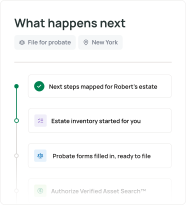
Once the order of summary administration is entered, Elayne surfaces every financial account and institution named in the petition, organized by asset type and distribution status. Any account that has not confirmed distribution is flagged for review before the matter moves to a closed status. Where the petition covers multiple beneficiaries receiving different asset categories, Elayne maps each distribution line against the order so legal teams can verify that what was entered has been carried out.
FAQ
How long does summary administration take in Florida for probate?
Most Florida summary administration cases close within two to eight weeks from the date of filing. The actual timeline depends on court backlog in your county, whether the petition is filed without errors or missing signatures, and whether homestead property requires a separate determination.
Is notice to creditors required in summary administration in Florida?
A formal published notice-to-creditors period is not required in Florida summary administration the way it is in formal administration. However, Florida Statute 735.206 requires that known or reasonably ascertainable creditors receive direct written notice before the petition is filed, and beneficiaries who receive distributions remain personally liable to unpaid creditors for two years from the date of death.
Florida summary administration vs. formal administration: which process fits a $200,000 estate?
It depends on what makes up that $200,000. If most of the value passes through joint accounts, payable-on-death designations, or life insurance with named beneficiaries, the probate estate may fall under Florida's $150,000 threshold and qualify for summary administration. If the full $200,000 consists of non-exempt probate assets, formal administration is the required path, and the more protective one when creditor exposure is a concern.
What is the order of summary administration in Florida and what does it actually do?
The order of summary administration is the signed court document that directs how estate assets are distributed to beneficiaries. Once a judge enters it, families present the order directly to banks, title companies, and transfer agents as legal authority to release assets, taking the place of the personal representative role that formal administration requires throughout the entire process.
*Disclaimer: This article is for informational purposes only and does not provide legal, medical, financial, or tax advice. Please consult with a licensed professional to address your specific situation.










.svg)