Bank and brokerage accounts can sit at dozens of institutions. Some generate no paper statements. Others belong to online-only banks or payment platforms that leave no physical record at all. As a result, during estate settlement, it's common for these types of accounts to go unnoticed. This guide covers key aspects of searching for bank and brokerage accounts: confirming legal authority, searching paper and digital records, contacting institutions directly, and checking state unclaimed property databases.
Key Takeaways
- Tax returns (Forms 1099-INT, 1099-DIV, 5498) name institutions that paid the decedent and are among the most reliable starting points
- State unclaimed property databases hold over $70 billion in dormant accounts
- Account ownership structure controls transfer timing: joint accounts can move in days, while sole-ownership accounts wait on probate
- Elayne coordinates the verified asset search across financial institutions, state unclaimed property databases, and government benefit records
Confirming Legal Authority Before Any Search Begins
Before searching for accounts, an executor or administrator needs legal authority to act on behalf of the estate. Without it, banks and brokerages will not release information or allow access to accounts.
The specific paperwork required depends on whether the estate goes through probate.
- For probated estates, the court issues Letters Testamentary (if there is a will) or Letters of Administration (if there is no will). These documents name the executor or administrator and grant legal authority to act on behalf of the estate. Most financial institutions require a certified copy, issued directly by the probate court, not a photocopy.
- For non-probated estates, authority comes from other sources: a surviving joint account holder has direct access by operation of law, a named beneficiary can claim assets by presenting a death certificate and completing the institution's claim form, and a trustee of a revocable living trust can act under the trust agreement itself.
What Financial Institutions Typically Ask For
Some institutions also request a tax identification number for the estate before releasing funds or retitling assets.
{{blog-cta-financial}}
Searching Paper and Digital Records
Beyond tax documents and statements from financial institutions, several other sources can help locate accounts:
- A safe deposit box may hold paper passbooks, certificates of deposit, or stock certificates. The box itself may be listed on a homeowner's insurance policy or referenced in a will.
- Cancelled checks in a filing cabinet or checkbook register can identify bank and investment accounts held at community banks or credit unions that don't appear in national searches.
- Email inboxes, if accessible, frequently contain e-statements, account alerts, or login confirmations from financial institutions. A search for terms like "statement," "account," or "deposit" may help locate accounts.
- Password managers or a list of saved browser logins may hold credentials for online-only banks or brokerage accounts.
How to Contact Banks and Financial Institutions Directly
What to Have Ready Before You Call
Before contacting any institution, gather the following:
- A certified copy of the death certificate, which the institution will require before disclosing any account information or releasing funds.
- Letters testamentary or letters of administration issued by the probate court, which confirm the executor's legal authority to act on behalf of the estate.
- The decedent's full legal name, Social Security number, and last known location on file, which the institution uses to search its records.
- Any account numbers, statements, or correspondence already in hand, since these can speed up the search considerably.
What to Expect From the Institution
Most banks and brokerages route estate inquiries through a centralized team instead of a local branch. Response times vary, but written requests sent via certified mail tend to produce more reliable outcomes, particularly when searching for bank accounts of a deceased parent, compared to phone calls alone. Some institutions require a written authorization form specific to their estates process before they will confirm or deny that an account exists.
If an account is located, the institution will typically provide a date-of-death balance, which is the figure used for estate valuation and tax purposes. For brokerage accounts, the institution will also provide a fair market value for any securities held on the date of death.
Using Credit Reports to Surface Unknown Accounts
A decedent's credit report can help surface bank and brokerage accounts. The three major bureaus (Equifax, Experian, and TransUnion) report open and recently closed accounts, and each creditor entry typically includes the institution's name, the account type, and the date it was opened.
Requesting a Deceased Person's Credit Report
Executors and administrators are entitled to pull a decedent's credit report with proper documentation. A request generally requires a death certificate, letters testamentary or letters of administration, and a written request on behalf of the estate.
Each bureau handles deceased requests slightly differently, so contacting all three separately is the standard approach. Discrepancies between bureau files are common, meaning one report may list an account that another omits.
What the Report Does and Doesn't Show
Credit reports show credit accounts: checking and savings accounts held solely at a bank without a credit product attached will not appear. Brokerage accounts held at firms without lending relationships are similarly absent.
The report is a starting point, not a complete inventory. Accounts opened long ago, accounts held jointly, and accounts at smaller credit unions may appear inconsistently across bureaus or not at all.
{{blog-cta-financial}}
Searching State Unclaimed Property Databases
Every U.S. state and most territories operate an unclaimed property database where dormant bank and brokerage accounts are eventually redirected. When financial institutions lose contact with an account holder, they are required to turn those funds over to the state after a dormancy period, typically between one and five years depending on the state and account type.
Searching for a Single State
For accounts held in one state, you can go directly to that state's official unclaimed property portal. Most states use a searchable database where you can enter the decedent's name and, optionally, their last known mailing location or Social Security number to narrow results.
Searching Across Multiple States
If a decedent lived in several states or held accounts in institutions headquartered elsewhere, MissingMoney.com is a free aggregator that searches participating state databases simultaneously.
Federal Accounts and Benefits
For accounts held with federal institutions or involving federal benefits, separate searches apply. The FDIC's BankFind tool can help identify whether a bank has failed and where its deposits were transferred. For savings bonds and Treasury accounts, TreasuryDirect and the Treasury Hunt tool are the relevant starting points.
What to Have Ready
- The decedent's full legal name, including any name variations or maiden names used on accounts
- Their last known residence and any prior locations across states where they lived
- Their Social Security number, which some state portals accept to return more precise results
- Approximate years the accounts may have been active, if known
How Elayne Supports the Practitioner's Verified Asset Search
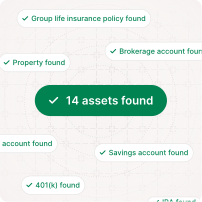
Elayne automates the verified asset search that practitioners may otherwise piece together manually. Where a manual search means pulling statements, checking mail, calling institutions, and waiting weeks for responses, Elayne coordinates those steps in parallel. Elayne surfaces account and asset information, flags potential unclaimed property matches, and organizes findings into a clear record that supports the broader process of organizing financial accounts after death for probate filings and beneficiary distributions.
FAQ
How do you find a decedent's bank accounts when no records were left behind?
A helpful starting point is with the last two to three years of tax returns. Form 1099-INT names every institution that paid interest, and Schedule B lists each account separately.
What's the difference between searching MissingMoney.com vs. going directly to state unclaimed property portals?
MissingMoney.com searches multiple participating state databases at once, which is useful when a decedent lived in several states. However, not every state participates, so for states where the decedent had financial ties, checking that state's official unclaimed property portal directly is important as well.
How does account ownership structure affect access during estate settlement?
Ownership structure controls both timing and documentation. A joint account with right of survivorship can transfer to the surviving co-owner within days of presenting a death certificate. A sole-ownership account stays frozen until probate letters issue, which can take months. Identifying each account's structure early tells the executor which assets are accessible now and which require a longer process before any distribution can occur.
What tool should I use to find forgotten 401(k) accounts from a decedent's former employers?
The National Registry of Unclaimed Retirement Benefits allows searches by Social Security number and is the most direct starting point for these types of 401(k) balances.
Can a credit report help locate bank or brokerage accounts?
A credit report can surface useful leads, but its coverage is limited. The three major bureaus report credit accounts and lines of credit. Checking and savings accounts held without an attached credit product will not appear, and brokerage accounts at firms without lending relationships are similarly absent. The report is a practical starting point for identifying institutions, not a complete inventory.
*Disclaimer: This article is for informational purposes only and does not provide legal, medical, financial, or tax advice. Please consult with a licensed professional to address your specific situation.










.svg)