.webp)

When someone dies, their assets transfer to heirs and beneficiaries through one of two paths: probate for assets owned solely in the decedent's name, or direct transfer for accounts with named beneficiaries or held in a trust. This guide covers key points about how inheritance works in the United States, including: how probate and non-probate assets differ, what happens with and without a will, how inheritance works when married, tax matters, inherited retirement account rules under SECURE Act 2.0, and more.
Key Takeaways
- Inheritance transfers through two paths: probate for solely-owned assets, and direct transfer for accounts with named beneficiaries or trusts.
- A will does not override beneficiary designations; retirement accounts and life insurance pass to whoever is named on the account.
- Non-spouse beneficiaries who inherit a retirement account must withdraw the full balance within 10 years, with annual RMDs required starting in 2026.
- Elayne organizes estate administration after a death, tracking SECURE Act 2.0 deadlines, searching for accounts, and coordinating survivor benefit identification.
What Inheritance Is and How It Transfers
Inheritance is the transfer of a deceased person's assets to their heirs or beneficiaries. That transfer happens through one of two channels, depending on how each asset was titled or designated before death.
The first channel is probate. Assets owned solely in the decedent's name, with no beneficiary designation, go through a court-supervised process that validates the will (if one exists) and authorizes distribution. The second channel is non-probate transfer, which bypasses court entirely. These assets pass directly to whoever is named as a beneficiary or co-owner, regardless of what a will says.
Non-probate assets include:
- Retirement accounts (IRAs, 401(k)s) with a named beneficiary
- Life insurance policies
- Bank and investment accounts with payable-on-death (POD) or transfer-on-death (TOD) designations
- Property held in joint tenancy with right of survivorship
- Assets held in a trust
Many estates involve both channels. A house might go through probate while a 401(k) passes directly to a named beneficiary the same week.
{{blog-cta-financial}}
How Inheritance Works When There Is a Will
A will names who receives what and appoints an executor to carry out those wishes. The will must first be validated by a probate court before any distribution can happen:
- The executor submits the original will to the probate court in the county where the decedent lived
- The court validates the will and issues Letters Testamentary, giving the executor legal authority to act on behalf of the estate
- The executor notifies creditors, pays outstanding debts, and files the decedent's final tax return
- Remaining assets are distributed to beneficiaries named in the will
Important to note: a will does not override beneficiary designations. A retirement account or life insurance policy passes to whoever is named on that account, even if the will says otherwise.
How Inheritance Works Without a Will
When someone dies without a will, state intestate succession laws decide who inherits. The court appoints an administrator instead of an executor to manage the estate.
Most states follow this general priority order:
- Surviving spouse, who typically receives a substantial share but not always everything, particularly when there are children from a prior relationship
- Children
- Parents
- Siblings
- More distant relatives
How Inheritance Works When Married
Marriage does not automatically mean a surviving spouse inherits everything. The outcome depends on factors such as whether a will exists, how assets were titled, and which state the couple lived in.
Every state is either a community property state or a common law state. In community property states (California, Texas, Arizona, and a handful of others), assets acquired during the marriage are generally owned equally by both spouses, and when one spouse dies, their half passes through their estate. In common law states, assets belong to whoever holds title, and a surviving spouse typically has a statutory right to a minimum share regardless of what the will says.
Inherited assets are generally treated as separate property. However, that can change if the inheritance gets commingled: depositing inherited funds into a joint account, using them to renovate a shared home, or retitling inherited property jointly can convert separate property into marital property.
{{blog-cta-financial}}
How Inheritance Works Through a Trust
Assets held in a trust pass to beneficiaries outside of probate entirely. The trust document governs who receives what, and a named trustee carries out those instructions after the decedent's death.
The trustee's steps typically include:
- Notifying beneficiaries that the trust exists and that they have a right to receive a copy
- Collecting and retitling trust assets
- Paying debts and taxes owed by the estate
- Distributing assets to beneficiaries according to the trust terms
Distributions can be mandatory (paid on a set schedule) or discretionary, where the trustee decides timing and amount based on criteria the trust specifies, such as health needs, education, or a set age. A trust that distributes outright at death can settle in weeks; one holding assets for a minor until age 25 stays active for years.
Because trust assets never enter the court system, there is no waiting for Letters Testamentary or court approval. A well-funded trust can transfer a house, investment accounts, and personal property in weeks instead of the months probate typically requires.
How Elayne Helps Families Through the Inheritance Process
Estate settlement can require hundreds of hours of administrative work across documents, financial accounts, creditor notices, and managing deadlines. Elayne serves as the operating layer for that process, supporting families through every process from estate organization to asset discovery and inheritance mapping.
Some of Elayne's specific capabilities include:
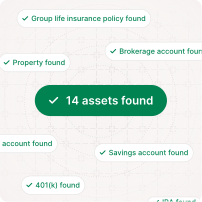
- Verified Asset Search™, which searches across financial sources to surface accounts, lost insurance policies, unclaimed property, and assets families may not know exist
- Survivor benefit identification, surfacing Social Security, pension, VA, and union benefit eligibility
- SECURE Act 2.0 deadline tracking for inherited retirement accounts, flagging mandatory annual RMD requirements and the 25% penalty for missed distributions
- Subscription and recurring-charge cancellation
- A shared dashboard where co-executors, family members, and attorneys work from one organized record
For families where the executor is also a beneficiary, that shared, auditable record supports transparent fiduciary administration and helps reduce the risk of disputes. Elayne is billed as an eligible estate expense, reimbursable from estate funds once an estate account is in place.
FAQ
How does inheritance work without a will?
When someone dies without a will, state intestate succession laws determine who inherits. Most states follow a priority order starting with the surviving spouse, then children, parents, and siblings, with the court appointing an administrator to manage the process. Bank accounts titled solely in the decedent's name and real property both go through probate before heirs can access them, and the rules differ meaningfully by state.
What is the difference between probate and non-probate assets?
Probate assets are those owned solely in the decedent's name with no beneficiary designation. They pass through a court-supervised process before heirs can receive them. Non-probate assets—such as retirement accounts with a named beneficiary, life insurance policies, accounts with payable-on-death designations, and assets in a trust—transfer directly to the named recipient without court involvement. A single estate can include both types of assets.
Does a will override a beneficiary designation?
No. A beneficiary designation on a retirement account, life insurance policy, or bank account with a payable-on-death designation controls who receives that asset, regardless of what a will says. If a will names one person and the account lists another, the account goes to the person named on the account.
How does inheritance work when married?
Marriage does not automatically mean a surviving spouse inherits everything. The outcome depends on factors such as whether a will exists, how assets were titled, and which state the couple lived in. Community property states treat assets acquired during marriage as equally owned by both spouses. Common law states assign ownership based on whose name is on the title, though a surviving spouse typically has a right to a minimum share. Assets that one spouse inherited separately can become marital property if they are commingled—for example, deposited into a joint account.
What is a stepped-up basis and why does it matter for inherited assets?
When someone inherits an asset, its cost basis is generally reset to the fair market value on the date of the original owner's death. This is called a stepped-up basis. If the heir later sells the asset, capital gains tax applies only to appreciation that occurred after the date of death, not to gains that built up during the original owner's lifetime. For assets that appreciated significantly over many years, the stepped-up basis can reduce the taxable gain substantially.
What are the rules for inheriting a retirement account?
Most non-spouse beneficiaries who inherit an IRA or 401(k) must withdraw the full account balance within 10 years of the original owner's death. Starting in 2026, annual required minimum distributions are also required within that 10-year window. Missing a required distribution triggers a 25% penalty on the amount that should have been withdrawn. Surviving spouses have more options: they can roll the account into their own IRA or treat it as their own, which affects when distributions must begin.
*Disclaimer: This article is for informational purposes only and does not provide legal, medical, financial, or tax advice. Please consult with a licensed professional to address your specific situation.







.svg)