

When settling an estate in Connecticut, executors and family members often file a series of forms with the Probate Court to open the estate, account for assets, and close the matter. The form required depends on the type of proceeding and the stage of the process. This guide covers information about key Connecticut probate forms that families and executors often need, including: how forms are numbered, where to find them for free, the core decedent estate forms, small estate options, estate tax returns, and how to find the right probate district.
Key Takeaways
- Connecticut probate forms use a "PC" prefix and are free to download at ctprobate.gov.
- A full estate follows a set sequence: PC-200 opens it, PC-440 inventories assets, PC-246 reports activity.
- Small estates with no solely owned real estate and personal property under $40,000 can use PC-212 to skip formal probate.
- Elayne organizes estate records and searches for accounts and unclaimed property so that inventory and accounting can start from a more complete picture.
Connecticut Probate Forms and How They Are Numbered
Every Connecticut probate form carries a "PC" prefix, short for Probate Court. The numbering is connected to different categories, so each type of matter falls into its own series, with forms running in the order you would use them. The Connecticut Probate Courts form list groups them this way:
- PC-100 series: general matters
- PC-200 series: decedent's estates
- PC-300 series: conservatorship
- Higher series: Fiduciary and other categories
The official versions are downloadable PDFs on ctprobate.gov, each carrying a QR code that links to related information.
{{blog-cta-financial}}
The Core Decedent's Estate Forms That Are Often Needed
| Form | Name | Purpose |
|---|---|---|
| PC-200 | Petition/Administration or Probate of Will | Opens the estate and asks the court to admit a will or appoint an administrator |
| PC-171 | Acceptance of Fiduciary Appointment | The fiduciary formally accepts the role |
| PC-440 | Inventory | Lists estate assets and their date-of-death values |
| PC-246 | Financial Report/Account | Reports receipts, disbursements, and distributions |
| PC-212 | Affidavit in Lieu of Administration | Settles a qualifying small estate without full probate |
PC-200: Opening the Estate and Petitioning to Probate a Will
The PC-200 opens most decedent's estate matters in Connecticut. It asks the court to admit a will to probate or appoint an administrator when there is no will. The proposed executor or administrator usually files it.
The form collects the decedent's information, the names and contact details of heirs and beneficiaries, and a description of the estate. It is filed in the probate court district where the decedent lived. A PC-200CI Confidential Information sheet accompanies it.
Estate Inventory and Financial Report
PC-440 lists everything the estate owns and its value as of the date of death: real property, accounts, vehicles, personal property, compiled into a probate estate inventory that must be filed with the court.
PC-246 is the financial report. It records activity over time: money that came in, debts and expenses paid, and what was distributed to beneficiaries. The inventory shows what existed at death; PC-246 shows what happened afterward. It often serves as the final accounting before closing probate and wrapping up the estate.
Small Estate Forms: The Affidavit in Lieu of Administration (PC-212)
Connecticut lets qualifying small estates skip formal probate through a process known as using a small estate affidavit. Under C.G.S. section 45a-273, the PC-212 affidavit applies only when the decedent owned no solely owned real estate and personal property does not exceed $40,000.
Filed where the decedent lived, it allows funeral and administration expenses and valid claims to be paid, with anything left going to heirs. A death certificate with the Social Security number redacted is required, along with PC-212A when assets exceed claims, and the PC-212CI Confidential Information Sheet.
When the decedent received state aid, the court waits 30 days after notifying the Department of Administrative Services before issuing its decree.
Connecticut Estate Tax Forms: CT-706 NT and CT-706/709
Every Connecticut estate is required to file a return within six months of death, even when no tax is owed. The form depends on whether the estate is taxable. These come from the Department of Revenue Services, not the Probate Court forms library, and the return is often required before the court allows final distributions.
{{blog-cta-financial}}
Finding Your Probate District and Looking Up a Case
Connecticut probate jurisdiction is based on the town where the decedent lived. A death in Norwalk, Bristol, or Trumbull goes to the probate court serving that town. Each town maps to one specific district, and that district handles the full scope of estate administration for that matter. The Connecticut Probate Courts directory maps every town to its corresponding district. Case status and filings are available through the court that holds the matter.
How Elayne Helps Families Organize the Estate Behind the Forms
Filing probate forms with the court is only part of settling an estate. Before an executor can complete the PC-440 inventory or the PC-246 financial account, they need a clear picture of what the estate actually holds. That is where Elayne comes in.
Elayne organizes the estate into one structured record. Every asset, account, document, and open question is located in one place, so the executor and any family members involved in the settlement process are always working from the same information.
What Verified Asset Search Does
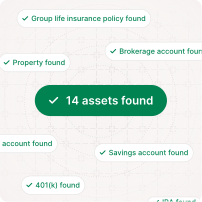
One of Elayne's core capabilities is Verified Asset Search. Here's what it looks for across different areas:
- Real property and deeds: property records tied to the decedent's name
- Life insurance policies: searched through the NAIC life insurance policy locator
- Unclaimed and state property: dormant bank accounts, uncashed checks, savings bonds, and assets held by state agencies
- Vehicle and vessel records: titled property the decedent owned
- Credit bureau trade lines: a pull from all three major bureaus (Equifax, Experian, and TransUnion) to help surface outstanding debts that need to be accounted for
- Recurring payment accounts: active subscriptions and recurring charges that may still be drawing from estate funds
Elayne also analyzes documents the family already has, such as tax returns and bank statements, to identify financial institutions that held accounts or paid income to the decedent. This document analysis can surface accounts that do not appear in any public database.
Why This Matters for PC-440 and PC-246
The PC-440 inventory requires the executor to list everything the estate owns as of the date of death. A search that misses an old brokerage account, an unclaimed insurance policy, or a piece of property means the inventory is incomplete. The PC-246 financial account tracks what came in, what went out, and what was distributed. Debts found through the credit bureau search need to be paid from estate funds before distributions can be made. Recurring charges that keep billing after death reduce the estate's value if they are not caught and stopped.
One Shared Record for Everyone Involved
Estate administration often involves more than one person. A spouse, an adult child, and an attorney may all need access to the same documents and account information. Elayne gives authorized family members and advisors a shared workspace where documents, records, and progress are visible to everyone who needs access.
FAQ
What CT probate forms do you need to open and close a decedent's estate?
Many Connecticut estates move through four core forms: PC-200 to open the estate and petition to probate the will, PC-171 for the fiduciary to accept appointment, PC-440 for the inventory of assets at date-of-death values, and PC-246 for the financial account before the estate closes. All are free to download as PDFs from ctprobate.gov.
What is the difference between CT probate form PC-440 and PC-246?
PC-440 is the inventory, which is a snapshot of everything the estate owned at the date of death and its value at that moment. PC-246 is the financial account, which records what happened afterward: money received, debts and expenses paid, and distributions made to beneficiaries. The inventory is filed early in the process and PC-246 near the end as the final accounting before the court closes the estate.
Does every Connecticut estate have to file a tax return even when no tax is owed?
Every Connecticut estate is required to file a return within six months of death, regardless of taxable status. Non-taxable estates file the CT-706 NT with the Probate Court; taxable estates file the CT-706/709 with the Department of Revenue Services.
Can a Connecticut estate skip formal probate if the assets are small?
A qualifying estate can use the PC-212 Affidavit in Lieu of Administration instead of full probate, but only when the decedent owned no solely owned real estate and personal property does not exceed $40,000.
Which CT probate court handles a specific estate?
In Connecticut, the probate court that handles an estate is determined by the town where the decedent lived. Each town is assigned to a specific probate district. The Connecticut Probate Courts directory lists every town and the district it belongs to. Once the correct district is identified, case status and filings can be checked directly with that court.
*Disclaimer: This article is for informational purposes only and does not provide legal, medical, financial, or tax advice. Please consult with a licensed professional to address your specific situation.










.svg)