

If you are named executor or suddenly handling an estate, you may be wondering what a probate attorney does and whether you truly need one. Some estates move through simple procedures with little legal help, while others benefit from someone who knows the court system and your state’s rules inside and out. This guide walks through when hiring an attorney makes sense, how they charge, and what you can often handle on your own when the estate is smaller and everyone agrees on the plan.
Key Takeaways:
- Probate attorneys guide families through court filings, debt payment, and asset distribution after a death.
- You are more likely to need one if the estate has disputes, multiple properties, no will, or complex business assets.
- Costs often fall somewhere between about 200 and 500 dollars per hour. Some states use a graduated percentage of estate value instead, and fees are typically paid from the estate before heirs receive anything.
- Many estates complete probate in roughly 6 to 12 months; simpler cases can be quicker, while complex ones may take longer.
- Elayne reduces the hundreds of hours of paperwork families often face, handling notifications and deadlines so you can focus on your people.
What Is a Probate Attorney?
A probate attorney helps families and executors manage the legal process of settling a person’s estate after death. Their work usually includes preparing and filing court forms, validating the will, helping you understand creditor claims, paying approved debts, and guiding the distribution of assets to heirs.
This is different from an estate planning attorney, who drafts wills, trusts, and powers of attorney while someone is still living. Once a death occurs, the planning phase gives way to the settlement phase. At that point, a probate attorney focuses on what needs to happen under your state’s rules.
Some lawyers handle both planning and settlement, but their work changes depending on timing. After a loss, you want someone with recent experience closing estates in the court where you will file.
When Do You Need a Probate Attorney?
Not every estate needs formal probate or ongoing legal help. Certain situations, though, make legal support much safer and more practical.
You may need a probate attorney if:
- A family member contests the will or disputes the division of assets.
- The estate includes real estate in more than one state, each with its own probate rules.
- There is no valid will, so state law determines who inherits.
- The estate holds business interests, high levels of debt, or complicated tax issues.
- You are named executor but feel unsure about your responsibilities or the legal steps.
If the estate is smaller, assets are straightforward, and family members agree on what should happen, you may be able to complete much of the process yourself or with limited legal review.
{{blog-cta-legal}}
What Does a Probate Attorney Do?
A probate attorney handles many of the legal and administrative steps the court expects from an executor or administrator.
They often:
- Prepare and file the initial petition to open the estate.
- Notify heirs, beneficiaries, and creditors as required.
- Submit the will for validation, or ask the court to appoint an administrator if there is no will.
- Help inventory and value estate assets, from bank accounts and investments to real estate and personal property.
- Coordinate communications with beneficiaries and help resolve disputes.
- Guide payment of final bills and debts, file last income tax returns, and advise on any estate tax issues.
- Help distribute the remaining assets to heirs according to the will or state law, and then close the estate with the court.
Their support can range from answering occasional questions to handling almost all court‑related tasks.
Understanding Probate Attorney Costs
Probate attorney fees vary based on where you live, how complex the estate is, and how the lawyer structures their pricing. These are common patterns versus hard rules.
- Hourly rates often fall somewhere between about 200 and 500 dollars, and probate attorney hourly rates in 2026 vary by region and experience. You pay for the actual time spent on your case, including court work, calls, and document preparation.
- Flat fees can cover a standard probate from start to finish for a single amount, which is helpful when the estate is straightforward. Typical flat fees range from the low thousands to around five figures, depending on the estate and region.
- Percentage‑based fees tie compensation to the estate’s value. California, for example, sets ordinary attorney fees on a graduated statutory schedule that starts at 4 percent of the first $100,000 and steps down as the estate grows.
- Hybrid or retainer models combine an upfront payment with hourly billing that draws down that amount.
Ask any attorney you interview to explain:
- How do they bill?
- What is included in the quoted fee?
- When will you be updated if costs start to exceed the initial estimate?
| Fee Structure | Typical Cost Range | How It Works | Best For | Potential Drawbacks |
|---|---|---|---|---|
| Hourly Rate | $200 to $500 per hour | You pay for every hour the attorney spends on your case, including court appearances, phone calls, document preparation, and correspondence with beneficiaries or creditors. | Estates with unpredictable complexity, contested wills, or situations where the scope of work is unclear at the start. | Costs can add up quickly if disputes arise or the estate takes longer than expected. The final bill may be difficult to predict upfront. |
| Flat Fee | $3,000 to $10,000, depending on estate size and complexity | A single fixed price covers all standard probate services from start to finish. You know the total cost before work begins. | Straightforward estates with clear assets, no disputes, and cooperative beneficiaries. Offers predictable budgeting. | May not cover unexpected complications. Additional charges may apply if disputes arise or extra court appearances are needed. |
| Percentage of Estate Value | Graduated tiers, such as 4% down to 1% in California | Attorney fees are calculated as a percentage of the total estate value before debts are paid. Common in California and a few other states with statutory fee schedules. | Larger estates in states that use statutory schedules. Provides clarity since the percentage is set by law. | Can be expensive for high-value estates. Applying California's statutory tiers to a $500,000 estate gives $13,000 for ordinary attorney services, regardless of actual work required. |
| Hybrid or Retainer | Initial retainer of $2,000 to $5,000, then hourly billing | You pay an upfront retainer that the attorney draws from at their hourly rate. Additional fees apply if the retainer is exhausted. | Estates where the initial scope is clear, but complications may happen. Balances predictability with flexibility. | You may need to replenish the retainer if the work exceeds the initial estimate. Requires monitoring of hours spent. |
Probate Costs by State
Probate rules and probate costs by state vary widely.
- Some states use statutory fee schedules that base attorney pay on the estate’s value. In California, for example, probate fees follow a graduated percentage of the gross estate. Applying the statutory tiers to a $500,000 estate gives $13,000 for ordinary attorney services.
- States such as Texas and Florida more often allow hourly or flat‑fee arrangements, which can be helpful for simpler estates but may become more expensive if disputes arise.
- States including New York, Pennsylvania, and Illinois generally focus on “reasonable” fees, with courts reviewing amounts when needed.
If you are settling an estate, checking your state’s rules early helps you budget and ask better questions during consultations.
{{blog-cta-legal}}
How Long Does Probate Take?
Most estates complete probate within 6 to 12 months, though the timeline depends on the estate's size and complexity, and a 2026 probate timeline guide walks through the stages.
Faster timelines are more likely when:
- The estate is modest in size.
- There is a clear, valid will.
- Heirs and beneficiaries agree.
- Property and accounts are easy to identify and transfer.
Estates can take longer when:
- There are disputes or contests.
- The estate holds multiple properties or business interests.
- Creditors have longer periods to submit claims.
- Courts in your area are backed up.
Knowing these variables helps you set expectations and reassure other family members along the way.
Who Pays Probate Attorney Fees?
In most cases, probate attorney fees come directly from the estate, not your personal funds. The estate pays these costs before distributing any assets to beneficiaries.
If you're acting as executor, you won't need to cover legal fees yourself. The attorney bills the estate, and you handle payment using estate funds, such as bank accounts or proceeds from asset sales.
Your own compensation as executor also comes from the estate. Many states allow reasonable fees for your time, though family members sometimes choose to waive payment.
During settlement, certain expenses get paid first. Court costs, attorney fees, and debts typically take priority over the inheritance of heirs, following either the will's instructions or state intestacy laws.
Do You Always Need a Probate Attorney?
You do not always need to hire a probate attorney. Some estates are simple enough to move through with limited or no legal representation.
You may be able to manage without an attorney if:
- The estate qualifies for small‑estate procedures. Many states allow simplified procedures when the estate is below a certain value, which ranges from the tens of thousands of dollars to well over 100,000 dollars, depending on local law.
- Most assets pass outside probate, such as life insurance with named beneficiaries, retirement accounts, or jointly owned property.
- All beneficiaries agree, and there are no disputes or unusual debts.
Even then, a brief consultation can still be helpful. A brief review by a local attorney can confirm that your plan complies with state rules and reduce the risk of errors that could delay distributions or cause problems later.
What Changed for Estates in 2026?
Tax rules add a layer to some estates, and 2026 brought a higher federal threshold. For people who die in 2026, the federal estate tax return filing threshold is $15 million, up from $13.99 million for deaths in 2025.
Most estates fall well below that level, so the filings an executor tracks are usually income tax returns. Three returns come up most often:
| Filing | Who It Applies To | Due Date |
|---|---|---|
| Final Form 1040 | The person who died, for the year of death | The usual April filing date in the year after the death |
| Form 1041 estate income tax return | An estate that earns income during administration | By the 15th day of the fourth month after the estate’s tax year ends (April 15 for a calendar-year estate) |
| Form 706 estate tax return | Estates above the $15 million 2026 threshold, or estates electing portability for a surviving spouse | Nine months after the date of death, with a six-month extension available using Form 4768 |
In practice, a modest estate usually involves the first two filings, while an estate near the federal threshold, or one subject to state-level estate or inheritance tax, benefits from a probate attorney working alongside a tax professional. State thresholds are separate and often lower than the federal figure, so checking the state’s rules is its own step.
Finding the Right Probate Attorney for Your Situation
If you decide you may need help, start by looking for attorneys who specialize in probate law in the state where the person lived or where the property is located.
During consultations, you can ask:
- How many probate cases do they handle in a typical year?
- Whether they have worked with estates similar in size and complexity to yours.
- How they structure fees and what is included.
- How you will receive updates and how often.
Pay attention to how clearly they explain things and how you feel after the conversation. You want someone who can answer your questions without making you feel rushed or confused by legal terms.
{{blog-cta-legal}}
A family settling an estate with a home in another county, for example, can confirm the attorney is licensed through the state bar website, ask whether they have filed in that specific probate court, and request a written fee agreement that names the billing method before hiring. This kind of vetting helps the family feel confident in the choice before any work begins.
Planning for Pets in Your Estate
If the estate includes pets, it helps to remember that, under the law, animals are treated as property. They cannot inherit directly.
- A will may name a caretaker for a pet, but the will usually has to go through probate before that gift takes effect. That gap can leave pets without formal support.
- A pet trust can set aside money and name someone to manage those funds for the animal’s care. A funded pet trust can take effect immediately upon the owner’s death because it does not pass through probate, and it can include instructions about food, medical care, and living arrangements.
- When no plan exists, family members may need to arrange temporary care while the estate moves forward.
Planning for pets early in the process avoids last‑minute scrambling and gives everyone peace of mind.

How Elayne Simplifies Estate Settlement
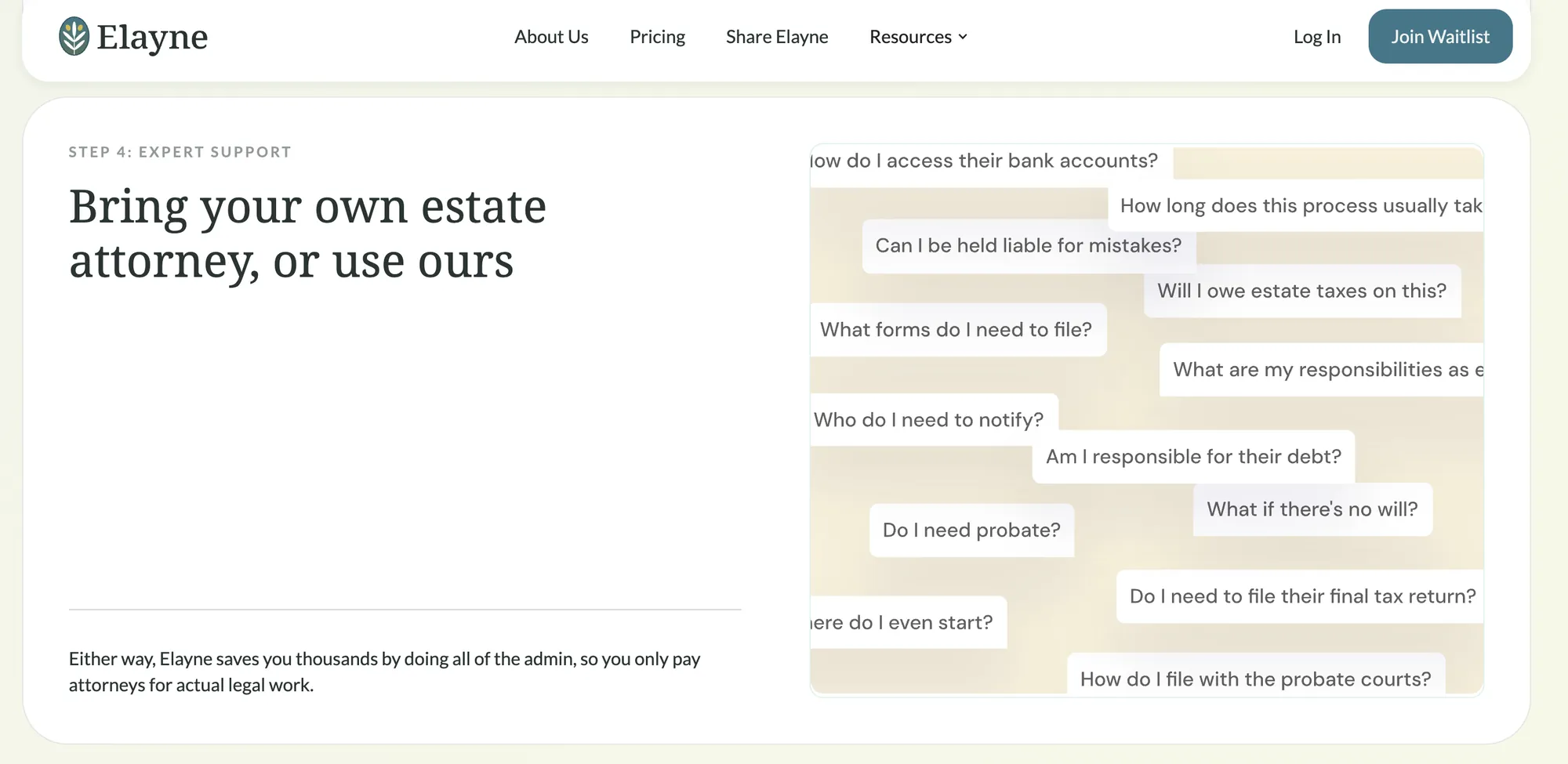
Settling an estate often means dealing with dozens of accounts, agencies, and deadlines while you are already drained by grief. In many cases, the work stretches over a year or more and can add up to hundreds of hours of effort for one family member.
Elayne reduces that burden by supporting many of the practical steps. Elayne helps with:
- Organize information about accounts, policies, and property.
- Prepare and route key notifications to agencies and institutions.
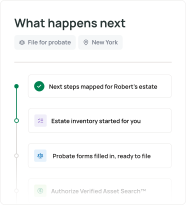
- Track deadlines and steps through a personalized checklist that updates as each step is completed.
- Give executors, relatives, and attorneys a shared dashboard showing what has been done and what is left.
You can still bring in a probate attorney when needed for legal advice or court work, while letting Elayne carry much of the day‑to‑day administrative weight.
Final Thoughts on Probate and Legal Help
Understanding what a probate attorney does, when you might need one, and how fees typically work gives you a clearer starting point during a difficult season. Some estates call for full legal representation from the start; others can move forward with a lighter touch and practical tools.
If you want help with the paperwork and coordination that can stretch on for months, you can see how Elayne works to guide your estate settlement while you focus on your family.
{{blog-cta-legal}}
FAQs
How much does a probate attorney typically cost?
Probate attorney fees depend on your state and estate complexity. You'll see hourly rates between $200 and $500, flat fees for simpler cases, or graduated percentage schedules in states like California, where the rate starts at 4% on the first $100,000 and steps down as the estate grows.
Do I need a probate attorney if the estate is small?
Many states offer simplified procedures for estates valued under $50,000 to $150,000 that don't require an attorney. However, even smaller estates can benefit from legal guidance if there are disputes, unclear ownership, or you're uncertain about your state's requirements.
What are alternatives to hiring a probate attorney?
The right alternative depends on the estate, and several options exist short of full representation. Small estate affidavits, limited-scope legal help such as a one-time consultation, and court self-help centers can each cover simpler situations, while assets with named beneficiaries or joint ownership often pass outside probate. Estates with disputes, property in several states, or tax questions are more likely to need full representation. Elayne helps families organize the estate and prepare for probate, and it works alongside an attorney when a family chooses to bring one in.
When should I hire a probate attorney?
Consider hiring an attorney if someone contests the will, the estate includes property in multiple states, there's no valid will, or the estate holds business interests or tax complications. You may also want one if you're an executor who needs help understanding your legal responsibilities.
Who is responsible for paying probate attorney fees?
The estate itself pays probate attorney fees before distributing assets to beneficiaries. If you're serving as executor, you won't pay these costs from your own funds; they come directly from estate accounts or asset sales, along with court costs and outstanding debts.
Can Elayne replace a probate attorney?
Elayne does not replace legal counsel when a family needs it. Settling an estate can involve hundreds of hours of administrative steps, and this is where Elayne helps, by organizing the estate, preparing paperwork, and tracking deadlines. That gives families clarity and reduces the administrative burden while they work with an attorney on legal matters.







.svg)