
In Texas, money or property in a deceased person’s name may be held by the state as unclaimed property, and families can search for this property for free on ClaimItTexas.gov. Whether a claim can be made depends on the claimant’s authority or entitlement to act for the estate or receive the property. This guide explains key points for families and executors to be aware of, including: how to search ClaimItTexas.gov, who has authority to claim, what documents are required, where else to search, and more.
Key Takeaways
- ClaimItTexas.gov offers free searches by a deceased loved one's name.
- Texas unclaimed property claims are free, with no filing deadline.
- Claims require proof of authority or entitlement. Documents vary by case.
- Approved Texas claims are paid by mailed check, not direct deposit or wire transfer.
- Elayne uses IRS authorization and Equifax to build inventories of assets and debts.
What Is Unclaimed Property in Texas?
Unclaimed property in Texas includes financial assets and safe deposit box contents left without owner contact for a legally set period. Examples include uncashed checks, bank accounts, and insurance proceeds. Businesses and financial institutions must report unclaimed property annually to the Texas Comptroller.
“Abandoned” means the applicable period passed without owner contact or activity. The Comptroller holds reported property without taking legal ownership. Owners or eligible heirs can seek its return.
{{blog-cta-financial}}
How Property Becomes Unclaimed in Texas
After a death, an account may have no further owner activity or contact. Texas counts the waiting period from that last activity or contact, or when payment became payable. Once the applicable period passes without qualifying owner activity or contact, the property is presumed abandoned under Texas law. The business or financial institution holding it is then responsible for reporting it to the Comptroller on the state’s annual reporting schedule, instead of waiting for a family member to request a search.
The Texas abandonment period schedule varies:
| Property | Waiting period |
|---|---|
| Wages | 1 year |
| Most other property | 3 years |
| Safe deposit box contents | 5 years |
| Traveler's checks | 15 years |
Afterward, the holder reports and transfers the unclaimed property to the Texas Comptroller.
How Much Unclaimed Property Does Texas Hold?
Texas currently holds $12.5 billion in unclaimed property, according to CBS News Texas reporting. This is separate from the more than $5 billion already returned to owners over time, shown below.
| Measure | Amount |
|---|---|
| Returned to owners overall | More than $5 billion |
| Returned in fiscal 2024 | Record $422.4 million |
| Claims paid in fiscal 2024 | Nearly 250,000 |
Return figures come from Texas's official search site and the Comptroller's fiscal 2024 announcement. An unclaimed inheritance search can be part of an estate’s account review, but a match is not guaranteed.
How to Search for a Deceased Loved One's Unclaimed Property in Texas
ClaimItTexas.gov is the Texas Comptroller’s official site for a free unclaimed money search by name. Key points to note:
- Searches begin with the deceased person’s last name; a first name narrows results.
- Former names and common misspellings can reveal other matches.
- MissingMoney.com, endorsed by NAUPA, provides free multistate searches for people with ties outside Texas.
The same process works for people searching their own names.
Where Else to Search Beyond Texas
USA.gov’s unclaimed money guide points families to databases by asset type:
- Department of Labor lists unpaid wages.
- Pension Benefit Guaranty Corporation handles unclaimed pensions.
- Department of Veterans Affairs holds unclaimed life insurance funds.
- TreasuryDirect covers U.S. savings bonds.
- Federal Deposit Insurance Corporation covers failed bank deposits.
No single database covers all unclaimed money. IRS refund searches are separate from state unclaimed property searches. Finding the assets of a deceased person often involves reviewing a loved one's financial history to guide which sources families search.
Who Has the Authority to Claim a Deceased Person's Property
Property in a deceased person’s name belongs to the estate. The Texas Comptroller requires proof of authority or entitlement to claim it.
- Letters Testamentary document an executor’s court appointment after a will is probated.
- Letters of Administration document an administrator’s appointment, commonly when there is no will.
- An Affidavit of Heirship may support some heirs’ claims without full probate; acceptance depends on the claim, and locating the deceased person’s Social Security number may be needed to complete certain filings.
The Comptroller determines each claim’s documentation requirements.
What Documents Are Required to Claim Unclaimed Property for a Deceased Person
Documents required for a deceased person’s Texas unclaimed property claim vary by case. The Comptroller’s claim instructions commonly require:
- A certified copy of the death certificate.
- The claimant’s government-issued photo ID.
- Letters Testamentary or Letters of Administration, obtained from the county clerk after appointment through probate.
- In some cases, a probated will.
- In some cases, a Muniment of Title.
- In some cases, an Affidavit of Heirship.
{{blog-cta-financial}}
How Elayne Helps Families Find Accounts Beyond the State Database
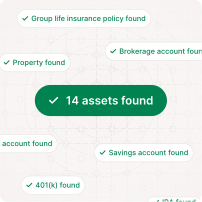
Elayne Asset Search builds an estate inventory of what a person owned and owed at the time of death. The search uses IRS authorization to request the person’s IRS tax transcripts, requests their Equifax credit report, and checks more than 100 other sources.
An IRS tax transcript is not a copy of a tax return. An IRS tax transcript is a record of what banks, employers, insurers, and other institutions reported to the IRS about the person. Elayne requests 10 years of IRS tax transcripts.
Each entry on an IRS tax transcript names the institution that filed the report. A bank that paid interest, a brokerage that reported dividends, and a retirement custodian that reported an account each appear by name. These entries point to accounts the estate may hold, even when no statement from that institution has arrived in the mail.
Employer history on the IRS tax transcripts can point to workplace benefits. A former employer can lead to an old 401(k), a group life insurance policy, or unpaid final wages. These leads can support a search for unclaimed retirement benefits.
The person’s Equifax credit report lists open accounts, credit cards, loans, and other credit lines in the person’s name. Debts appear in the estate inventory alongside assets, so the estate’s obligations are visible before any money is paid out.
The same search also checks these sources:
- The life insurance locators (NAIC and MIB), which show in-force and lapsed policies and insurance application history.
- The pension registry (PBGC), which holds unclaimed pensions from terminated plans.
- The national unclaimed property database (MissingMoney.com), which covers participating states.
- Property and vehicle records, which show real estate and vehicles titled in the person’s name.
- Crypto accounts at major exchanges, when the records point to crypto holdings.
- Veterans benefits and VA life insurance, when the estate record shows military service.
Findings are organized into six categories: retirement accounts, bank and brokerage accounts, life insurance, property, business interests, and debts. Each item in the estate inventory names the source that reported the item, so families and their attorney can review the supporting record. The estate inventory then serves as a working list for settling the estate, one account at a time.
Portions of the search can begin before anyone holds legal authority. Once the court issues Letters Testamentary or Letters of Administration, the appointed executor or administrator has access to the full search. A 1:1 call with an Estate Expert covers the findings.
When the search turns up no new accounts, the results still show whether the estate owes the IRS anything, which debts are open, and a documented record that the search was done. Elayne Asset Search is an eligible estate expense, paid from the estate account or reimbursed by the estate.
FAQ
What does it mean if ClaimItTexas.gov shows no results for a deceased loved one?
A missing result does not mean there are no accounts left to claim; property may still be held by a bank or insurer before it is turned over to Texas. Statements, mail, and tax documents can point to institutions the estate’s authorized representative can contact directly. MissingMoney.com can help with searches in other states where the deceased person had financial ties.
Can the NAIC Life Insurance Policy Locator help if ClaimItTexas.gov has no insurance listing for a loved one?
Yes, the NAIC Life Insurance Policy Locator can help locate a policy before proceeds appear in a state unclaimed property database. ClaimItTexas.gov lists property already reported to Texas, so a negative result does not rule out life insurance. If the insurer’s name is known, contacting its claims department can start the inquiry without waiting for a state listing.
How is a Texas Comptroller unclaimed property listing matched to a deceased loved one?
A matching name is a lead, not proof of ownership. Comparing the reporting company and any location details with the deceased person’s statements or other records can help distinguish people with the same name. The Texas Comptroller reviews supporting documents to verify ownership and the claimant’s authority or entitlement before approving a claim.
Does it cost anything to search for or claim Texas unclaimed property?
Searching ClaimItTexas.gov and filing a claim with the Texas Comptroller are both free, and families can file claims themselves. A third-party finder may charge a fee for help. Texas Property Code § 74.507 limits finder fees to 10% of the value of property recovered, plus reasonable attorney’s fees necessary to pursue the claim.
*Disclaimer: This article is for informational purposes only and does not provide legal, medical, financial, or tax advice. Please consult with a licensed professional to address your specific situation.