
During estate settlement in Florida, families of a person who died with a smaller estate may be able to use a simplified court process instead of full probate. Florida does not have a single small estate affidavit form, so the process that applies depends on what the person left behind and when they died. This guide explains key points for families and executors to be aware of, including: Florida's two simplified options, the new 2026 value limits, who has authority to file, and more.
Key Takeaways
- Florida has no single small estate affidavit form that transfers an entire estate.
- Summary administration's non-exempt cap is $150,000 for deaths on or after July 1, 2026.
- Disposition without administration requires court approval and cannot transfer real estate.
- County probate clerks provide local petition packets and filing requirements.
- Elayne flags potential simplified-estate eligibility; attorneys provide legal advice.
Does Florida Have a Small Estate Affidavit?
Florida has no single small estate affidavit form that transfers an entire estate. Downloadable PDFs serve limited situations, with separate small estate eligibility requirements.
Chapter 735 provides two main alternatives to full probate: disposition without administration and summary administration. These Florida simplified probate options require different paperwork based on the property left behind and the estate’s circumstances.
{{blog-cta-financial}}
Disposition Without Administration
Section 735.301 of the Florida Statutes covers two kinds of requests. A person who paid qualifying final expenses for the person who died can ask to be paid back from the estate's personal property. A surviving spouse can claim exempt property, and when there is no surviving spouse, the children of the person who died can make that claim. Eligible property and expenses include:
- Exempt personal property under §732.402.
- Out-of-pocket funeral expenses up to $6,000.
- Medical expenses from the last 60 days of life.
The court reviews the request; an affidavit alone cannot release assets.
What Counts as Exempt Property in Florida
Exempt property is protected from creditor claims. Under §732.402, qualifying vehicles and household items may include:
- Two cars, subject to statutory conditions.
- Certain household items valued up to $20,000.
These belongings are not automatically exempt. For Florida summary administration, assets exempt from creditors are excluded from the value cap calculation. As a result, an estate’s total property value can exceed the amount counted toward that cap.
Worked example of the value test:
- Estate value: $75,000 in probate assets, assumed for this example.
- Exempt property: none assumed, so the full estate value counts toward the cap.
- Applicable cap: $150,000 in non-exempt property.
- Key date: the example assumes a death on or after July 1, 2026, when the higher summary administration cap applies.
- Consequence: the estate falls below the cap, but all other eligibility requirements still apply.
Meeting the value test alone does not authorize anyone to receive estate assets; a court order is still required.
Who Has Legal Authority to File and What They Can Do
Filing does not grant general authority over estate assets. Eligibility depends on the procedure:
- Disposition without administration: a final-expense payer seeking reimbursement, a surviving spouse, or children if there is no surviving spouse.
- Summary administration: a beneficiary or nominated personal representative may petition. Being an interested person alone is insufficient.
In summary administration, the court’s order authorizes receipt of particular assets, not general estate management, which is one reason the Florida probate process timeline can vary by procedure.
Comparing Florida's Three Probate Paths
| Factor | Disposition without administration | Summary administration | Formal administration |
|---|---|---|---|
| Eligibility | Exempt property; expense limits | Value or time-since-death test | No small-estate ceiling |
| Personal representative | None | None | Appointed |
| Court involvement | Authorization | Distribution order | Ongoing oversight |
| Assets | Limited personal property | Qualifying assets, including real estate | Probate assets needing management |
The choice also depends on whether assets need management before distribution. A will directing formal administration prevents summary administration.
How to File for Disposition Without Administration in Florida
- Final expenses and property are reviewed for eligibility, with reimbursement requests considered separately from exempt-property claims.
- Supporting documents are gathered: a death certificate, receipts for final expenses paid, and proof supporting any exempt-property claim.
- A verified petition, signed under oath, is filed with the probate court in the county where the person lived. Supporting documents are submitted with the petition for court review.
How to File for Summary Administration in Florida
- Non-exempt assets are valued against the applicable summary administration cap.
- The petition identifies beneficiaries and heirs. Required signatures or consents are gathered; those who do not join receive formal notice as required.
- Known creditors are identified, with required notice and provision for payment.
- The petition is filed with the probate court, usually through an attorney.
The court reviews entitlement to assets and creditor treatment before issuing a distribution order.
{{blog-cta-financial}}
How Elayne Supports Families Through Florida's Small Estate Process
Elayne is an online service that supports families through estate settlement, one step at a time. It is offered as 3 tiers after a free start: Estate Setup, Asset Search, and Estate Settlement. Each tier includes everything in the tier before it.
Estate Setup
Estate Setup is for families who do not yet have legal authority, the court paper that lets someone act for the estate. In Florida, that paper depends on the route: letters of administration in formal administration, or a court order in the simplified processes. Estate Setup includes an Estate Expert call, with slots opening within 24 hours, and guided preparation of the court forms for getting legal authority.
Estate Setup also keeps a photo of each receipt in one place, including funeral and final medical expenses. These receipts are among the supporting documents for a disposition without administration request. Other parts of Estate Setup include the deceased notification sent to the credit bureaus, an encrypted document vault, and invites for family members and professionals.
Asset Search
Elayne Asset Search is for families who have, or are about to have, legal authority. Elayne holds IRS authorization to request 10 years of IRS tax transcripts for the person who died. An IRS tax transcript is not a tax return. It shows what banks, employers, insurers, and other institutions reported to the IRS about the person, which points to the accounts they held.
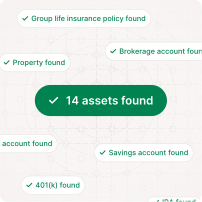
The search also includes the person's Equifax credit report and more than 100 other sources, such as the life insurance locators, the pension registry, the national unclaimed property database, and property and vehicle records. Each finding goes into a source-attributed estate inventory that names the institution that reported it, with debts listed alongside assets.
A Florida summary administration petition involves both the value of non-exempt assets and the estate's known creditors. The estate inventory shows both in one record. Part of the search can run before legal authority is in place, and legal authority unlocks the full search.
Estate Settlement
Estate Settlement is for families ready to handle the estate's money. It includes obtaining the estate's tax ID (EIN), help opening an estate bank account, and working with each bank and company on what it needs to release an account. Transfer forms are pre-filled, the estate account is monitored, and costs with receipts are paid back from estate funds. The final accounting lists every payment and deposit, ready for the court, the attorney, and the people receiving what's left.
Every family starts free. Estate Setup is $500, Asset Search is $3,000, and Estate Settlement is $6,000. Earlier payments count toward later tiers, while court, attorney, and other outside fees are separate. Elayne is an eligible estate expense, paid from the estate or reimbursed by it.
FAQ
Is Elayne Estate Setup enough if a family disagrees about who inherits?
No. Elayne Estate Setup supports paperwork preparation, but an inheritance dispute requires legal advice. A Florida probate attorney can review the will, family relationships, and notice requirements; Elayne can keep documents in a shared estate record with permission-based access.
What is the difference between summary administration and disposition without administration in Florida?
Both are simplified alternatives to formal probate under Chapter 735, and they cover different situations. Disposition without administration is a court-reviewed request involving exempt property and qualifying final expenses, and it cannot transfer real estate. Summary administration uses a petition and a distribution order, and it can cover qualifying assets, including real property, when the estate meets the value or time-since-death test.
Is a personal representative appointed in Florida summary administration?
No. Summary administration does not appoint a personal representative. The court’s order authorizes the receipt of particular assets by the people entitled to them, and it does not grant general authority to manage the estate.
What is the Florida summary administration value cap in 2026?
For deaths on or after July 1, 2026, the cap is $150,000 in non-exempt property. For deaths before that date, the previous $75,000 cap applies, regardless of the filing date. Falling below the cap does not qualify an estate on its own, because the other eligibility requirements still apply.
*Disclaimer: This article is for informational purposes only and does not provide legal, medical, financial, or tax advice. Please consult with a licensed professional to address your specific situation.