

In general, probate attorney fees in 2026 range from $150 to $400 per hour for an estate. Some states set fees by statute, based on the gross value of the estate. Others leave fees open to negotiation. What you pay depends on different factors, including where the estate is, how complex it is, and which billing structure an attorney uses.
Several factors can lead to attorney fees being higher than the baseline rate. Examples of this may include: contested wills and family disputes requiring court appearances and additional legal work. Or, estates with real property in more than one state having to open a separate ancillary probate proceeding in each state, which means additional filings and attorney time.
For context, attorney fees are paid from estate assets, not from any beneficiary's personal funds. The executor draws on the estate account to cover legal costs before making distributions to heirs. In statutory fee states, the attorney fee amount is calculated from the gross estate value, which includes the full market value of real property before subtracting any mortgage balance.
Key Takeaways:
- In general, probate attorney fees in 2026 range from $150 to $400 per hour.
- California and Florida set fees by statute based on gross estate value; a $500,000 California estate will have roughly $13,000 in attorney fees.
- Contested wills, out-of-state property, and missing documents can lead to increased costs.
- Attorney fees are paid from estate assets before distributions.
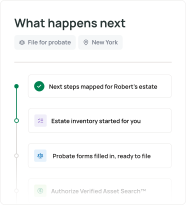
- Elayne works alongside attorneys, managing administrative tasks like account searches and institutional notifications.
How Probate Attorneys Help
A probate attorney guides an estate through the court-supervised process of validating a will, paying debts, and transferring assets to beneficiaries. Their work spans across several distinct areas:
- Preparing and filing the petition to open probate with the court, along with the death certificate, original will, and any supporting documents the jurisdiction requires
- Notifying creditors and beneficiaries within court-mandated deadlines, which vary by state
- Identifying, valuing, and inventorying estate assets, including real property, financial accounts, and personal property
- Handling creditor claims, reviewing which debts are valid, and overseeing payment from estate funds
- Preparing and filing any required estate tax returns at the state or federal level
- Drafting the final accounting and distribution plan, then securing court approval before assets transfer to beneficiaries
Some attorneys take on a limited role, advising the executor on specific steps while the executor handles filings directly. Others manage the process end to end, appearing in court and corresponding with financial institutions on the estate's behalf.
{{blog-cta-legal}}
Fee Structures Probate Attorneys Use
Hourly Billing
Most attorneys bill by the hour, with rates that vary based on geography, experience, and estate complexity. Straightforward estates in lower-cost states may receive rates in the range of $150 to $250 per hour, while attorneys in major metro areas or those handling contested matters may charge $300 to $500 or more.
Percentage-Based Fees
Some states permit attorneys to charge a percentage of the gross estate value. California and Florida, for example, set statutory fee schedules that define what attorneys may collect based on estate size.
Flat Fees
For routine, uncontested probates, some attorneys offer a flat fee covering the full proceeding. This gives families cost predictability, though the scope of what is included varies.
Statutory Fee States
How California's Statutory Fee Schedule Works
California Probate Code sections 10800 and 10810 set fees for both the executor and the attorney on a sliding scale tied to the gross estate value:
| Gross Estate Value | Attorney Fee Rate |
|---|---|
| First $100,000 | 4% |
| Next $100,000 | 3% |
| Next $800,000 | 2% |
| Next $9,000,000 | 1% |
| Next $15,000,000 | 0.5% |
| Above $25,000,000 | Court discretion |
How Florida's Statutory Fee Schedule Works
Florida sets fees under Fla. Stat. § 733.6171 on a percentage basis tied to gross estate value: 3% on the first $40,000, 2.5% on the next $60,000, and 3% on amounts above $100,000. Estates above $3,000,000 are subject to negotiated or court-set fees.
| Gross Estate Value | Attorney Fee Rate |
|---|---|
| First $40,000 | 3% |
| Next $60,000 | 2.5% |
| Above $100,000 | 3% |
| Above $3,000,000 | Negotiated or court-set |
Florida also allows fees for "extraordinary services," which function similarly to California's add-on provisions, and uses gross estate value as the basis for calculation, not the net value after debts or mortgages. Both states use gross estate value, not net value, as the basis for calculation.
Probate Attorney Cost Comparison by State
Probate attorney costs vary considerably from state to state, shaped by local court fees, attorney fee structures, and how each state's probate laws govern compensation.
Some states set statutory fees for probate attorneys, meaning the law defines exactly what an attorney can charge based on a percentage of the estate's gross value. Other states leave fees entirely to negotiation between the attorney and the estate.
Statutory Fee States vs. Negotiated Fee States
In statutory fee states, attorney compensation follows a fixed schedule. California, for example, sets fees at 4% of the first $100,000, 3% of the next $100,000, 2% of the next $800,000, and so on. Florida uses a similar percentage-based structure.
In negotiated fee states, hourly rates and flat fees are common. Rates in these states typically range from $150 to $350 per hour, though complex estates in high-cost markets can push rates well above that.
Beyond Attorney Fees: Other Probate Costs
- Probate costs including court filing fees are typically $200 to $500, varying by state and county.
- Executor compensation falls between 1% to 5% of the estate under most state laws, though family members frequently waive this.
- Professional appraisals are required for real property, business interests, and certain personal property to determine date-of-death values.
- Surety bond premiums range from $500 to $1,500 annually unless the will explicitly waives the requirement.
- Accountant fees cover the final personal income return and any estate income tax filings.
{{blog-cta-legal}}
Who Pays Probate Attorney Fees
Fees are paid from estate assets in most states, not from the executor's or any beneficiary's personal accounts. The executor draws on estate funds to cover legal costs before distributions go to heirs.
How Elayne Supports Families and Legal Teams
Elayne supports families and legal teams by handling estate administration tasks: searching for accounts and assets, notifying financial institutions, and helping coordinate the administrative steps that follow a death.
What Elayne Handles
Elayne searches for financial accounts, insurance policies, real property records, unclaimed assets, and eligible survivor benefits through its Verified Asset Search. The search runs across databases, document records, and financial records to surface accounts and assets that might otherwise be missed.
Once accounts are identified, Elayne notifies financial institutions directly. This includes banks, brokerage firms, and retirement account custodians, each of which has its own documentation requirements and timelines.
Elayne also scans financial records for recurring charges: streaming subscriptions, gym memberships, software plans, and other accounts. Elayne manages cancellation with each provider directly and monitors subsequent statements to confirm charges have stopped.
A Shared View of the Estate
Elayne's shared dashboard gives authorized family members, co-executors, and attorneys access to documents, account records, and progress tracking in one place. For dual-role executors who serve as both executor and beneficiary, the dashboard also functions as a documented record of decisions made.
FAQs
What is the average cost of working with a probate attorney in 2026, and what does the service include?
Most probate attorneys charge between $150 and $400 per hour in 2026, with total fees for a straightforward estate typically falling in the $3,000 to $15,000 range. A straightforward estate generally means one with a clear will, a modest number of assets, no disputes among heirs, and no real property in more than one state.
That figure covers court filings, creditor notification, asset inventory, and the final distribution accounting. Contested matters, out-of-state property, or tax complications can push total costs well above the range referenced above, sometimes into $20,000 to $30,000 territory or higher for large or complex estates.
Are probate attorney fees negotiable?
In states that don't set fees by statute, rates and billing structures are open to discussion. Flat fees, limited-scope arrangements, and hybrid models can be discussed during an initial consultation. In statutory fee states, the schedule is set by law, though extraordinary fee add-ons may have some room for negotiation.
How do California and Florida probate attorney fees compare to negotiated-fee states like Texas or New York?
California and Florida set attorney fees by statute as a percentage of the gross estate value, so a $500,000 estate in California amounts to roughly $13,000 in attorney fees before any extraordinary charges. Texas and New York leave fees to negotiation, where hourly rates of $150 to $350 are typical.
What drives probate attorney fees higher than the baseline hourly rate?
Contested wills, family disputes, and estates with out-of-state real property are common reasons for increased costs.
Who pays probate attorney fees?
Fees are paid from estate assets in most states, not from any beneficiary's personal funds.
*Disclaimer: This article is for informational purposes only and does not provide legal, medical, financial, or tax advice. Please consult with a licensed professional to address your specific situation.










.svg)