.webp)

When a private-sector employer shuts down or goes bankrupt, the pension plans it sponsored don't simply disappear. A federal agency called the Pension Benefit Guaranty Corporation (PBGC) steps in, takes over those plans, and holds the money until participants or their families come forward to claim it. For estate settlement, if a decedent held a private-sector job during their career, a PBGC search is worth running. The search is free, and requires only the decedent's last name and the last four digits of their Social Security number.
Key Takeaways
- You can search pbgc.gov for free using the decedent's last name and last four SSN digits.
- Roughly 80,000 workers had unclaimed PBGC benefits as of 2026.
- A will does not control PBGC beneficiary designations; whoever is named on file with PBGC receives the benefit.
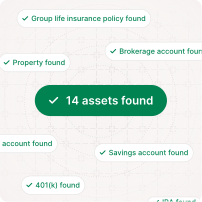
- Elayne's Verified Asset Search covers PBGC and 100+ financial sources as part of a single benefit discovery process.
What the PBGC Is and What Plans It Covers
The Pension Benefit Guaranty Corporation is a federal agency that insures private-sector defined benefit pension plans. When a covered plan terminates without enough money to pay promised benefits, the PBGC steps in and takes over payment responsibility directly.
These are traditional pension plans that promise a specific monthly payment at retirement, calculated from factors like years of service and salary history. They are distinct from 401(k)s and defined contribution plans, which PBGC does not insure.
PBGC coverage is also limited to private-sector employers. Several common plan types fall entirely outside its scope:
- Federal government pensions (Civil Service, FERS, CSRS)
- Military retirement benefits
- State and local government pensions
- Church plans
- Most plans covering only business owners or partners
{{blog-cta-financial}}
How to Search the PBGC Unclaimed Benefits Database
The PBGC maintains a free searchable database. It can be used by those with permission to access the decedent's identifying information.
To run a search, you need two pieces of information:
- The decedent's last name
- The last four digits of their Social Security number
How to Run the Search
The unclaimed pension search tool is available at pbgc.gov. The search field accepts the decedent's last name as it would appear on employment records, along with the last four digits of their Social Security number. Any matching records across PBGC's database of participants in terminated or trusteed plans are returned.
A few aspects of the search to note:
- The database updates quarterly, so a plan that terminated recently may not yet appear in results
- The search is exact-match on name, meaning a maiden name or hyphenated surname used at any point in the decedent's career would require a separate search for each variation
- Only the last four SSN digits are required, which helps limit exposure of sensitive information during the search
What a Result Actually Means
A positive result means the PBGC has a record of a benefit associated with that individual and has not yet made contact or confirmed payment. The next steps involve contacting PBGC directly to identify the plan, confirm the decedent's identity, and determine whether a survivor benefit applies.
A negative result could mean: no covered plan exists for that individual, the benefit was already claimed, or that the plan has not yet been processed into the database.
The PBGC Missing Participants Program Explained
When a retirement plan terminates, administrators must account for every participant, including those they cannot locate. For PBGC-insured single-employer and multiemployer defined benefit plans, transferring missing participants to the Missing Participants Program is mandatory. Defined contribution plans like 401(k)s can participate voluntarily if they terminated on or after January 1, 2018, when the program expanded beyond traditional pensions.
Funds transferred through the program are not frozen. They grow at the federal mid-term rate while held, so a benefit that sat unclaimed for years may be worth more than the original plan statement indicated.
The PBGC Trusteed Plans Search and Insured Plans Search
The PBGC unclaimed benefits database is not the only place to search. PBGC maintains two additional searchable directories that executors can check.
The Trusteed Plans search lists every plan PBGC has taken over as trustee following a distress or involuntary termination. If the decedent's former employer went through bankruptcy or shut down with an underfunded plan, PBGC likely became trustee and now pays benefits directly. You can search this directory by employer name. A match confirms PBGC controls the plan and is the right contact for any survivor benefit claim.
The Insured Plans search covers plans that are still ongoing but insured by PBGC. If a plan appears here, it has not yet terminated, meaning the plan administrator handles benefit payments and participant records, not PBGC. In that case, you can contact the plan administrator directly using the employer information listed.
| Search | What It Covers | How to Search | Who Handles Payments |
|---|---|---|---|
| Unclaimed Benefits | Benefits PBGC holds for participants it has not yet contacted or confirmed payment for | Last name + last 4 SSN digits at pbgc.gov | PBGC |
| Trusteed Plans | Plans PBGC took over as trustee after a distress or involuntary termination (e.g., employer bankruptcy) | Employer name at pbgc.gov | PBGC |
| Insured Plans | Active plans still insured by PBGC that have not yet terminated | Employer name at pbgc.gov | Plan administrator |
What to Do When the Decedent Appears in the Database
To move forward, you can call PBGC directly at 1-800-400-7242 and identify yourself as the executor or personal representative of the decedent's estate.
Having the following ready before the call is helpful:
- The decedent's full legal name and Social Security number
- A copy of the death certificate
- Your Letters Testamentary or other court-issued authority document
- Your own government-issued ID
PBGC will use these to verify the decedent's identity and confirm your legal authority to act on behalf of the estate. Without documented authority, PBGC cannot release account or plan information to you, regardless of your relationship to the decedent. After the call, PBGC typically mails correspondence to the executor's location of record. Response times vary, but follow-up letters generally arrive within a few weeks. If you do not hear back, you can call again with your case reference number. Once identity and authority are confirmed, PBGC can help clarify the benefit amount, any applicable survivor benefit options, and what forms are needed to start payment.
{{blog-cta-financial}}
How Executors Report a Death and Claim Survivor Benefits
When a PBGC-covered participant dies, two separate questions arise: whether the estate is owed any unpaid benefit payments, and whether a survivor benefit is payable to a named beneficiary. The answer to both depends on the annuity form the decedent elected when benefits began.
PBGC will request the death certificate, Letters Testamentary or a court appointment order, and the participant's Social Security number. Once submitted, PBGC reviews the participant's file to confirm the elected annuity option.
There are two common outcomes depending on what the decedent chose:
- A single-life annuity ends at death with no survivor benefit payable to the estate or any beneficiary.
- A joint-and-survivor annuity continues payments to the named surviving beneficiary after the participant's death.
Any payments issued after the date of death but before PBGC was notified may need to be returned.
How Elayne Supports Pension and Benefit Discovery During Estate Settlement
Elayne's Verified Asset Search reaches across 100+ financial sources, covering unclaimed property databases and PBGC as part of a single credentialed discovery process. Survivor benefits, including Social Security, pension, and veterans' benefits, are surfaced through a structured identification step so the executor does not need to locate them independently. A shared dashboard keeps co-executors, attorneys, and family members aligned on what has been confirmed and what still needs follow-up. For estates that include inherited retirement accounts, Elayne also tracks inherited IRA distribution rules and SECURE Act 2.0 distribution deadlines and mandatory annual RMD requirements.
FAQ
How do I search the PBGC unclaimed pensions database for a decedent's benefits as an executor?
The PBGC unclaimed pensions database accepts the decedent's last name and the last four digits of their Social Security number. Because the search is exact-match on name, maiden names or hyphenated surnames used at any point in the decedent's career each require a separate search, since name variations will return different results.
What is the National Registry of Unclaimed Retirement Benefits?
The National Registry of Unclaimed Retirement Benefits is a free, voluntary registry where employers register former employees who left without claiming 401(k) or pension benefits.
How to find a deceased parent's unclaimed pension and retirement benefits in 2026?
The PBGC unclaimed pensions database is a helpful resource for defined benefit pensions, as are the National Registry of Unclaimed Retirement Benefits and every state unclaimed property database.
What happens to a PBGC pension benefit if the decedent elected a single-life annuity?
A single-life annuity ends at the participant's death with no survivor benefit payable to the estate or any named beneficiary. Only a joint-and-survivor annuity continues payments after death, and those payments go to whoever is on file with PBGC, not to whoever is named in the will, since PBGC beneficiary designations are governed entirely by plan records and are not controlled by a court-admitted will.
*Disclaimer: This article is for informational purposes only and does not provide legal, medical, financial, or tax advice. Please consult with a licensed professional to address your specific situation.









.svg)