

During probate, a personal representative has a fiduciary duty to identify every asset the decedent owned. This article explains key points for probate attorneys and personal representatives using IRS records in an estate asset search to be aware of, including: how to request transcripts, which transcript types are especially useful, what other sources a complete search requires, and more.
Key Takeaways
- IRS wage and income transcripts map every institution that reported income to the IRS against a decedent's SSN, across three years of returns.
- Form 4506-T is filed at no cost; tax professionals with e-Services access can pull transcripts the same session through the IRS Transcript Delivery System.
- The NAIC Life Insurance Policy Locator has connected consumers with over $16 billion in unclaimed benefits since 2016 and is free to use.
- A defensible diligent-search record logs each source queried, the date, and the outcome, including searches that returned nothing.
- Elayne handles the asset search across 100+ financial sources and organizes findings in a source-linked record for attorney review.
What IRS Records Reveal About an Estate
A decedent's tax transcripts are among the most information-dense documents an estate search can access.
Wage and income transcripts aggregate every information return filed against a taxpayer's Social Security number for a given year. Every 1099-INT from a bank, every 1099-DIV from a brokerage, every 1099-R from a retirement account custodian, and every W-2 from an employer appears in one place. Each issuer named on the transcript is a financial institution worth contacting.
No other single source provides the same breadth, though a fuller set of asset discovery tools after a death rounds out the picture more fully. Bank records show one institution. Credit bureau pulls show debt. The IRS transcript maps income relationships across every institution that filed a return against the decedent's SSN, which is why it functions as a strong starting map.
{{blog-cta-financial}}
How to Request a Decedent's Tax Transcripts from the IRS
Before IRS records are released, the personal representative must confirm legal authority. The required documentation includes the decedent's full name, last known mailing on file, and Social Security number; a copy of the death certificate; and either Letters Testamentary approved by the court or Form 56 (Notice Concerning Fiduciary Relationship) with any court-issued letters.
With authority confirmed, the personal representative submits Form 4506-T. It covers wage and income transcripts, tax return transcripts, tax account transcripts, and records of account.
Registered tax professionals with e-Services access can pull transcripts directly through the IRS Transcript Delivery System instead. Mailed Form 4506-T requests can take several weeks; TDS returns results the same session.
Which Transcript Types Are Most Useful for Asset Discovery
The wage and income transcript is often the first request on any estate matter. It covers income-generating accounts across all institutions that filed information returns for the year, without requiring the family to identify those institutions first. Three years of wage and income transcripts can give a reliable picture of active financial relationships.
| Transcript Type | What It Contains | Asset Discovery Value |
|---|---|---|
| Wage and Income | All third-party information returns (1099-INT, 1099-DIV, 1099-R, W-2) filed against the SSN | Highest. Maps every institution that reported income to the IRS. |
| Tax Return | Line-by-line copy of the filed return (1040) | High. Schedule B surfaces interest and dividend payers; Schedule E flags rental property and partnership interests. |
| Tax Account | Filing history, payments, adjustments, penalties | Moderate. Confirms whether a return was filed and flags outstanding balances the estate may owe. |
| Record of Account | Combined tax return and tax account data | Useful when both filing content and account standing are needed in a single pull. |
Asset Categories a Complete Estate Search Should Cover
Transcripts identify income-generating relationships; they do not confirm asset titles, policy beneficiaries, or dormant accounts that stopped paying interest years ago.
Categories worth investigating:
- Financial accounts: checking, savings, money market, CDs, and brokerage accounts at banks, credit unions, and investment firms
- Retirement accounts: IRAs, 401(k)s, 403(b)s, and pension interests
- Real property: primary residence, vacation property, rental units, undivided interests in inherited land, and mineral rights
- Titled personal property: vehicles, boats, aircraft, and trailers registered with state motor vehicle agencies
- Life insurance policies: individual, group, employer-sponsored, and credit life policies
- Business interests: sole proprietorships, partnership interests, LLC membership interests, S-corp shares, and closely held stock
- Unclaimed and dormant property: accounts escheated to state agencies after years of inactivity
- Digital assets: cryptocurrency wallets, online brokerage accounts, PayPal or Venmo balances, domain names, and monetized content accounts
IRS transcripts surface financial accounts and business interests reliably. Real property requires a deed search. Titled assets require state DMV records. Life insurance requires its own search process, and unclaimed property requires state registry queries.
Life Insurance Policies
The NAIC Life Insurance Policy Locator has matched billions in unclaimed benefits since its launch. The tool is free, and participating insurers search their records against submitted information and respond directly if a match is found. It requires the decedent's full name, date of birth, Social Security number, and the submitter's contact information. Insurers have up to 90 business days to respond.
IRS wage and income transcripts work alongside the locator. A transcript may show a 1099-R from an insurance company that administered an annuity or managed a cash-value policy, giving the personal representative a carrier name to contact directly. The locator can reach policies that never generated taxable income; transcripts surface insurance relationships that did.
Unclaimed Property Searches and State Registries
After a period of inactivity, financial institutions and insurers are required by state law to remit funds to the state as unclaimed property. The state then holds them, indefinitely in most cases, until a rightful claimant comes forward.
Every state maintains a searchable unclaimed property database. The multi-state aggregator Unclaimed.org lets a personal representative run a single search across participating states, though state databases update on different schedules and some states are not fully represented there.
The search should cover every state where the decedent lived or held accounts. A decedent who retired to Florida after working in Ohio for thirty years may have dormant accounts sitting in both registries.
Each state has its own escheat timeline, typically three to five years of inactivity before remittance is required.
{{blog-cta-financial}}
How Elayne Supports the Attorney's Estate Asset Search
Elayne handles the asset search as the administrative layer beneath the attorney's matter, so the attorney's time starts at reviewing results, not running the search.
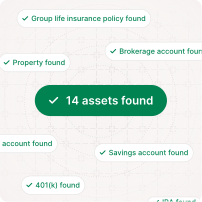
The Verified Asset Search™ reaches across 100+ financial sources: real property records, vehicle and vessel titles, the NAIC life insurance locator, unclaimed and state property registries, credit-bureau trade-line data from all three major bureaus, and document analysis that surfaces financial institution clues from tax returns and bank statements. Every finding lands in a single, source-linked estate record, organized and flagged for attorney review. Legal judgment stays with counsel.
Across the matters it has supported, Elayne can absorb up to hundreds of hours of estate administration per estate, with the intake packet typically completing within two days. Elayne is billed as an eligible estate expense.
FAQ
How do I find out if a deceased parent had life insurance policies I don't know about?
The NAIC Life Insurance Policy Locator is a strong starting point. It's free, and participating insurers search their records against the decedent's name, date of birth, and Social Security number and respond directly if a match is found. Insurers have up to 90 business days to respond. IRS wage and income transcripts can supplement the locator: a 1099-R from an insurance company may name a carrier that administered an annuity or cash-value policy.
What does a decedent's IRS wage and income transcript actually show for estate asset discovery purposes?
A wage and income transcript aggregates every information return filed against a taxpayer's Social Security number for a given year (1099-INT, 1099-DIV, 1099-R, W-2) in one place. Each issuer named on the transcript identifies a financial institution worth contacting.
Can an estate asset search for probate attorneys rely on IRS transcripts alone?
IRS transcripts are a strong starting point but cover only income-generating relationships. They do not confirm asset titles, identify dormant accounts that stopped paying interest, or surface life insurance policies that never generated taxable income. A thorough estate asset search for probate attorneys should also include real property deed searches by county, state DMV records for titled personal property, the NAIC life insurance locator, multi-state unclaimed property registry queries, and credit bureau trade-line pulls from all three major bureaus.
How do you pull a decedent's IRS transcripts when working against a probate inventory deadline?
Registered tax professionals with IRS e-Services access can pull transcripts directly through the Transcript Delivery System in the same session, compared to mailed Form 4506-T requests that can take several weeks. The personal representative still needs to confirm authority first: the decedent's full name, last known mailing location on file, and Social Security number, a copy of the death certificate, and either Letters Testamentary or Form 56 with any court-issued letters.
*Disclaimer: This article is for informational purposes only and does not provide legal, medical, financial, or tax advice. Please consult with a licensed professional to address your specific situation.










.svg)