

When selling inherited real estate, beneficiaries may owe capital gains tax on any appreciation that occurred after the date of death. How much is owed, or whether anything is owed at all, depends on factors such as the stepped-up basis and how quickly the property is sold. This guide covers key points for families and executors to know, including: how the stepped-up basis works, long-term capital gains rates, trust and community property rules, and reporting a sale.
Key Takeaways
- Revocable trusts preserve the stepped-up basis; irrevocable trusts do not.
- Inherited property automatically qualifies for long-term capital gains rates, regardless of how soon after the date of death the property is sold.
- In community property states, the surviving spouse receives a stepped-up basis on the entire property at death, including their own half.
- When multiple heirs inherit the same property, each heir reports their own share of a sale on their own tax return.
- Retirement accounts such as IRAs and 401(k)s do not qualify for the stepped-up basis. Distributions from inherited retirement accounts are taxed as ordinary income.
- Elayne organizes estate records, account statements, and date-of-death valuations so families have the documentation needed to support the stepped-up basis at filing.
Differences Between Inheritance Tax and Capital Gains Tax
Inheritance tax and capital gains tax are two separate taxes.
Inheritance tax is a state-level tax that some beneficiaries pay for receiving assets from an estate. It is based on the value of what you inherit and comes due after the estate settles. States that have an inheritance tax include Kentucky, Maryland, and Nebraska.
Rates depend on the beneficiary's relationship to the person who died. Spouses are exempt in every state that has an inheritance tax. Direct descendants such as children and grandchildren often qualify for reduced rates or full exemptions. Unrelated heirs typically face the highest rates.
Estate tax is paid by the estate itself, before assets are distributed to heirs, so beneficiaries do not pay it directly. There are 12 states that have estate taxes. The federal government has an estate tax as well, though the $15 million per-person exemption means most families owe nothing at the federal level. There is no federal inheritance tax.
In this context, capital gains tax is a federal tax triggered when you sell inherited property for more than its value at the time you inherited it. Receiving an inheritance creates no capital gains liability on its own. Only the sale does.
{{blog-cta-financial}}
How the Stepped-Up Basis Works
When you inherit property, its cost basis resets to the fair market value on the date the original owner died. Any appreciation that occurred during their lifetime is effectively erased for tax purposes. An important exception: certain retirement accounts like 401(k)s and IRAs do not qualify for the stepped-up basis. Those distributions are taxed as ordinary income when withdrawn, not as capital gains.
Long-Term Capital Gains Rates on Inherited Property
Inherited property automatically receives long-term capital gains treatment regardless of how soon you sell. The usual 12-month holding requirement does not apply.
The rate depends on your total taxable income for 2026: 0%, 15%, or 20%. High earners with a modified adjusted gross income above $200,000 (single filers) or $250,000 (married filing jointly) may also owe an additional 3.8% net investment income tax on top of the standard rate.
| Filing Status | 0% Rate | 15% Rate | 20% Rate |
|---|---|---|---|
| Single | Up to $47,025 | $47,026 to $518,900 | Over $518,900 |
| Married Filing Jointly | Up to $94,050 | $94,051 to $583,750 | Over $583,750 |
Selling Inherited Property with Multiple Owners
When multiple heirs inherit the same property, each one owns a percentage of it. That percentage is called a fractional interest. Owning one-third of a property, for example, means one of three heirs controls decisions about that share, including whether to agree to a sale.
If the property is sold, each heir reports their own share on a separate tax return. On Schedule D and Form 8949, each heir reports their proportional share of the sale price and their proportional share of the stepped-up basis. Three siblings who each inherited one-third would each report one-third of the total sale price and one-third of the total basis. Each heir's gain or loss is calculated on its own, separate from the other owners.
When heirs disagree about selling, the process gets more complicated. If one co-owner wants to sell and others refuse, any co-owner can file a partition action in court. A partition action is a legal proceeding that asks a judge to resolve the dispute.
{{blog-cta-financial}}
How Elayne Helps Families With Inherited Property
Elayne organizes an estate's financial records, account statements, and legal documents in one place. When a date-of-death valuation or a prior account statement is needed for a tax filing, those records are accessible and organized.
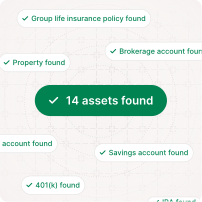
Elayne's Verified Asset Search looks across financial institutions, state unclaimed-property registries, dormant accounts, lost or forgotten insurance policies, and eligible survivor benefits.
For families selling inherited property, Elayne tracks date-of-death valuations across the estate so the correct basis is available when it is time to report the sale. This is one of the most important numbers in the entire transaction: an inaccurate or undocumented basis can lead to overpaying capital gains tax or errors at filing. Elayne also provides a shared dashboard where co-executors, family members, and advisors can access documents, track progress, and work through steps together. Each person sees the same information, which helps reduce miscommunication and duplicated effort.
Inherited retirement accounts carry their own set of requirements. Under SECURE Act 2.0, most non-spouse beneficiaries face a 10-year distribution window and mandatory annual required minimum distributions starting in 2026. Missing a required distribution carries a 25% penalty. Elayne tracks these deadlines and surfaces them proactively to help families avoid being caught off guard when a distribution is due.
Elayne also scans financial records for recurring charges that continue billing after death. This includes streaming services, software subscriptions, gym memberships, and other recurring payments that do not stop automatically. Elayne identifies these charges, manages the cancellation process directly with providers, and monitors statements to confirm that the charges stop.
The administrative side of inherited property is one piece of a much larger settlement process. Throughout that process, Elayne's role is to organize what exists, surface what might have been missed, and keep the documentation in order so families and their advisors can make more informed decisions.
FAQ
How is inherited property taxed when sold in a community property state versus a common-law state?
There are nine community property states: Arizona, California, Idaho, Louisiana, Nevada, New Mexico, Texas, Washington, and Wisconsin. In these states, most assets acquired during a marriage are considered equally owned by both spouses. When one spouse dies, the surviving spouse gets a step-up in basis on the entire property, including both the deceased spouse's half and their own half. The new basis equals the full fair market value on the date of death.
In a common-law state, each spouse owns their share of an asset separately. When one spouse dies, only the deceased spouse's half gets a stepped-up basis. The surviving spouse's original half keeps its old purchase price as the basis.
What is the stepped-up basis, and how is it calculated?
The stepped-up basis is the fair market value of an inherited property on the date the original owner died. It replaces what the original owner paid for the property. If a parent bought a home for $100,000 and it was worth $400,000 at the time of their death, the heir's basis is $400,000, not $100,000. Any gain or loss on a future sale is measured from that $400,000 starting point, not from the original purchase price.
The basis is typically established through a qualified appraisal ordered around the time of death, or through the estate's date-of-death valuation if one was prepared for estate tax purposes.
What happens if the inherited property went down in value after the date of death?
If the property sells for less than its stepped-up basis, the sale produces a capital loss. That loss may be deductible against other capital gains on the same tax return. The stepped-up basis still comes from the fair market value at death, so the loss is measured from that starting point, not from what the original owner paid.
How does an irrevocable trust affect the stepped-up basis on inherited property?
Property held in an irrevocable trust at the time of death generally does not receive a stepped-up basis. Because the original owner transferred legal ownership of the property into the trust before death, it is typically no longer part of their taxable estate. The heir takes over the trust's existing basis, which is often the original purchase price.
By contrast, property held in a revocable living trust does receive a stepped-up basis at death. The original owner kept control of the property during their lifetime, so it remains part of their estate for tax purposes.
*Disclaimer: This article is for informational purposes only and does not provide legal, medical, financial, or tax advice. Please consult with a licensed professional to address your specific situation.










.svg)