
A step-up in basis generally resets the tax basis of inherited property to its fair market value on the date the owner died. Basis is the amount used to calculate taxable gain when an asset is sold, so the adjustment generally removes the owner’s lifetime growth from the heir’s taxable gain. Whether it applies depends on the type of asset and how it was owned. This guide explains key points for heirs and executors to be aware of, including: how the adjustment is calculated, which assets qualify and which do not, how jointly owned property and trusts are treated, the six-month alternate valuation date, the one-year rule, and more.
Key Takeaways
- Step-up in basis generally resets inherited assets' tax basis to fair market value at death.
- Lifetime appreciation is generally excluded from capital gains tax; gains after death can still be taxed.
- Traditional IRAs, 401(k)s, and deferred annuity earnings do not receive a step-up in basis.
- Date-of-death appraisals document inherited real estate values for future capital gains calculations.
- Elayne helps locate inherited assets, organizes inheritance records, and tracks estate deadlines.
What Step-Up in Basis Means
A step-up in basis generally resets an inherited asset’s tax basis to its fair market value on the date the owner died. Basis is the amount used to calculate gain when an asset is sold.
The adjustment generally excludes appreciation during the owner’s lifetime from the heir’s taxable gain. Any increase in value after death can still be taxable upon sale.
{{blog-cta-financial}}
How the Step-Up in Basis Is Calculated
Inherited basis generally uses fair market value at death: the price informed, unpressured buyers and sellers would agree on.
- Real estate generally requires a date-of-death appraisal.
- Publicly traded securities use market pricing under applicable valuation rules.
- Closely held businesses often need professional valuations.
On a later sale, taxes on selling inherited property are generally based on net proceeds minus inherited basis, adjusted for improvements or depreciation.
What Assets Qualify for a Step-Up in Basis
Assets generally eligible for a step-up in basis at death include:
- Real estate: homes, rental properties, and land.
- Taxable investments: stocks, bonds, mutual funds, and ETFs.
- Business interests: private-company shares or partnership interests.
- Personal property: art, jewelry, collectibles, and vehicles.
What Assets Do Not Get a Step-Up in Basis
Assets that do not get a step-up in basis include:
- Traditional IRAs, 401(k)s, and similar tax-deferred retirement accounts.
- Deferred annuity earnings.
- Other income owed to the person who died, such as unpaid wages, called income in respect of a decedent (IRD).
Untaxed amounts generally become ordinary income when received, subject to inherited IRA distribution rules. After-tax contributions can reduce the taxable portion; qualified Roth distributions are generally tax-free.
Step-Up in Basis for Jointly Owned Property: Married Couples
For married couples in common law states, only the deceased spouse’s share typically receives a basis adjustment. Under community property basis rules, both halves generally adjust if half or more enters the deceased’s gross estate. Community property states: Arizona, California, Idaho, Louisiana, Nevada, New Mexico, Texas, Washington, and Wisconsin.
Step-Up in Basis and Irrevocable Trusts
Assets in an irrevocable grantor trust excluded from the grantor’s taxable estate receive no step-up in basis at death under Revenue Ruling 2023-2.
The Six-Month Alternate Valuation Date Rule
The executor’s alternate valuation date election generally values estate assets six months after death. It must reduce both:
- The gross estate’s overall value.
- Estate tax liability.
Assets sold or distributed earlier use disposition-date values.
The One-Year Rule: IRC Section 1014(e)
Beyond valuation timing, another limitation affects basis: the one-year rule. The step-up in basis one-year rule denies a step-up when appreciated property is gifted within one year before the recipient’s death and returns to the donor or donor’s spouse.
How the Step-Up in Basis Affects Estate Settlement
The executor or personal representative obtains and documents estate asset valuations to support heirs’ step-up in basis records for future sales. Informal estimates or outdated statements can leave heirs unable to substantiate reported capital gains. Keeping valuation reports with distribution records helps connect each inherited asset to its documented tax basis.
{{blog-cta-financial}}
How Elayne Supports Inherited Asset Tracking and Discovery
A step-up in basis record depends on several facts: which assets exist, how each one was owned, and what each was worth on the date of death. Elayne supports estate settlement after a death by organizing those facts in one estate record. The record is shared with the executor, heirs, and advisors who are authorized to see it.
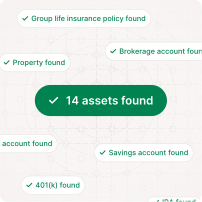
Elayne's Verified Asset Search locates assets that families may not know exist, such as forgotten bank accounts, lost life insurance policies, unclaimed property, real property records, and vehicle records. Document analysis adds to the search by reading tax returns, bank statements, and other records to identify the financial institutions that hold estate assets.
Assets located after the first inventory are added to the same record with their date-of-death values. Basis documentation then covers the full estate, including accounts that were unknown at the start.
Authority to act for an estate generally comes from the court. In a probate estate, the court issues Letters Testamentary to the executor named in a will, or letters of administration to an administrator when there is no will. Procedures and terms vary by state.
Elayne ties deeper searches to that authority. They become available only after the person requesting them is verified, so access to financial information follows the right to act for the estate.
For each inherited asset, the shared estate record organizes date-of-death account values alongside the supporting statements. It also holds appraisal reports for real estate and other property valued by a qualified appraiser. For inherited retirement accounts, it tracks distribution deadlines, including annual required minimum distributions where they apply under SECURE Act 2.0.
The record also organizes ownership information, such as whether an asset was held in a trust, jointly, as community property, or with a beneficiary designation. That detail matters because basis treatment can differ by how an asset was held. The estate record places those facts beside the valuation documents so they can be reviewed together.
If an heir later sells an inherited asset, the taxable gain is calculated from the inherited basis. The valuation documents in the estate record are the same documents that support that figure, so they are kept with the distribution records.
Authorized family members, executors, and advisors can each be given access to the shared record with role-based permissions, so everyone works from the same documents.
FAQ
If an estate is being organized with Elayne and no appraisal was done at death, can a step-up in basis still be documented?
Yes. A qualified appraiser can prepare a retrospective appraisal estimating the property’s fair market value on the date of death. Elayne helps organize inheritance records; the appraisal supplies the professional valuation needed to support the inherited real estate basis.
What is an example of a step-up in basis?
A parent buys stock for $50,000, and it is worth $200,000 on the date of death. The heir’s basis becomes $200,000 instead of $50,000. If the heir later sells the stock for $210,000:
- Taxable gain with the step-up: $10,000 ($210,000 minus $200,000).
- Taxable gain without the step-up: $160,000 ($210,000 minus $50,000).
The sale is reported on Form 8949 and Schedule D of the heir’s federal income tax return.
How does a step-up in basis work for inherited real estate?
Inherited real estate generally takes a basis equal to its fair market value on the date of death, which is usually documented with a date-of-death appraisal. For example:
- Original purchase price: $150,000.
- Appraised value at death, which becomes the heir’s basis: $500,000.
- Later sale price of $520,000 produces a gain of $20,000, before selling costs and improvements are factored in.
Elayne organizes the appraisal report alongside the other estate records, so the date-of-death value is on file when a sale takes place.
Is inherited property treated as a long-term or short-term capital gain?
Property with a basis determined at death is generally treated as held for more than one year, no matter how long the heir owns it. A gain on a sale shortly after the death is therefore generally taxed at long-term capital gain rates. This holding-period rule appears in IRC Section 1223(9).
What happens if inherited property was worth less at death than the owner paid for it?
The basis is generally reduced to the lower fair market value on the date of death, which is sometimes called a step-down in basis. The same date-of-death rule that raises basis for appreciated property lowers it for property that lost value. For example, stock bought for $100,000 and worth $70,000 at death gives the heir a $70,000 basis.
How does basis for inherited property differ from basis for gifted property?
Property received as a gift during the owner’s life generally keeps the donor’s original basis, called carryover basis, under IRC Section 1015. The donor’s lifetime appreciation therefore remains part of the recipient’s taxable gain on a later sale. Property received at death generally takes its date-of-death value instead.
*Disclaimer: This article is for informational purposes only and does not provide legal, medical, financial, or tax advice. Please consult with a licensed professional to address your specific situation.