
Form 706 is the federal estate tax return an executor files after someone dies. Whether a return is required depends on the value of the gross estate plus taxable gifts made during the person's lifetime, compared against the 2026 threshold of $15 million. This guide explains key points for families and executors to be aware of, including: what form 706 is, who has authority to file, how the gross estate is calculated, which estates must file, deadlines and extensions, the schedules that report assets and deductions, portability for a surviving spouse, Form 706-NA, state estate taxes, and more.
Key Takeaways
- Form 706's 2026 filing test counts gross estate plus adjusted taxable gifts against $15 million.
- Filing and payment are generally due nine months after death. Filing extensions do not delay payment.
- Filing below the threshold can preserve a deceased spouse's unused exclusion for a surviving spouse.
- Form 706 reports estate assets, deductions, and estate and generation-skipping transfer taxes.
What Form 706 Is
Form 706, the United States Estate (and Generation-Skipping Transfer) Tax Return, is a federal return an executor files after someone dies. It calculates:
- Estate tax under Chapter 11 of the Internal Revenue Code.
- Generation-skipping transfer (GST) tax under Chapter 13 on transfers called “direct skips.”
The IRS form overview explains both functions. Filing the return does not necessarily mean the estate owes tax.
{{blog-cta-financial}}
Who Has Authority to File Form 706
The executor or personal representative files Form 706. Under the Form 706 executor rules, if no executor is appointed, qualified, and acting in the United States, anyone in actual or constructive possession of the deceased person’s property is treated as an executor.
Multiple executors may share responsibility, though one signature is sufficient. Co-executors can review the completed return together and agree which executor will sign it. Federal filing duties can apply without a court appointment.
How the Gross Estate Is Calculated
The gross estate generally uses date-of-death fair market values. It includes:
- Probate assets.
- The includible share of jointly owned property.
- Life insurance proceeds when the deceased held ownership rights
- Includible annuity interests.
- Certain lifetime transfers within three years of death.
- Property subject to certain powers of appointment.
Property passing outside probate can still count toward the federal estate tax filing threshold.
Deadlines, Extensions, and Paying the Tax
Form 706 has separate rules for filing extensions and payment relief.
| Step | Timing and form |
|---|---|
| Filing and payment | Generally nine months after death |
| Filing extension | Timely Form 4768 requests an automatic six-month extension |
| Payment relief request | Separate Form 4768 request, subject to approval |
A filing extension does not extend the payment deadline.
The Schedules That Build the Gross Estate
Form 706 groups gross-estate assets by type:
- Schedule A reports real estate, supported by deeds and appraisals.
- Schedule B reports stocks and bonds, supported by brokerage statements.
- Schedule C covers mortgages, notes, and cash, using loan records and account statements.
- Schedule D covers life insurance, supported by policy records.
- Schedule E reports joint property, with titles and contribution records documenting ownership.
- Schedule F covers miscellaneous property, supported by inventories.
- Schedule G reports lifetime transfers, supported by transfer documents.
- Schedule H reports powers of appointment, supported by trust documents.
- Schedule I reports annuities, supported by the annuity contracts.
- Records document ownership and reported values.
The Deduction Schedules
Form 706 deduction schedules report eligible amounts subtracted from the gross estate:
- Schedule J reports funeral and administration expenses.
- Schedule K reports debts, mortgages, and liens.
- Schedule L reports administration losses and certain other expenses.
- Schedule O reports the charitable deduction.
- Schedule M reports the marital deduction, including QTIP elections.
A qualified terminable interest property (QTIP) election lets qualifying property held for a surviving spouse receive the marital deduction. Allowed deductions reduce the taxable estate.
The Generation-Skipping Transfer Tax Component
A direct skip generally transfers property to a grandchild or another “skip person,” including certain trusts, subject to exceptions. Form 706 Schedules R and R-1 report generation-skipping transfer (GST) tax calculations and exemption allocations.
Form 706-NA for Nonresident Non-Citizens
Form 706-NA applies to estates of people who were neither U.S. citizens nor U.S. residents for estate tax purposes, as explained in the IRS Form 706-NA definitions.
Filing is generally required when U.S.-situated assets exceed $60,000, subject to treaties and other rules. These assets can include U.S. real estate, physical property located here, and stock in U.S. corporations.
The standard federal estate tax exclusion does not automatically apply to these estates.
State Estate Taxes and Form 706
State estate or inheritance tax returns are separate from Form 706 and may be required even when no federal estate tax is owed. Massachusetts and Oregon, for example, have estate tax exemptions below the federal level.
Common Filing Errors and Consequences
Form 706 filing errors include:
- Incomplete schedules or missing valuations.
- Missed elections to transfer unused estate tax exclusion to a surviving spouse.
- Incorrect generation-skipping transfer tax exemption allocations.
Late filing and late payment carry separate penalties.
{{blog-cta-financial}}
How Elayne Supports Families Through the Estate Settlement Process
Elayne is an online service for settling an estate after a death. Form 706 is one part of a much larger set of steps, and Elayne supports the work around it: organizing the estate, locating assets, and mapping who inherits what.
The executor files Form 706, often with help from an estate attorney and/or tax professional. The return relies on complete lists of assets, debts, and supporting documents. Elayne helps build those lists.
Organizing the Estate
Elayne gathers documents, contacts, account details, and key facts about the person who died into one estate record. Authorized family members, co-executors, and advisors view the same information through a shared dashboard with role-based permissions. Elayne also tracks deadlines and sends reminders as steps come due.
Searching for Assets
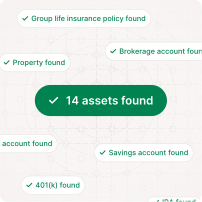
Elayne's Verified Asset Search looks for accounts and property that families may not know exist. It searches sources such as real property records, vehicle records, life insurance policies, and state unclaimed property registries. Elayne also reviews tax returns, bank statements, and similar documents for clues about which financial institutions hold estate assets.
Mapping Who Inherits What
Elayne maps each asset to its beneficiary and records how it transfers, such as through a trust, a beneficiary designation, joint ownership, or probate. It also records date-of-death account values and supports applying for an EIN and opening an estate bank account. These records give the executor and any professionals preparing Form 706 an organized starting point.
Subscriptions and Recurring Charges
Elayne identifies recurring charges such as streaming, gym, software, and app subscriptions. It manages cancellation directly with providers, monitors later statements to confirm the charges stopped, and logs each confirmation for estate accounting. Recurring charges can keep billing an estate for months if they are not canceled.
Survivor Benefits
Elayne identifies which survivor benefits may apply to an estate, including Social Security, pension, veterans', and union benefits. It surfaces the eligibility requirements and deadlines attached to each one.
How This Work Relates to Form 706
The table shows how this work relates to the Form 706 schedules.
| Elayne's work | Related Form 706 content |
|---|---|
| Asset search and estate record | Schedules A through I, which report gross estate assets by type |
| Beneficiary and ownership mapping | Schedules M and O, which report marital and charitable deductions |
| Document and debt records | Schedules J and K, which report funeral and administration expenses, debts, and liens |
Working Alongside Professionals
Attorneys, tax professionals, and other advisors can work in the same shared dashboard as the family. Elayne prepares an organized estate overview so that tasks can begin from a more complete record.
FAQ
What is the federal estate tax rate?
The federal estate tax is a graduated tax with a top rate of 40%. It applies to the amount above the basic exclusion amount, not to the full value of the estate. Estates at or below the exclusion generally owe no federal estate tax.
How does Form 706 differ from Forms 709, 1041, and 1040?
Each form reports a different tax:
- Form 706 reports federal estate tax and generation-skipping transfer tax on property transferred at death.
- Form 709 reports taxable lifetime gifts. The person who made the gift files it, generally by April 15 of the following year. The 2026 annual gift exclusion is $19,000 per recipient.
- Form 1041 reports income the estate earns after the date of death.
- Form 1040 is the final individual income tax return for the year of death.
How is Form 706 submitted, and what does the IRS send afterward?
Form 706 is filed on paper, because the IRS does not accept electronic filing for this return. The instructions list where to send it. Supporting documents include a copy of the will when one exists, Form 712 for life insurance reported on Schedule D, and appraisals for certain assets.
The IRS issues an estate tax closing letter on request.
What is portability, and how does a surviving spouse use it?
Portability lets a surviving spouse add a deceased spouse's unused exclusion, called the deceased spousal unused exclusion (DSUE) amount, to the survivor's own exclusion. The executor makes the election by filing a complete and properly prepared Form 706. The survivor can apply the DSUE amount to lifetime gifts or to the survivor's own estate.
*Disclaimer: This article is for informational purposes only and does not provide legal, medical, financial, or tax advice. Please consult with a licensed professional to address your specific situation.