

When inherited property is sold, capital gains tax is often a key consideration for heirs. How much is owed depends on the property's value at the date of death, any appreciation since then, and when the sale occurs. This guide explains key points for families and executors, including: how the stepped-up basis works, which taxes can apply and who pays them, documents required for the sale, how to handle sales when multiple owners are involved, what partition actions involve, and how to report the sale on a tax return.
Key Takeaways
- The stepped-up basis resets your cost basis to the property's value at death, so only appreciation after that date is taxable when you sell.
- Inherited property qualifies for long-term capital gains rates regardless of how long you hold it before selling.
- Three separate taxes can apply when inherited property is sold: inheritance tax (paid by the beneficiary), estate tax (paid by the estate before distribution), and capital gains tax (paid by the seller at the time of sale).
- If the deceased owned the property solely in their name, it typically must pass through probate before a sale can proceed. Joint tenancy, living trusts, and transfer-on-death deeds bypass probate entirely.
- Selling inherited property requires documents across four categories: legal authority, property records, financial and tax records, and certified death certificates.
- Elayne handles the administrative layer of estate settlement, helping co-owners and co-executors organize documents and communicate through a shared dashboard.
Confirming Ownership and Probate Status
If the deceased owned the property outright in their name alone, it typically must pass through probate before it can be sold. The court confirms the will, appoints an executor, and issues Letters Testamentary, which grant legal authority to act on behalf of the estate. Without those letters, no one can legally list or sell the property.
Several ownership structures bypass probate entirely:
- Joint tenancy with right of survivorship passes the property directly to the surviving co-owner upon death, usually requiring only a death certificate and an affidavit.
- A living trust transfers ownership to the trustee immediately, allowing sale without court involvement.
- Transfer-on-death (TOD) deeds, available in many states, let the named beneficiary record the deed and proceed to sale with minimal delay.
If probate is required, the executor holds the authority to sell. If there is no will, the court appoints an administrator who holds legal authority to act on behalf of the estate. Before any listing agreement is signed or offer accepted, that court-issued authority needs to be in hand.
{{blog-cta-financial}}
Three Taxes That Can Apply When You Sell Inherited Property
Inheritance tax is paid by the beneficiary who receives the asset. Estate tax is paid by the estate itself before assets are distributed, not by the beneficiary after they sell. The federal estate tax applies only to estates exceeding $15 million per individual in 2026. Maryland and a handful of other states have their own estate taxes at lower thresholds, but this remains a pre-distribution obligation.
Capital gains tax on inherited property applies when a sale is made. It applies to the profit between what the property was worth when you inherited it and what you sell it for. Inherited property receives a stepped-up basis, which resets the cost basis to the fair market value at the date of death.
| Tax | Who Pays | When |
|---|---|---|
| Inheritance tax | Beneficiary | After receiving the asset |
| Estate tax | The estate | Before distribution |
| Capital gains tax | Seller | When the property is sold |
The Stepped-Up Basis Rule
When someone dies, the IRS resets the property's cost basis to its fair market value on the date of death. Only appreciation after that reset date is taxable when a sale is made.
Example: a parent bought a home in 1985 for $80,000. By the time they died, it was worth $450,000. The stepped-up basis is $450,000. If the heir sells a year later for $475,000, the taxable gain is $25,000, not $395,000.
Documents Required to Sell Inherited Property
Legal Authority
- Will or certified trust documentation, plus Letters Testamentary or Letters of Administration issued by the probate court
- For smaller estates that bypass probate, some states accept an Affidavit of Heirship instead
Property Records and Title
- The current deed, plus a preliminary title report from a title company to surface any hidden liens or encumbrances before listing
Financial and Tax Records
- Date-of-death appraisal to set the stepped-up basis
- Mortgage payoff statement and any lien release documents
- Property tax records confirming payments are current
Death Certificates and Co-Owner Consent
Certified death certificates are needed in multiple copies across institutions. When multiple heirs share ownership, every co-owner typically must sign off before closing, either directly or through a signed power of attorney.
Selling Inherited Property With Multiple Owners
During probate, the executor can sell without unanimous heir consent. Once title transfers to heirs as tenants in common, every co-owner must agree before the property can list or close. If no agreement can be reached, a court can order a legal partition, forcing a sale and dividing proceeds among co-owners.
{{blog-cta-financial}}
Reporting the Sale of Inherited Property on Your Tax Return
The sale is reported on Form 8949 and carries to Schedule D of Form 1040.
The cost basis entry reflects the stepped-up fair market value at the date of death, not the original purchase price. The acquisition date is recorded as the date of death, which triggers automatic long-term capital gains treatment regardless of how long the property was held afterward.
Net proceeds are calculated as the sale price minus allowable selling costs: agent commissions, title fees, and closing costs documented on the final settlement statement. These deductions may reduce the reportable gain.
How Elayne Supports Executors and Families Through an Inherited Property Sale
During an estate settlement, documents need to be located, legal authority needs to be confirmed, deadlines need tracking, and multiple family members often need to coordinate tasks.
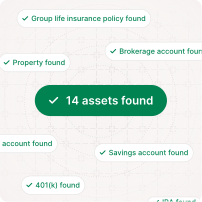
Elayne handles that administrative layer. The Verified Asset Search™ surfaces real property, deeds, life insurance, and unclaimed assets heirs may not know exist, supporting the diligent search obligation executors carry. Every document and action is kept in one source-linked estate record, so families arrive at closing with an organized file.
The shared dashboard keeps co-owners and co-executors on the same page without requiring someone to manually relay every update. Elayne has supported 1,000+ families and attorneys through estate settlement. To learn more about Elayne's work and mission, visit elayne.com.
FAQ
Do you pay capital gains tax on inherited property you sell?
Yes, but the stepped-up basis rule can significantly reduce what most heirs owe. The IRS resets the property's cost basis to its fair market value on the date of death, so only appreciation after that date is taxable. If you sell soon after inheriting and the property has not gained much value since the date of death, your taxable gain can be small or zero.
Can I sell my share of inherited property if a sibling refuses to sell?
Any co-owner can file a partition action in court, which can result in a forced sale even without unanimous agreement. Several states, including California and Florida, require an independent appraisal and give co-owners the right to buy out the filing party before a forced sale proceeds.
What documents are required for selling inherited property?
The core documents fall into four categories: legal authority (Letters Testamentary or Letters of Administration, plus the will or trust), property records (the current deed and a preliminary title report), financial and tax records (a date-of-death appraisal, mortgage payoff statement, and current property tax records), and certified death certificates—ordered in multiple copies, since several institutions will each require one. The exact list shifts depending on whether the property passes through probate or transfers directly via a trust, TOD deed, or joint tenancy.
How do I report the sale of inherited property on my tax return?
The sale is reported on Form 8949 and carries to Schedule D of Form 1040. The cost basis is the stepped-up fair market value at the date of death, not the original purchase price. The acquisition date is recorded as the date of death, which triggers automatic long-term capital gains treatment regardless of how long the property was held afterward.
What is a partition action?
A partition action is a court proceeding in which a co-owner requests that a court either divide or order the sale of jointly owned property. In inherited property situations, this typically arises when heirs hold title together as tenants in common and cannot reach agreement on a sale. A court can order a physical division of the property if that is practical, or order a forced sale with the proceeds distributed among co-owners according to their ownership shares. Several states require an independent appraisal before a forced sale proceeds and give co-owners the right to buy out the party who filed the action at the appraised value.
*Disclaimer: This article is for informational purposes only and does not provide legal, medical, financial, or tax advice. Please consult with a licensed professional to address your specific situation.










.svg)