

A payable on death (POD) account names a beneficiary directly on a bank account. When the account owner dies, the beneficiary can claim the funds by presenting a death certificate to the bank.
What can often be challenging is knowing how POD accounts interact with wills, estate debts, and taxes, and what happens when the designation is outdated or incomplete. This guide covers how POD accounts work, and key points that are important for beneficiaries and executors to know.
Key Takeaways:
- A POD account transfers funds directly to a named beneficiary after death, bypassing probate.
- Beneficiaries claim funds by presenting a certified death certificate and valid ID to the bank.
- POD accounts are included in the deceased's gross estate for federal estate tax purposes, even though they pass outside of probate.
- POD designations should be reviewed after major life events (marriage, divorce, the birth of a child, or the death of a previously named beneficiary).
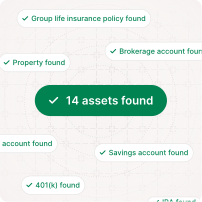
- Elayne organizes account discovery and tracks which accounts transfer through POD versus probate.
What Is a Payable on Death Bank Account?
A payable on death account is a bank account that names a beneficiary to receive the funds directly after the account owner dies. While the owner is alive, the named beneficiary has no access to the account and no legal claim on the balance. The designation only activates upon death, at which point the beneficiary can claim the funds by presenting a death certificate to the bank.
POD designations can be applied to checking, savings, CDs, and money market accounts. You may also see them called Totten trusts, an older legal term for the same arrangement that remains in use in some states.
How Payable on Death Accounts Work
During the owner's lifetime, a POD designation changes nothing about how the account operates. You can deposit, withdraw, close the account, change the named beneficiary, or remove the designation at any time. The beneficiary has no role in those decisions.
After death, the beneficiary visits the bank with a certified copy of the death certificate and a government-issued ID. The bank verifies both documents and releases the funds. No probate filing or court involvement is needed. Many banks complete the transfer within a few business days once documentation is processed.
{{blog-cta-financial}}
What the Beneficiary Needs to Bring
The exact requirements vary by institution, but most banks ask for the same core items:
- A certified copy of the death certificate, obtained from the state records office in the state where the person died. A photocopy is not accepted.
- A valid government-issued photo ID, such as a driver's license or passport, to confirm the beneficiary's identity.
- The account number or enough identifying information for the bank to locate the account.
POD Accounts vs. Trusts
POD accounts and revocable living trusts are both tools that let assets pass outside of probate, but they work differently and suit different situations.
A POD designation covers a single account. A trust can hold multiple accounts and property under one legal structure. For families with straightforward finances and one or two bank accounts, a POD designation is often enough. For families with more complex estates, a trust offers broader coordination.
There are a few other distinctions worth knowing:
- A trust lets you set conditions on how and when a beneficiary receives assets. A POD account transfers the full balance immediately upon death, with no ability to delay or restrict access.
- Trusts require an attorney to draft and typically cost several hundred to several thousand dollars to set up. A POD designation is usually free and added directly at the bank.
- A trust can name a successor trustee to manage assets if you become incapacitated before you die. A POD designation only takes effect at death and offers no incapacity protection.
- Trusts are subject to their own administrative requirements. They need to be funded correctly, meaning accounts and property must be retitled into the trust's name, or the trust provides no benefit.
Neither option is universally better. The right choice depends on the size of the estate, the number of accounts involved, whether any beneficiaries need managed distributions, and what the account holder wants to happen if they become unable to manage their own finances before they die.
POD Accounts vs. Beneficiary Designations
"POD" is the bank term for this designation. The same probate-avoidance function appears under different names depending on the account type:
| Account Type | Designation Term |
|---|---|
| Checking accounts, savings accounts, CDs | Payable on death (POD) |
| Brokerage and investment accounts | Transfer on death (TOD) |
| IRAs and 401(k)s | Beneficiary designation |
| Life insurance policies | Beneficiary designation |
In practice, all four work the same way: the account or policy transfers directly to the named individual upon death, outside of probate, without court involvement. A POD designation and a beneficiary designation are functionally the same thing. The label changes based on the institution and asset type.
Benefits of POD Bank Accounts
POD designations are free to add at most banks and take only a few minutes to set up. No attorney is required, and a will or trust is not needed for the designation to be valid.
There are several practical reasons families choose POD accounts:
- Beneficiaries can access funds relatively quickly after a death, which can matter when families face immediate expenses like funeral costs or household bills.
- POD accounts bypass probate entirely, meaning the funds transfer directly without court involvement.
- The designation does not affect how the account owner uses the account during their lifetime, so there is no loss of access or control.
Disadvantages and Risks of POD Accounts
- A POD designation provides no protection if the account owner becomes incapacitated. The designation only activates at death. For lifetime management, a durable power of attorney or trust is needed separately.
- POD funds go directly to the beneficiary and bypass the estate entirely. That can leave the estate short of liquid assets to pay funeral expenses, debts, and creditor claims.
- If the named beneficiary dies before the account owner and the designation is never updated, those funds typically fall back into the probate estate.
Creditor and Estate Planning Conflicts
State law varies on whether creditors can reach POD funds when the estate itself is insolvent. In some states, creditors have a path to those funds; in others, they do not. Either way, the interaction between POD accounts and outstanding debts is worth reviewing with an estate planning attorney before finalizing designations.
Tax Implications of POD Accounts
Income Tax
The funds in a POD account are not subject to federal income tax at the time of transfer. Beneficiaries receive the balance without owing ordinary income tax on the principal. Any interest that accrues after the account owner's death, however, is taxable income to the beneficiary in the year it is received.
Estate Tax
POD accounts are included in the deceased's gross estate for federal estate tax purposes. In 2026, the federal estate filing threshold is $15 million. As a result, the vast majority of estates will not owe federal estate tax regardless of whether assets passed through POD designations or probate.
State Inheritance Tax
A smaller number of states have an inheritance tax, which is paid by the beneficiary instead of the estate. Whether a POD account is subject to state inheritance tax depends on the state where the deceased lived and the beneficiary's relationship to the account holder. Spouses are typically exempt; more distant relatives or unrelated beneficiaries may owe tax at varying rates.
A Note on Stepped-Up Basis
Unlike inherited investment accounts, bank account balances do not carry a cost basis, so the stepped-up basis rules that apply to stocks and real estate are not relevant here. The beneficiary simply receives cash.
{{blog-cta-financial}}
How to Set Up a POD Bank Account
Setting up a POD designation is straightforward at most banks. Here is how the general process works:
- Contact your bank, visit a branch, or log into your online banking portal. Many major institutions now allow POD designations to be added or updated entirely online.
- Request a POD beneficiary designation form. Some banks label it a "beneficiary form" or "account designation form."
- Provide each beneficiary's full legal name, date of birth, and contact information. If naming multiple beneficiaries, specify how the account balance should be divided.
- Submit the form and confirm the designation appears on your account statements or records. Keep a copy for your files.
There is typically no cost to add or change a POD designation.
How Elayne Helps Executors and Beneficiaries Manage Financial Accounts After Death
Elayne organizes account discovery, tracks outstanding financial accounts, and helps families understand which assets transfer through a POD designation and which need additional legal steps. For executors managing an estate with multiple accounts across different banks, having a clear picture of what exists and what each account requires can reduce delays and make the overall settlement process run more efficiently.
FAQs
What is a payable on death bank account?
A payable on death (POD) account is a bank account that names a beneficiary to receive the funds directly after the account owner dies by presenting a death certificate to the bank. The beneficiary has no access or claim to the account during the owner's lifetime, and the designation only activates upon death, allowing the funds to transfer outside of probate.
Can I set up a POD bank account without an attorney?
Yes. POD designations are free at most banks. You simply complete a beneficiary designation form at your bank, online, or in person. The form asks for each beneficiary's full legal name, date of birth, and contact information, and becomes active immediately once submitted.
POD accounts vs trusts for a simple estate?
POD accounts work well for straightforward finances with one or two bank accounts. They're free, transfer funds quickly, and avoid probate. Trusts offer broader coordination for multiple accounts, real estate, and investments, allow conditions on distributions, and provide incapacity protection before death, but cost more to set up and require retitling assets into the trust's name.
What happens if my POD beneficiary dies before I do?
If the sole named beneficiary dies before you and you never updated the designation, the account falls back into your probate estate. If you named multiple beneficiaries and one predeceases you, most banks distribute the balance equally among surviving beneficiaries. The deceased beneficiary's heirs typically receive nothing unless your state law or account agreement allows representation.
How do taxes on payable on death bank accounts work?
POD account funds transfer to the beneficiary without federal income tax on the principal, though any interest earned after the account owner's death is taxable income to the beneficiary. The account is included in the deceased's gross estate for federal estate tax purposes, but most estates fall well below the 2026 filing threshold of $15 million.
*Disclaimer: This article is for informational purposes only and does not provide legal, medical, financial, or tax advice. Please consult with a licensed professional to address your specific situation.









.svg)