.webp)

Next of kin is a legal designation set by state law that identifies a person's closest living relative. It governs who inherits when there is no will, who makes medical decisions when someone is incapacitated, and who has standing to handle an estate in court. This article covers key points for families and executors to be aware of when it comes to the topic of next of kin, including: the legal definition and priority order, how next of kin differs from beneficiary and heir, what happens when someone dies without a will, rights and responsibilities after a death, medical decision-making authority, and more.
Key Takeaways
- Next of kin follows a fixed state law order
- A beneficiary designation on a financial account overrides the next-of-kin order entirely
- Unmarried partners hold no automatic next-of-kin standing in most states, affecting both inheritance and medical decisions
- Next of kin status alone grants no authority to access accounts or transfer property until a court formally appoints an administrator
The Legal Definition of Next of Kin
"Next of kin" refers to a person's closest living relative by blood, marriage, or legal adoption. In U.S. law, the term carries two distinct meanings depending on context.
In inheritance law, next of kin identifies who inherits when no valid will exists. State intestacy statutes set a fixed priority order, and the person at the top steps in as the legal heir. In medical and emergency law, next of kin identifies who hospitals contact when someone is incapacitated and who is authorized to make decisions on their behalf.
These two uses do not always point to the same person, and neither is strictly limited to blood relatives in every state. Some states recognize registered domestic partners or close friends under certain legal arrangements. The definition varies by context and jurisdiction.
{{blog-cta-financial}}
The Next of Kin Hierarchy: Legal Order of Priority
Many U.S. states follow the same general priority order when determining next of kin under intestate succession laws:
- Surviving spouse
- Children (biological and legally adopted)
- Parents
- Siblings
- Grandparents
- Aunts, uncles, and cousins (more distant relatives, in descending order)
This order governs more than inheritance. It also determines who has priority to petition the court to administer the estate and who must receive official legal notifications during probate. The rules of intestate succession shape each of these outcomes.
State laws vary, so this hierarchy is the prevailing general rule, not a universal one. Some states treat registered domestic partners the same as spouses, and others apply different inheritance rules to half-siblings or grandchildren.
Next of Kin vs. Beneficiary vs. Heir: What's the Difference
These three terms overlap but serve different legal functions.
Next of kin is your closest living relative by default priority, determined by state law. An heir is a person legally entitled to inherit under intestacy rules when no will exists. A beneficiary is someone named directly to receive assets in a will, trust, life insurance policy, or retirement account.
| Term | Who It Is | What Governs It |
|---|---|---|
| Next of kin | Closest living relative | State law priority order |
| Heir | Person entitled to inherit | Intestacy statutes |
| Beneficiary | Named recipient of assets | Will, trust, or account designation |
The same person can hold all three roles simultaneously, or none of them can overlap at all.
Next of Kin Rights and Responsibilities After a Death
Being next of kin after a death carries both legal standing and practical responsibility. Common rights and responsibilities that fall to next of kin include:
- Registering the death and obtaining death certificates
- Making funeral and burial arrangements when no written instructions exist
- Petitioning the court to open probate or administer the estate
- Acting as the primary point of contact for banks, insurers, and government agencies
- Identifying and inventorying assets and outstanding debts
Holding the role does not automatically confer inheritance rights. Rights to property flow from the intestacy hierarchy or a valid will. Also, a key point to note: next of kin have no authority to access accounts, sign documents, or transfer property until a court formally appoints them as administrator. Legal standing and court-recognized authority are separate aspects of the settlement process.
How State Laws Shape Next-of-Kin Rules
Next-of-kin rules are set by state law. There is no single federal standard governing who qualifies or what share they inherit.
In community property states like California and Texas, a surviving spouse owns half of all marital assets outright regardless of whose name is on the title. In common-law states, ownership follows the title, and the surviving spouse's inheritance share is determined by the intestacy formula instead of automatic co-ownership.
Some states extend next-of-kin standing to registered domestic partners or civil union partners, treating them identically to spouses.
Proving You Are Next of Kin
Banks, courts, and government agencies require proof of relationship before releasing information or assets. The documents needed depend on how close the relationship is.
For immediate family, the standard documents are:
- A death certificate for the deceased
- Your own birth certificate or marriage certificate confirming the connection
- Court orders for legal adoption
When the relationship is more distant, genealogical records, prior death certificates of connecting relatives, and court petitions may be needed to trace the chain of kinship formally.
A notarized affidavit of next of kin is used when no probate proceeding is open but an institution needs written confirmation of the family structure. It typically lists surviving relatives in kinship order, states the nature of each relationship, and is signed under oath before a notary.
{{blog-cta-financial}}
How Elayne Supports Families Managing Next-of-Kin Responsibilities
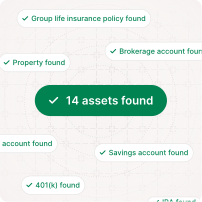
Elayne helps families understand what assets exist, which accounts are in the deceased's name, and what obligations the estate carries before any distributions happen. Elayne's Verified Asset Search helps surface forgotten financial accounts, lost insurance policies, unclaimed property, and eligible survivor benefits. It also scans financial records to catch recurring charges that keep billing after death.
FAQ
How do you prove you are next of kin to a bank or government agency after a death?
The documents required depend on how close the relationship is. A death certificate for the deceased, plus your own birth certificate or marriage certificate confirming the connection, cover many immediate-family situations. For more distant relationships, genealogical records and prior death certificates tracing the chain of kinship may be needed. When no probate proceeding is open, a notarized affidavit of next of kin, listing surviving relatives in priority order and signed under oath, is the standard mechanism, though each institution sets its own threshold and some require court-issued letters of administration before acting.
Who is next of kin if someone is not married?
For an unmarried person, the next-of-kin order typically starts with biological and legally adopted children, then moves to parents, siblings, grandparents, and more distant relatives. An unmarried partner holds no automatic next-of-kin standing in many states, regardless of how long the couple was together. Some states recognize registered domestic partnerships and treat those partners the same as spouses.
Who makes medical decisions if the patient is not married and has no health care proxy?
When a patient is incapacitated and has no health care proxy or advance directive on file, hospitals follow a state-set priority order for surrogate decision-makers. This order typically runs: spouse, adult children, parents, siblings, then more distant relatives.
Can a friend be next of kin?
Under standard state intestacy law, a friend has no next-of-kin standing. Next of kin is limited to relatives by blood, marriage, or legal adoption. A friend can be given inheritance rights through a will or named as a beneficiary on a financial account, but those designations do not make that person a legal next of kin for purposes such as medical decision-making or estate administration.
What happens when someone has no next of kin?
When a person dies with no known living relatives, the estate passes to the state through a process called escheat. The state takes ownership of the assets after the estate is administered through probate. Some states require a waiting period and public notice before the assets are absorbed.
Does divorce affect next-of-kin status?
Yes. Divorce removes a former spouse from next-of-kin standing in many states. Once a marriage is legally dissolved, the ex-spouse is no longer treated as a surviving spouse for intestacy or medical decision-making purposes. However, beneficiary designations on financial accounts and life insurance policies are separate from intestacy rules. A divorce does not automatically remove an ex-spouse named as a beneficiary on those accounts.
Are half-siblings treated the same as full siblings?
In many states, half-siblings are treated the same as full siblings for intestacy purposes. Both inherit equally in the same priority tier. A smaller number of states reduce a half-sibling's share compared to a full sibling, but this is the minority rule. The specific outcome depends on the state where the deceased was domiciled.
Are grandchildren next of kin?
Grandchildren can be next of kin, but only if their parent, who would have inherited first, has already died. This is called the right of representation, or per stirpes distribution. If an adult child of the deceased is still living, that child takes their share and the grandchildren do not inherit in their place. If the adult child has died, their share passes down to their own children (the grandchildren of the deceased).
*Disclaimer: This article is for informational purposes only and does not provide legal, medical, financial, or tax advice. Please consult with a licensed professional to address your specific situation.










.svg)