

Key Takeaways
- Estate settlement often involves 10–20 or more separate claims, each with different rules and timelines.
- Claims do not move automatically, many stalls unless someone follows up.
- A simple tracking system prevents missed benefits, duplicate filings, and confusion.
- Executors who track claims carefully recover money faster and reduce estate delays.
{{blog-cta-legal}}
After a loved one dies, benefits and assets don’t arrive automatically. Life insurance, retirement accounts, survivor benefits, pensions, veterans benefits, refunds, and reimbursements all require separate claims, often with separate paperwork and follow-up.
What surprises many executors is not how hard any single claim is, but how many there are, how long they take, and how easily they disappear into silence if no one is tracking them.
Keeping a clear, centralized record of every claim is one of the most effective ways to keep an estate moving forward and ensure nothing is lost.
What Counts as a “Claim”?
Executors often underestimate how many things count as claims. Common examples include:
- Life insurance policies
- Retirement accounts such as 401(k), IRA, pension
- Employer survivor benefits
- Social Security survivor or death benefits
- Veterans Affairs benefits
- Union or association death benefits
- State-level benefits or burial assistance
- Refunds from insurance, utilities, or prepaid services
- Class action or settlement payouts
- Unclaimed property filings
Each of these usually involves:
- A separate form or portal
- Proof of death
- Proof of relationship or authority
- Processing time that can range from weeks to months
Without tracking, it’s easy to forget what’s been filed and what hasn’t.
What You’ll Need
To track claims effectively, gather:
- A claims tracking system
- Spreadsheet, checklist, notebook, task app, or estate software
- Claim confirmation details
- Reference or claim numbers
- Copies of letters, emails, uploads, or screenshots
- Contact information for each organization
- Phone numbers
- Website or portal logins
- Names of representatives you’ve spoken with
The system doesn’t need to be fancy, it just needs to be consistent and centralized.
Why Claims Get Lost Without Tracking
Claims stall or disappear for predictable reasons:
- A form is missing one document
- A death certificate wasn’t certified
- A portal upload failed silently
- A mailed packet was received but not processed
- A deadline passed without follow-up
When this happens, organizations often don’t notify you proactively. From their perspective, the claim simply remains incomplete.
Without a tracking system, executors may assume:
- “They’re still working on it,”
- “It must have been denied,”
when in reality, the claim is just waiting for a follow-up.
How to Track Claims Effectively
For every claim you submit, record the same core details. Consistency matters more than format.
At minimum, track:
- Company or Agency Name
- Type of Benefit
- Life insurance, pension, survivor benefit, etc.
- Date Submitted
- Claim or Reference Number
- Current Status
- Pending
- Under review
- Approved
- Paid
- Denied
- Needs additional information
- Contact Information
- Phone number
- Website or portal
- Representative name (if applicable)
- Notes
- “Waiting on death certificate”
- “Requested tax form”
- “Follow-up scheduled for 10/15”
This turns claim management from guesswork into a checklist.
Step 1: Set Up One Central System
Choose one place where all claimed information lives. Mixing notebooks, emails, and memory increases the chance of mistakes.
Common options:
- A simple spreadsheet
- A shared document or notes app
- A dedicated estate task tracker
- Estate management software like Elayne
What matters is that:
- You update it every time something changes
- You can see all claims at once
Step 2: Log Claims Immediately After Submission
As soon as you submit a claim:
- Enter it into your tracker
- Save confirmation emails or screenshots
- Record any reference number provided
Don’t wait until “later.” Many executors forget details within days, especially when juggling multiple tasks.
Step 3: Update After Every Interaction
Every time you receive:
- A letter
- An email
- A portal message
- A phone call
Update the status and notes immediately.
If additional documents are requested, record:
- What was requested
- When it was requested
- When and how you sent it
This prevents duplicate submissions and missed deadlines.
Step 4: Set Follow-Up Reminders
Claims rarely move on their own.
Best practice:
- Set a follow-up reminder 30–60 days after submission
- Shorter follow-ups (10–14 days) for time-sensitive benefits
- Follow up sooner if funds are needed for bills or estate expenses
When you follow up, you can reference:
- The claim number
- Submission date
- Prior communications
This dramatically improves response quality.
Why Claim Tracking Protects the Estate
Strong claim tracking helps executors:
- Recover benefits faster
- Avoid submitting duplicate claims
- Prove diligence if questioned by beneficiaries or courts
- Prevent missed deadlines
- Reduce emotional stress and decision fatigue
It also creates a clear paper trail showing the executor acted responsibly.
How Claim Tracking Fits Into Estate Administration
Claim tracking runs in parallel with many other estate tasks:
- Probate
- Insurance updates
- Debt resolution
- Tax filings
Because claims resolve at different speeds, tracking ensures:
- Estate cash flow is visible
- Pending funds are not forgotten
- Distribution planning is accurate
This is especially important before final distributions.
Common Mistakes Executors Make
Without a system, executors often:
- Assume “no news is good news”
- Forget which documents were sent where
- Lose confirmation numbers
- Miss follow-up windows
- Discover months later that a claim was never completed
These mistakes can cost real money.
How Elayne Helps Track Claims
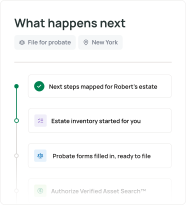
Elayne acts as a central command center for estate claims.
Elayne can help:
- Log every claim in one place
- Store confirmation documents securely
- Track statuses and outstanding requests
- Set reminders and follow-ups
- Show at a glance which benefits are paid vs. pending
- Reduce the mental load of being the “project manager”
Instead of chasing updates, you get visibility.
When Claim Tracking Becomes Critical
Tracking becomes especially important when:
- Multiple family members are beneficiaries
- Claims span months or years
- Estate funds are needed to pay bills
- The executor must report progress to heirs
- The estate is nearing final distribution
At that point, memory is not reliable, records are essential.
Conclusion
Keeping track of all claims submitted after a loved one’s death is one of the most important, and most overlooked, executor responsibilities. With dozens of claims moving at different speeds, even organized people can lose track without a system.
A simple tracking approach ensures benefits aren’t missed, delays are caught early, and the estate moves forward with clarity instead of confusion.
If you’d rather not act as the project manager for every claim logging details, setting reminders, and following up, Elayne can organize and track all claims for your loved one and keep you informed without constant chasing.
{{blog-cta-legal}}
FAQs
Q: How many claims are typical in an estate?
Many estates involve 10–20 or more claims, depending on employment history, benefits, and location.
Q: How long do claims usually take?
Anywhere from a few weeks to several months. Some take longer if documents are missing.
Q: Should I follow up even if they didn’t ask me to?
Yes. Polite follow-ups often move claims forward.
Q: What if a claim is denied?
Denials can often be appealed. Tracking helps you know what happened and when.
**Disclaimer: This article is for informational purposes only and does not provide legal or financial advice. Claim requirements and timelines vary by organization and benefit type. Consult a licensed professional for guidance specific to your situation.










.svg)