
When someone dies, the paperwork starts before the grief has even settled in. Credit card bills come due, insurance claims need to be filed, property transferred, government agencies notified, subscriptions canceled, digital accounts secured. Hundreds of tasks surface in the weeks and months that follow a loss, and there's no roadmap, no system, no one coordinating any of it.
The average estate takes 18 months to settle and demands over 500 hours of administrative work - that's roughly 12 weeks of full-time effort that falls on the people closest to the loss. And all of this happens while you're grieving, expected to go back to work, show up for your family, and resume your life as if you're getting over a quick cold.
The problem is that the system wasn't built for families. It was built for institutions. Every bank has a different process, every state has different rules, every form asks for the same painful information in a slightly different way. Families are expected to figure it all out on their own.
Adria Ferrier experienced this firsthand. After losing her mother - a nephrologist who spent her career helping others - Adria found herself buried in paperwork, sitting on hold for hours, and navigating complex financial and legal decisions, all while grieving and trying to keep her own life moving forward. That experience became the founding story of Elayne.
Launched in 2024, Elayne is an AI-native estate settlement platform that automates the administrative complexity of settling an estate. Backed by Y Combinator, the company partners with estate attorneys and funeral care providers across the US to reach families at the moment they need help most - right after their loss.
We sat down with Adria to talk about how Elayne works, where the company is headed, and the personal story that started it all.
How would you describe what Elayne does?
We help families settle estates after someone passes away, but honestly, I've always found that description incomplete. The word "estate" makes it sound like it's just about money. It's not. What it really is is unwinding someone's entire life - insurance policies, property records, subscriptions, social media accounts, digital wallets, mail forwarding... all the things families didn't even realize they'd have to sort through, piling up while they're still processing the loss itself.
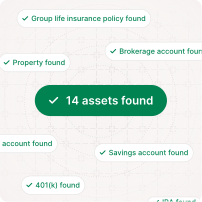
What Elayne actually does is bring structure to that chaos. When a family comes to us, we start by gathering any information they have on hand: a death certificate, a will, trust paperwork, and we build a personalized roadmap that tells them what needs attention now, what can wait, and how each step connects to the bigger picture. We also help uncover accounts and assets families may not know exist. A retirement account from an early job. A life insurance policy opened decades ago. A savings account that was barely used. These things don't announce themselves, and finding them takes real effort.
And we don't disappear after the roadmap is built. If families want continued guidance, we prepare paperwork, track deadlines, coordinate with attorneys when legal work is involved, and handle the follow-ups that can stretch on for years. No one is left wondering if they missed something or if they're doing it wrong. The goal is to make sure they can put their energy where it actually belongs - remembering the person they lost, caring for each other, and finding their footing again.
The roadmap you mentioned is one of the first things families see when they begin using Elayne. What went into designing it?
First off, to me the emotional design of the roadmap matters just as much as the functional design - maybe more.
When I was settling my mom's estate, one of the most painful parts was the repetition. Every phone call, every form, every institution required me to explain that she had died. Her date of death, her Social Security number, the same facts repeated over and over - it was like death by 1000 cuts, just to get through the administrative process. Elayne is designed specifically so that never has to happen. Once you tell us something, the information is encrypted and stored, only surfacing when you need it.
The roadmap is what families see when they begin using Elayne, and it's modeled after TurboTax in a way. We built it to be step-by-step, so that a grieving person who's never done any of this can follow it without feeling overwhelmed. My cofounder, who spent years building in the mental health space, has been instrumental in shaping the roadmap experience.
Behind the scenes, the roadmap is sequencing over 400 potential settlement steps by urgency, flagging potential fraud and ensuring compliance, customizing to each state's regulations, and adapting to the specifics of the estate. But from the family's perspective, it simply tells them: here's what to do now, here's what can wait, and here's what Elayne will handle for you.
Lastly, it's collaborative. Families can share the roadmap and store documents securely between them so the burden doesn't fall on one person. And when someone completes a step, they see a message like "The estate is now protected. You just saved 2+ hours." That was deliberate. Estate settlement can feel like it stretches on forever with no end in sight. We wanted families to feel, at every step, that they're making progress.
Beyond the practical support, how do you hope families actually feel when they're using Elayne?
That they're not alone. That's the simplest answer, and it's the most important one.
Right now there's a real gap in the system. The care providers who supported the family through the funeral have done their part wonderfully, but nothing was designed to carry families through what comes next. There's no natural handoff. You walk out of the funeral home with a death certificate and hundreds of unanswered questions, and you're just... on your own.
Elayne exists in that gap. And beyond the practical support, what I really want families to feel is capable. Grief has a way of making you feel powerless, like you've lost control of your own life. Every time a family completes a step, secures an account, or discovers something they didn't know existed, they get a little bit of that agency back. That matters more than people realize.
And then there's the human side. Over the course of a settlement, our care team becomes deeply familiar with each family's situation: they know each family member by name, what they're navigating, their anxieties, what they're waiting on, and the hard-won progress along the way. The bond that develops between our families and their care team is something we take really seriously, and it reinforces our belief that the best outcomes come from pairing technology with genuine human care.
{{blog-cta-financial}}
How does Elayne balance human care with AI?
We're building at the intersection of grief and the most powerful technology of our generation, and that's a unique challenge. You can't throw automation at someone who just lost a parent. The technology has to serve the human experience, never the other way around.
Being AI-native means the technology is woven into the foundation of how we operate - it's not bolted on as an afterthought. It handles the procedural, data-heavy work: discovering assets across financial accounts and government databases, parsing documents so families don't have to re-enter painful information by hand, flagging accounts that would otherwise fall through the cracks. This layer of intelligence is what makes a business like Elayne possible - this kind of complexity at scale simply wasn't feasible before AI.
But we draw a clear line. If something is procedural, AI should make it better, faster, and more secure. If something is sensitive or nuanced... humans need other humans. A family navigating a difficult bank process, trying to understand a legal concept for the first time, or just needing someone who gets what they're going through - that's a human moment. You don't optimize that. You protect it.
Our attorneys and legal partners feel this tension as well. They tell us: handle the admin, organize the data, let us focus on the legal work. So we give them complete estate inventories, organized documents, and a dashboard to track each case. It frees them up to do the work they're meant to do, speeds up their process, and decreases costs for the families they serve.
Something I think about a lot is how this space will evolve over the next decade. The definition of an "estate" is already expanding beyond what most people expect. Digital accounts, personal data, photos, online subscriptions - and increasingly, questions that didn't exist a few years ago. Would someone want a digital version of themselves to exist after they've died? Who should make that call? These are emerging questions, but they're real, and they deserve thoughtful attention. Our role isn't just to help families navigate what's in front of them today. It's to prepare for what's becoming a new dimension of the legacies we leave behind.
What's Elayne focused on next?
The opportunity ahead is enormous, because estate settlement sits at the intersection of legal, financial, funeral care, and healthcare, and none of those industries were designed to coordinate with each other. Which is why families fall through the gaps. So we're building the connective tissue.
On the legal side, we're scaling from pilot partners toward a broader attorney network across New York (our home base!). On the care provider side, we're partnering with funeral technology platforms and aftercare companies to reach families at the moment they need help most. These are the trusted community leaders that families turn to after a loss, and they consistently tell us they wish they had something more to offer when families ask them "What do I do now?"
We're also exploring a community layer where families can connect with others going through this process. Estate settlement is isolating in a way that's hard to describe until you've been through it. Sometimes the most helpful thing isn't a tool or a document - it's knowing someone else has been where you are.
And then there's what I'm maybe most excited about: what happens before a loss. So many of the difficulties families face can be traced back to conversations that were postponed, paperwork that was never updated, accounts that no one documented. When that information is scattered, the people left behind carry all of that weight.
But when individuals hear "estate planning," they picture a 50-page will or having to answer questions they don't even want to think about. That's not our vision. What people actually need is a living map - where accounts are held, who the beneficiaries are, what passwords and documents exist, who should be contacted and when. Not a legal document, but a reference that adapts effortlessly as your world changes.
Our vision is to define a category that didn't exist before. And I think that's what makes this moment so exciting - we're not improving an old system. We're building a new one. My hope is that ten years from now, this is just how families do things. That Elayne is as natural a part of life as health insurance or a savings account. Something you have, something you trust, something that's there for you and your loved ones when you need it most.
When you think about your mother and everything that followed her loss, what do you think she'd say about Elayne?
My mom was from a small town in eastern Hungary. By the time she was three years old, she knew she wanted to become a doctor in the US. She made it happen - and as a nephrologist in Rhode Island, she gently guided her patients through the most difficult moments of their lives, like losing a kidney or living on dialysis. She did that by just showing up, every day, even when she was really sick herself.
I think about her a lot when I think about Elayne. Not just because her loss is what started all of this, but because the way she lived is what shaped it. She believed that no one should have to face something frightening alone. That care should be real, not transactional. That simply showing up for people matters more than anything else.
If she could see what we're building, I don't think she'd ask about the technology or the metrics. She'd want to hear about our impact on individual lives, if our families feel us in their corner, and the change we're bringing to this space. I know she'd be so proud of us.
In many ways, Elayne is a continuation of the work she started, just in a form she never could have imagined. And if we can put even a fraction of the kindness she brought into the world back into it, then we're exactly where we're supposed to be.





.svg)