.webp)

Key Takeaways
- The traditional sympathy gestures — flowers, food, sympathy cards, donations in their loved one's name — are real and meaningful. Each one says something a little different about the support you're offering.
- Different gestures fit different moments. The week after a loss is different from the month after. The first holiday is different from the second.
- Grief counselors consistently report that one of the most helpful things you can do is offer something specific instead of "let me know if you need anything."
- A newer category of sympathy gift focuses on the practical and administrative work that follows a loss — the kind of help most friends and family aren't able to offer from a distance.
- Share Elayne is a gift that handles the estate paperwork, account searches, and next-step roadmapping for someone after a loss. It can be sent with your name or anonymously.
When you hear the news and want to do something
There is a particular kind of pause that happens after you hear that someone you care about has lost a parent, a spouse, a sibling, a close friend.
The pause is the gap between I want to help and I don't know what to send.
You think about flowers, but you wonder if they already have flowers. You think about food, but you wonder if they already have a freezer full of casseroles. You write a card, but you worry the words are inadequate. You consider doing nothing, and that feels worst of all.
This guide walks through what to send a grieving friend, what each option says, when each one fits, and what often gets overlooked. It's for anyone who has ever stood in that pause and wanted to do something useful.
Why "what to send" is one of the hardest decisions in grief
The reason this decision feels hard isn't that you don't care. It's that grief is unpredictable, and the same gesture can land very differently depending on the person, the relationship, and the timing.
Grief researchers and counselors have spent decades studying what helps. The common finding: there is no single right answer. There are, however, gestures that consistently land well, and a few well-meaning instincts that fall flat.
The biggest of those is the vague offer. "Let me know if you need anything" is one of the most common phrases offered in grief, and one of the least likely to translate into action. As counseling psychologists writing in The Conversation point out, reaching out to ask for help can feel impossible when someone is in deep grief. The VA's National Center for PTSD makes the same point in different words: a specific offer is far more useful than an open-ended one.
What follows is a guide to specific gestures — what each one says, and when each one fits.
{{blog-cta-admin}}
The classic gestures, and the role each one plays
Flowers
Flowers are the oldest sympathy gesture in most cultures, and they remain meaningful for good reason. They mark a moment. They fill a room with something living during a time when the absence of a person is overwhelming. They give other guests at a service something to look at and around.
Flowers are at their best when they arrive close to the time of the funeral, memorial, or shiva. They say: I noticed. I came, or I wanted to. I'm sorry.
The grief educators at What's Your Grief — a long-running grief community — note that flowers can be a beautiful gesture, especially when you sense the person would appreciate them, or when you might be one of the few people thinking to send them. Where flowers fall short is in the weeks after the service, when the bouquet has wilted and the family is alone with the rest of the work.
Food
Bringing food is the gesture most likely to be remembered, because it answers a real and immediate need. Grief makes appetite unreliable, decision-making exhausting, and the simple act of feeding a household feel impossible. A meal arriving at the door is one less thing to figure out.
Food is at its best in the first two weeks. Coordinated meal trains — where friends sign up for specific days — help avoid the freezer-full-of-casseroles problem. Sealed, freezer-friendly options extend the window. Gift cards to a familiar restaurant or a grocery delivery service work well when you don't know the household's preferences or dietary needs.
Harvard Health specifically recommends offering hands-on help with cooking and shopping, especially for surviving spouses adjusting to cooking for one.
Cards, notes, and continued contact
A handwritten note is a small thing that often outlives the moment. Many grieving people describe keeping cards for months, sometimes years, rereading them when the loneliness is loud.
The most meaningful notes tend to share a specific memory of the person who passed, name the loss directly without rushing to a silver lining, and don't require the recipient to respond. As one HopeHealth grief counselor describes it, the work is "showing up with compassion, and meeting them where they are."
Cards are also the gesture that ages best. Sending a note three weeks, three months, or one year after a loss — when most other support has faded — is one of the most validating things a friend can do.
Donations in their loved one's name
A donation to a cause connected to the person who passed — their alma mater, a hospice that cared for them, a foundation researching their illness, a charity they supported — turns the gift into a quiet legacy. It says: Their life mattered. The thing they cared about will continue.
Donations work especially well when the family has named a preferred charity in the obituary, when flowers feel impractical (long distance, unknown household), or when you want to do something that doesn't require the family to manage anything.
{{blog-cta-admin}}
What grief counselors say is often missing
The classic gestures cover the early, visible phase of grief well. But ask any hospice bereavement coordinator or grief counselor what tends to be missing, and a consistent answer emerges: practical help with the parts of life the person who passed used to handle.
What's Your Grief, drawing on years of community feedback, identifies two reasons grieving families need practical support — because their loved one used to handle certain things, and because grief itself makes it hard to focus on the minutia of daily life.
Harvard Health includes the same observation in its support guidance, noting that "sometimes your help is most valuable later" — and offering examples that include a lawyer answering questions about the estate, or a handy person buttoning up the house before winter. This is the work that happens after the funeral, when the visible support has receded and the to-do list has not. (For a sense of the scope, our step-by-step guide for what to do after mom dies walks through what most families end up navigating.)
It's also the work most friends and family can't easily offer from a distance. Closing accounts, filing probate paperwork, navigating insurance claims, and tracking down assets requires hours of phone calls and document handling. It's not the kind of help you can drop off in a Pyrex.
A modern addition: practical help with the estate
This is the gap Share Elayne was built to fill.
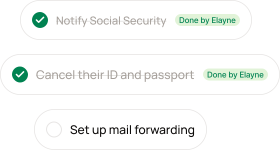
Share Elayne is a gift you can send to someone after a loss. The recipient receives an Estate Discovery Package: a full search for every financial account in their loved one's name, an assessment of whether they need probate or can work through trusts and beneficiary designations, and a clear roadmap of every step ahead, with timelines and costs.
It's the kind of help that traditionally only a knowledgeable friend or a hired professional could provide, and the kind grieving families often need most without knowing how to ask for it. (If your friend has been named executor of an estate, the work ahead can be especially heavy.)
The gift can be sent with your name and a personal note, or anonymously. Anonymous gifting is often used by people who want to help across complicated relationships, by groups pooling together, or by senders who simply want to spare the recipient the social labor of writing a thank-you note. The recipient receives the gift the same day it's sent and can use it whenever they're ready.
Share Elayne doesn't replace the bouquet, the meal, or the handwritten note. It joins them — designed for the longer phase those gestures aren't built for.
Matching the gift to the relationship and the moment
A few practical guidelines have held up across grief counselors, hospice professionals, and bereaved people themselves.
If the loss is recent — the first two weeks — traditional gestures fit best. Flowers, food, cards, attendance at the service. Our free after-death checklist is also a useful thing to share if your friend is asking where to start.
In months two through six, this is the phase grief counselors describe as the loneliest. Most of the visible support has faded. A check-in text, a note on a meaningful date, or a more substantial form of practical help (like Share Elayne) is often what's most needed.
If you don't know the family well — a coworker, a neighbor, a distant cousin — a donation in the loved one's name, a thoughtful card, or a Share Elayne gift are all gestures that don't require closeness to be meaningful. They also don't require the family to host you, thank you, or manage the relationship.
If you're not sure what's been sent already, lean toward gestures that don't pile up. Practical help, donations, and continued contact can never be redundant in the way a fourth bouquet can.
Frequently asked questions
What if I'm not close to the person who passed but I am close to the one grieving?You're a perfect candidate to send something. Closeness to the grieving person is what matters. Practical help, a thoughtful card, or a donation in the name of the person who passed all fit.
What if it's been weeks or months since the loss?Reach out anyway. The PTSD National Center notes that contact months after a loss is often deeply appreciated, because most of the support has dropped off by then. A late gesture is rarely unwelcome.
What if I can't afford a more substantial gift?A heartfelt card, a homemade meal, a check-in text, or a small donation are all meaningful. The thoughtfulness of the gesture matters far more than the price tag.
What about gift baskets or self-care items?They can be lovely, especially when chosen with the recipient in mind. They tend to land best when the household is past the initial wave of food and flowers and into the longer middle phase.
Is it appropriate for a workplace to send something?Yes. Many workplaces send flowers, donations, or a group gift. Pooling resources for a more substantial gesture (like a Share Elayne gift) is a respectful way to express collective support without the awkwardness of a passed-around card.
Can I send something anonymously?Yes. Some gifts, including Share Elayne, can be sent without your name attached. This is often appreciated by recipients who feel overwhelmed by the obligation of acknowledging help, and it's also useful in complicated family or professional situations.
Showing up over time
The single piece of guidance grief professionals return to most often is also the simplest: show up, and keep showing up.
The gesture you choose matters less than the choice to make one. Flowers, food, cards, donations, practical help — they all carry the same underlying message. I see you. I'm here, and I'll be here later, too.
If someone you care about is grieving right now, the small action you take today can mean more than you realize.
Send real help — we handle the rest →









.svg)