.webp)

When someone dies, their Social Security number stays active in financial systems until the death is formally reported. To help protect against deceased identity theft, this guide explains key points for families and executors to note, including: notifying the Social Security Administration, placing deceased alerts with credit bureaus, filing a report if fraud has occurred, and monitoring credit and digital accounts.
Key Takeaways
- A Social Security number stays active until formally reported.
- It's important to notify the SSA, and then place a deceased alert with all three credit bureaus separately, since each bureau maintains its own file.
- Filing the final Form 1040 promptly is a direct defense against tax identity theft targeting a deceased person.
- If fraud has occurred, an FTC Identity Theft Report filed at IdentityTheft.gov requires creditors to stop collection on fraudulent accounts.
- Elayne scans financial records for recurring charges, manages cancellations, and searches for dormant accounts.
Why Deceased Identity Theft Happens and Why It Is Hard to Detect
A deceased person's Social Security number does not expire when they pass away. It stays active in financial systems until someone formally reports the death and institutions update their records, which can take weeks or months. That gap is where criminals operate.
Some of the way fraudsters may exploit a deceased person's information include:
- Opening new credit cards or personal loans in the deceased's name.
- Filing a fraudulent federal tax return to claim a refund before the estate files the legitimate return.
- Billing Medicare or Medicaid for services never provided, using the deceased's insurance information.
- Accessing or creating online accounts to drain digital assets or rewards balances.
{{blog-cta-financial}}
How Obituaries Are Exploited
Thieves scan obituaries to piece together details in order to answer security questions, open accounts, or impersonate the deceased with financial institutions.
A few targeted omissions can help protect the family without diminishing the tribute:
- Omitting the full birth date; birth year alone is sufficient
- Omitting the home location
- Omitting a specific employer
Notifying the Social Security Administration
Funeral homes typically report a death to the SSA as part of their standard service, but it's important to confirm this. If the funeral home did not file the report, a surviving family member or executor can report a death to Social Security directly.
Once reported, the SSA adds the deceased's Social Security number to the Death Master File (DMF), a national database used by banks, credit bureaus, and government agencies to flag the number as inactive. In addition to notifying the SSA, it's also important to contact other organizations, such as credit bureaus, lenders, and government benefit programs.
Placing a Deceased Alert with All Three Credit Bureaus
A "deceased" notation on a credit file instructs lenders not to extend new credit under that Social Security number.
To place the notation, you will need a certified copy of the death certificate and documentation showing your authority to act on the estate's behalf, such as Letters Testamentary or a court order naming you executor.
| Credit Bureau | Documentation Required |
|---|---|
| Equifax | Certified death certificate + proof of authority |
| Experian | Certified death certificate + proof of authority |
| TransUnion | Certified death certificate + proof of authority |
Once placed, any lender who pulls that credit file will see the deceased flag and should decline new applications. The flag does not close existing accounts or resolve fraud already in progress, but it helps prevent additional lines of credit from opening.
Securing the Estate's Financial Accounts and Closing or Transfering Them
Notifying financial institutions promptly after a death helps close the window for unauthorized access. Banks, brokerage firms, retirement account custodians, and insurance companies each operate independently, so each requires a separate notification with a certified death certificate and proof of authority to act.
Once notified, most institutions will freeze the account pending estate processing, preventing new transactions. Accounts with named beneficiaries can transfer directly; others require probate authority before funds move. The notification itself is the protective step.
Filing an FTC Identity Theft Report If Fraud Has Already Occurred
Executors and authorized representatives can file on behalf of a deceased person at IdentityTheft.gov, which includes a section for reporting on another's behalf. Having Letters Testamentary or a similar court order ready helps to document your legal authority.
The FTC Identity Theft Report generated from that filing serves as formal proof that fraud occurred. Creditors are required to review it and stop collection activity on fraudulent accounts. If the theft involves financial accounts, you can also pull the deceased's credit report from Equifax, Experian, and TransUnion, as the Identity Theft Resource Center notes, and dispute each fraudulent account using the FTC Identity Theft Report as supporting proof of fraud.
Copies of the FTC report, letters sent to creditors, and any written responses received help form a record of the dispute process.
Reporting Deceased Identity Theft to Law Enforcement
A police report is not always required, but creditors and credit bureaus often ask for one alongside the FTC report when disputing fraudulent accounts. Having it strengthens your documentation.
Many local departments accept reports in person or online. Common documentation used when filing includes:
- A certified copy of the death certificate
- Proof of your legal authority (Letters Testamentary or equivalent)
- The FTC Identity Theft Report
- Any fraudulent account statements or collection notices
The officer creates a report number that can be provided to creditors and bureaus as part of the dispute process.
{{blog-cta-financial}}
Monitoring the Deceased Person's Credit and Digital Accounts
Placing a deceased alert with the credit bureaus reduces exposure but does not guarantee every fraudulent attempt will be caught. Periodic review of the deceased's credit reports for several months after death helps provide visibility into whether the alert is holding. Authorized representatives with documented legal authority can pull reports from all three bureaus.
Managing digital assets after loss involves a related set of risks. Email accounts, social media profiles, financial apps, and rewards accounts that remain open are potential entry points for unauthorized access. An active email account can be used to trigger password resets across any linked service.
Key points to note about different account types:
- Financial apps and investment accounts: these are closed or transferred through the institution using estate authority documentation
- Email accounts: the provider can be contacted to close or memorialize the account
- Social media: most major platforms have memorialization or removal options for deceased users
- Cloud storage and subscriptions: accounts can be closed and cancellation confirmed in writing
- Rewards and loyalty programs: a claim can be submitted or the account closed before balances expire
How Elayne Supports Families in Protecting a Deceased Person's Identity
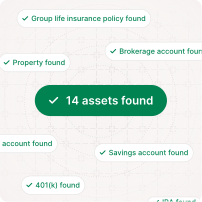
Elayne's subscription discovery and cancellation service scans the deceased's financial records for recurring charges, manages cancellation directly with providers, and logs each confirmation. Elayne's Verified Asset Search™ goes beyond public-record lookup to surface dormant accounts, unclaimed property, and forgotten financial holdings across more than 100 sources. In addition, Elayne's shared dashboard gives executors, family members, and attorneys one organized record showing what exists, what has been closed, and what still needs action. That visibility helps prevent gaps that criminals try to exploit.
FAQ
What typically happens in the first week after a death to protect finances and identity?
In the first week after a death, the SSA is typically notified, financial accounts are frozen or flagged at each institution using a certified death certificate, and bank statements are reviewed for recurring charges that continue billing until canceled. In addition, reviewing the deceased's email inbox and bank statements can help locate digital accounts that remain open.
How do I notify the IRS after a family member dies?
Writing "Deceased" and the date of death on the final Form 1040 when filing formally notifies the IRS. If tax identity theft has already occurred, IRS Form 14039 (the Identity Theft Affidavit) flags the account and starts the resolution process; the IRS Identity Protection Specialized Unit handles deceased taxpayer cases. An executor or surviving spouse with documented legal authority can file both the return and the affidavit.
Can I file an FTC identity theft report for a deceased person if I'm the executor?
Yes. Authorized representatives can file on behalf of a deceased person at IdentityTheft.gov, which includes a section for reporting on another's behalf. Letters Testamentary or a similar court order helps document legal authority. The FTC identity theft report the filing generates serves as formal proof of fraud; creditors are required to review it and stop collection activity on fraudulent accounts. Credit bureaus also accept it as documentation when reviewing disputes over fraudulent entries on the deceased's credit file.
What is the Death Master File?
The Death Master File (DMF) is a national database maintained by the Social Security Administration. When a death is reported to the SSA, the deceased's Social Security number is added to the DMF as inactive. Banks, credit bureaus, and government agencies reference the DMF to flag numbers associated with deceased individuals, which helps reduce the chance of new credit or benefits being issued under those numbers.
*Disclaimer: This article is for informational purposes only and does not provide legal, medical, financial, or tax advice. Please consult with a licensed professional to address your specific situation.










.svg)